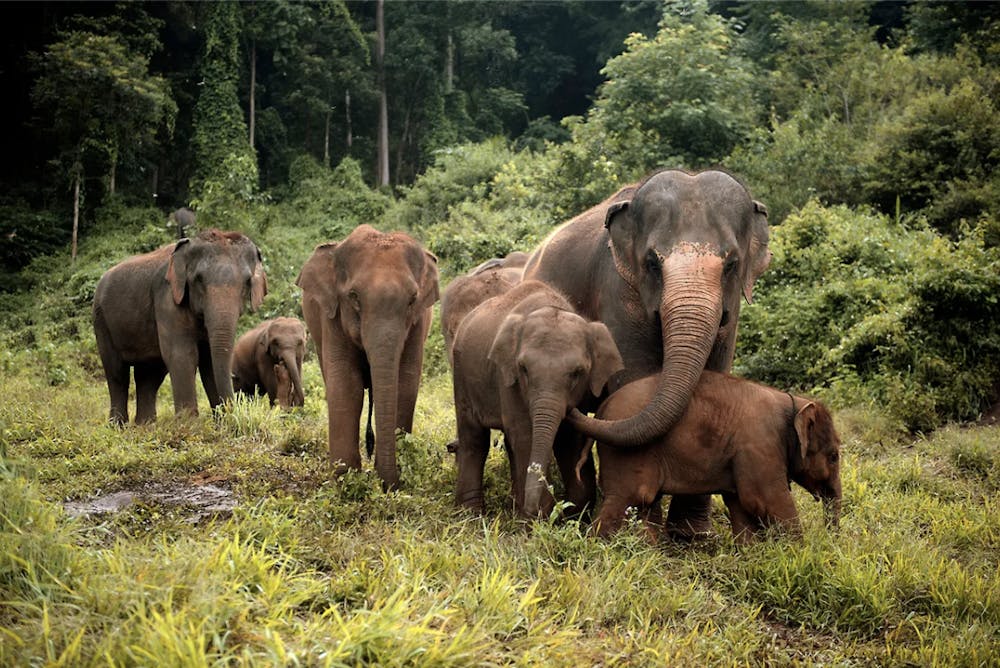
Elephants, it turns out, have been outsmarting scientists for decades — just not in the way we originally thought. Joshua Plotnik, director of Comparative Cognition for Conversation Lab at the City University of New York, delivered a PBS Colloquium lecture on March 4 in Gilman Hall about cognitive flexibility in Asian elephants and revealed a few of the insights gained in the field of comparative cognition.
Plotnik opened with a pointed challenge, describing the way cognitive scientists have historically approached non-human animals. According to Plotnik, most experimental tasks designed to test animal cognition are built for non-human primates. These species, he explained, absorb information visually and tactilely.
However, when these same tasks are given to an elephant, or even a dog or a bird, a negative result can be easily obtained and therefore misinterpreted because elephants simply do not have strengths in these domains of cognitive ability.
"You can say this animal does not have this particular cognitive ability," Plotnik said, "and I think as scientists we reach that conclusion far too often.”
Therefore, Plotnik’s solution is to design experiments in consideration of a particular animal’s sensory perspective. Specifically, for elephants, it means centering research on olfaction because that is how they primarily sense and view the world. With roughly 2,000 functional olfactory receptor genes, five times the number humans have and twice that of dogs, elephants possess what Plotnik called a remarkable “periscope” for the world. Thus, his lab has spent over 20 years in Northern Thailand to expand a bigger window into elephant cognition.
The pivot to olfaction though was not born from observational data Plotnik and his team procured. Plotnik recounted an early field experience that inspired his entire approach. He had initially set out to test whether elephants, like many domesticated species, could follow human pointing cues (physical gestures) to locate hidden food. However, after testing them, he found they couldn't. None of more than 20 elephants he tested consistently followed a pointed finger to a bucket. When he reported this to the mahouts, handlers who work with the elephants daily, they were unimpressed, and even a little offended.
"Why are you trying to make our elephants look stupid?" Plotnik recalled them asking.
What followed was a revelation. One mahout described a routine task: when tourists remove their sandals at the riverbank before bathing the elephants, the handler points at the pile of flip-flops on the ground and asks the elephant to pick them up and return them to their owners. The elephants do it reliably, every time. Plotnik had unexpectedly stumbled upon a revelation: elephants weren't failing to follow visual cues, they were following a different kind entirely.
With their vast olfactory system, their large ears angled toward the ground, and their trunks hovering over the sandals, the elephants were navigating by smell and sound, not sight. "It's not visual information at all that they're following," Plotnik stated. "Maybe it's acoustic, maybe it's olfaction." This experience sent his lab to explore an entirely new direction.
Plotnik’s results have been remarkable and revolutionary when it comes to evolving our understanding of elephants and their capabilities. He and his team discovered that elephants leave behind scent trails that other elephants can read. For example, naive elephants consistently made a beeline for canisters previously handled by trained individuals. This suggests scent can encode meaningful information about where food is located.
The first set of experiments Plotnik conducted presented elephants with two buckets of sunflower seeds of different quantities, (i.e., 150 versus 100, or 150 versus 180), with no visual difference between them. Using smell alone, Elephants always chose the larger quantity, even when the sunflower seeds were almost identical in number.
From here, his team studied olfaction as a tool to understand higher-order reasoning capabilities in animals. In an inferential exclusion task that Plotnik’s team designed, elephants were allowed to smell one bucket before two buckets were presented simultaneously. If the sniffed bucket contained no food, elephants always chose the alternative (the one with food). This suggests elephants use olfactory information to reason about the location of a hidden reward.
Plotnik then continued his talk by explaining his research findings about inhibitory control, a measure of cognitive flexibility that tests whether an animal can suppress an impulsive response in favor of a learned one. The test to measure this involves using a transparent box with food visible inside, but the box is designed to be permeable to smell, which means elephants can detect food through the surface. So, when his team observed that the elephants did not reach impulsively through the clear surface as other species typically do, they reasoned that elephants had the capacity to apply previously learned knowledge to ignore misleading olfactory information — a strong marker of inhibitory control.
The final third of the talk transitioned from a focus on the lab to the natural environment the elephants reside in. Plotnik conducts his wild elephant research in Salakpra Wildlife Sanctuary in Wang Dong, Thailand. Here, his team has identified over 300 individual elephants to study human-elephant conflict. Human-elephant conflict is a dire issue, where expanding farms and villages push into elephant habitat. This instigates elephants to raid crops and property, which can trigger dangerous encounters that threaten both local livelihoods and elephant survival.
"They (a single group of elephants) can take out 25% of a crop field that a farmer has been tending for more than six months in less than one night," Plotnik said.
To combat this problem, Plotnik is building individual cognitive and personality profiles for the 300 elephants. With this information, the goal is to create a deterrence device that could be programmed to an elephant’s profile, which releases combinations of light, sound and odor to redirect the elephant away from farms.
"Instead of recognizing [different] elephants that are coming into the crop field," Plotnik explained, "you are recognizing that individual elephants have individual personalities and cognitive abilities, and you work with that."
Plotnik closed with a reflection on what drew him to this work. Twenty years in, the elephant remains for him a unique test case, not just for understanding convergent cognitive evolution, but for rethinking what it means to study another mind at all.