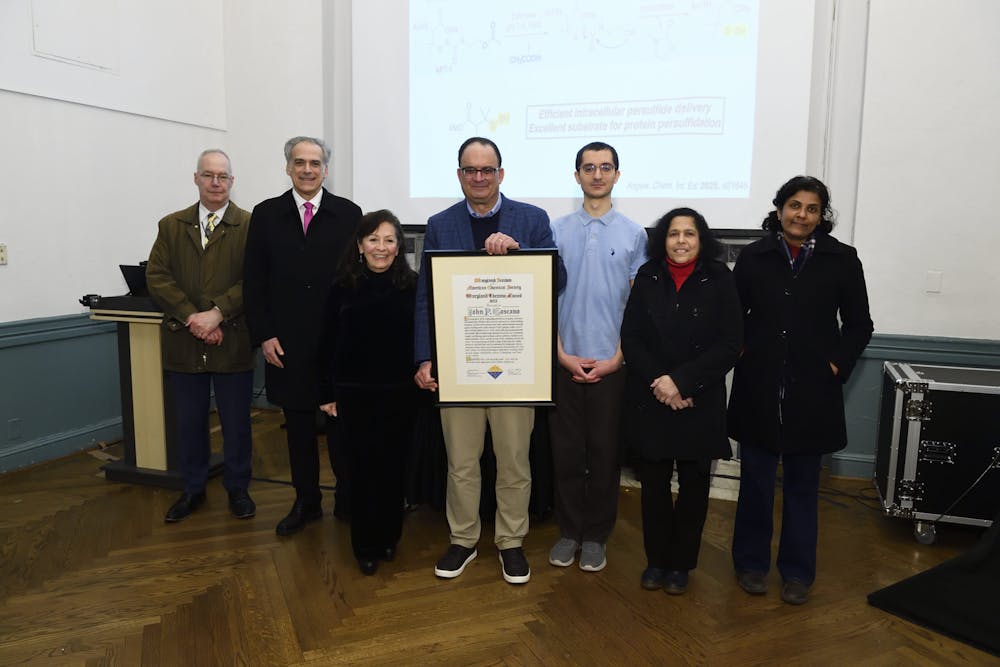
John P. Toscano is a professor in the Hopkins Department of Chemistry. He joined the department in 1995 as an assistant professor, eventually becoming a full professor in 2003. He later served as vice-chair of the department in 2004, and served as chair from 2005 to 2011 and again from 2013 to 2014. He also served as vice dean and interim dean for the University’s natural science departments.
Currently, he runs a research lab studying active biological signalling molecules alongside teaching Introductory Organic Chemistry. He was recently awarded the 2025 Maryland ACS Chemist of the Year Award, and in an interview with The News-Letter, he discussed the award, his evolving journey in research, his time teaching and working at Hopkins and his future outlook upon his work.
The 2025 Maryland ACS award, presented on Feb. 4 at the Levering Hall, centered on Toscano’s work with
“fundamental organic reactive intermediates and small molecule bioactive signaling agents,” which included molecules like nitric oxide, nitroxyl, hydrogen sulfide and related hydropersulfides. Yet, his research path didn’t always focus on these molecules; when recounting his research career development, his PhD at Yale University originally dealt with low-temperature photochemistry of single crystals and the formation of reactive intermediates.
“We took single crystals of solid rocket fuel, cooled it down to liquid helium temperature and zapped it with light. We made intermediates,” Toscano said. “It turned out, we made a lot of nitrogen oxide, so… we ended up studying NO, HNO and other things, and it was really, really complicated… One of the things I got out of that, from my PhD advisor, was making sense of complicated things.”
After that, Toscano completed his postdoc at the Ohio State University, where he pivoted away from cooling crystals to implementing fast-detection techniques, another method to study reactive intermediates. He credited the vastly collaborative nature of his lab and his postdoc advisor Matthew Platz for his growth and development, especially when developing time-resolved infrared spectroscopy, a technique he would end up using heavily as a professor.
“A UV visible spectrum… doesn't tell you about the structure of the molecule, but an infrared spectrum can tell you about a structure,” Toscano said. “I asked my postdoc advisors: ‘Why doesn't anyone do time resolved infrared spectroscopy instead of time resolved UV-vis, which was a very common technique?’... I ended up spending a month in Japan to learn [infrared spectroscopy].”
After Toscano arrived at Hopkins in 1995, he applied the time-resolved infrared spectroscopy technique to investigate photochemistry-generated precursors to nitric oxide, a vasodilator and highly important signalling biomolecule.
“We set up an instrument to do infrared spectroscopy… on a really fast time scale so that we could look at these intermediates that are only around… for nanosecond or microsecond lifetimes.”
At the School of Medicine, a pair of cardiologists researching the impact of nitric oxides on heart function, David Kass and Nazareno Paolocci, would start a long and ongoing collaboration with Toscano’s research group.
“These [molecules] had very interesting biological, physiological properties… Naz investigated some of the precursors… to these reactive species, and then looked at their potential for treatment of heart failure,” Toscano said. “That led to other things from reactive nitrogen species to reactive sulfur species… we're trying to study those intentionally, make precursors to them, and then… look at potential in physiological applications.”
In fact, this work with Kass and Paolocci has resulted in Cardioxyl Pharmaceuticals, a biotechnology company that specifically developed new therapeutic drugs for cardiovascular disease. Cardioxyl was sold to Bristol-Myers Squibb for $300 million in 2015.
In his past 31 years at Hopkins, Toscano’s publications have included over 25 undergraduates, and he regularly mentors and takes on undergraduate students. He specifically appreciated the collaborative and widely knowledgeable aspect of the University’s broader community.
“A lot of the problems in chemistry, biology and science in general are more and more complicated these days,” Toscano began. “Being in an environment like this with not only great colleagues, but great students, both graduate, undergrad and everything, makes it possible to do the things that you know you want to do.”
Outside of his research, Toscano has contributed in a myriad of ways to the Department of Chemistry and the broader campus. He teaches Introductory Organic Chemistry I alongside Christopher Falzone and has worked as Department Chair and Vice and Interim Dean of Natural Sciences.
“As an individual faculty member, you're very focused on your research, your lab, your teaching and what you're doing. As a department chair, you learn more about not only your department, but other departments,” Toscano commented. “You learn not only more about your school, but also the University as a whole in interactions between the Krieger School, the Whiting School and School of Public Health… I just have a much greater appreciation of the University as a whole.”
Finally, when asked about any specific research goals and questions remaining in his field, Toscano focused on the unknown molecular mechanisms that govern physiology.
“We’re trying to understand the underlying molecular mechanisms behind observed physiology. The observed physiology is fairly well understood, but the molecular mechanisms underlying them are not well understood at all. If we can understand that, then we might be able to design drugs or therapeutics. We’re trying to build up a chemical toolbox to help us ultimately understand physiology.”