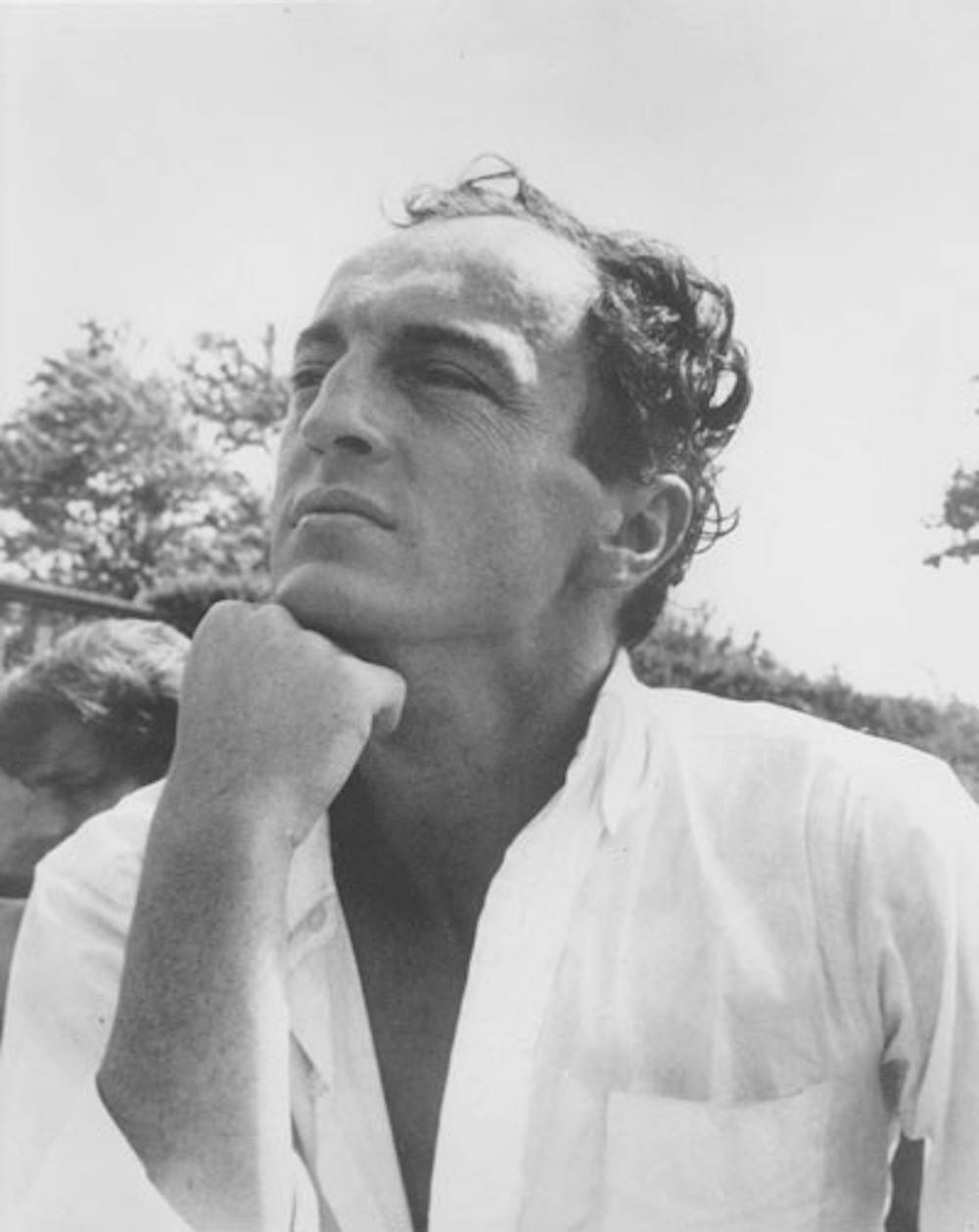
March 27, 2026 marks the centennial birthday of the beloved American poet Frank O’Hara. Although the city most affiliated with O’Hara is New York City, with his name present in any mention of The New York School of Poets, he was born in Baltimore, thus giving us an excuse (not that it’s needed) to write about him for our Baltimore-located newspaper.
O’Hara grew up in Massachusetts, where he studied music and English at the New England Conservatory and Harvard University. He later served in the Pacific during World War II as a sonarman and then settled in New York in 1951, where he began to work at the Museum of Modern Art (MoMA), write reviews for the ARTNews magazine and contribute to the New York School of Poets, where he wrote many of his most notable poems. Notably, O’Hara identified as gay, forming relationships with other men in New York and frequently centering these romantic encounters with male subjects in his works, which include the acclaimed poem “Having a Coke With You.” To this day, he remains a tremendously influential figure to the queer community and the literary world. Having spent the last few years of his life curating exhibitions and catalogs at the MoMA, O’Hara died at 40 in a sand buggy accident on July 25, 1966.
Introduction to O’Hara
Myra Saeed: I learned about O’Hara’s works and his life quite recently, yet I couldn’t help but fall in love with the undeniable life that breathes through his works. Many of O’Hara’s poems serve as records of his life and observations, rather than lofty commentaries about the shifting order in the post-war era — a choice I believe was intentional. One of his friends, American poet John Ashbery, noted how O’Hara “dash[ed] the poems off at odd moments,” including in a room full of people or in the street during lunchtime, and he’d simply forget about them. His poetry highlighted directly personal and oddly intimate moments, introducing beauty into even the most subtle moments, such as waiting in a taxi or for a sandwich. The post-war period pushed for an ideal conformity in the social sphere, leaving society struggling to make sense of the war’s resulting unvoiced trauma. I’d like to think O’Hara used his directness to loosen the silence choking everyone’s hearts. I, quite shamefully, struggle to make sense of many great poets, but I’ve always admired the humanity and simplicity in Walt Whitman’s Leaves of Grass, which seeks to celebrate the human’s small victories and individuality. Both O’Hara’s and Whitman’s greatness comes from this ability to speak the language of the heart, an experience similar to reading correspondence from a friend.
Grace Oh: Like many of his readers, my first introduction to him was through his quintessential love poem “Having a Coke with You.” O’Hara’s writing is magnetic, whether it’s for a lover, an actress or a city. A poem by him doesn’t seem to be the culmination nor intellectualization of abstract, indescribable emotions chased by poets across the centuries; rather, his poems reflect already lived-out emotions where whatever overflowed almost too-casually spilled and arranged itself onto paper. Looking at his “Personism: A Manifesto,” O’Hara (perhaps hypothetically) stopped writing a poem for someone and instead went to the telephone to dial them. He writes in a way that makes me believe in the existence of the poem’s subject.
Favorite poems
MS: As much as I’ve rambled on about O’Hara revitalizing the mundane, his poem “Mayakovsky,” which invokes the theatrical, melodramatic style of Russian poet Vladimir Mayakovsky in O’Hara’s own authentic style, enamors me beyond reasonable measure. “Mayakovsky” catches the speaker in an emotional breakdown, desperately craving a touch from a lost lover and questioning one’s worth as a poet and individual. One moment, the speaker rapidly agonizes for relief of pain, waiting for the lover to “come back once and kiss [them] on the face”; the next, the speaker quietly reflects on their “wounded beauty which at best is only a talent for poetry.” This poem presents a beautifully raw representation of the feelings from an emotional collapse, feelings that admittedly seem relatable and familiar, especially with the horrifyingly vulnerable line of the speaker “waiting for the catastrophe of [their] personality to seem beautiful again, and interesting, and modern.” The word “modern” here is deliberate; “modern” embodies the traditional ideal of the ‘50s, with its perfectly defined gender roles and perfectly nuclear family model. I think it’s all too familiar for me — for college students, for all of us, really, to wish and beg and agonize over the desire to embody our society’s ideal productive success story. We commit crimes like taking breaks, pursuing creative passions, loving another deeply and ending up in a bathtub, wishing for everything to be okay, not unlike the speaker does. And most humanly of all, we sometimes even find it funny. The third stanza is my favorite of this poem because of its unshakable reality: Emotions can be so contradictory. There are feelings that can shake an individual’s world from top to bottom and left to right to even bring moments of laughter over the absurdity of it all. Sure, “Mayakovsky” can be grand and emotional, but following the typical O’Hara style, the poem presents a stripped-down, direct look into human behavior.
GO: I don’t think the world needs another analysis on the brilliance of “Having a Coke With You.” Instead, another one of my favorite poems by him is “Why I Am Not a Painter.”
At first glance, the poem contains the conversational, almost diaristic tone that O’Hara is known for. After my first read, I had no clue who Mike Goldberg was, other than an artist, but that’s part of the appeal of how O’Hara writes — he assumes that you know the characters he name-drops in the retelling of whatever event, and there is no purely expository fluff. You’re in the loop, even if you’re not quite sure what that is. This case is a rare example of when I feel compelled to search up a name as I wanted to see what Sardines looked like, but most of the time, I abstain. To do so breaks the casted spell because, within that poem, the character is immortalized, and the reader is immersed. Mike begins as someone that might drop by at a cafe before continuing to head down the street, but after a Google search, Mike becomes defined by a black and white photograph.
Regarding the second half of the poem, a certain irony exists. The communication that O’Hara describes is something akin to carving away at a block of marble to shape a message, achieved only by eliminating what it isn’t. This doesn’t quite align with O’Hara’s previously established style, or even the one present within the poem with O’Hara directly referencing oranges to set up the scenario of the speaker not mentioning oranges. Maybe the poem itself is attempting to do the same as its content does, addressing something without ever directly mentioning it, but I’m uncertain as to what that would be.
Several other O’Hara poems that contain oranges or something similar include the “orange shirt” and “orange tulips” in “Having a Coke With You” and the bag enclosing tangerines in “Poem [“The eager note on my door said, ‘Call me,’”].” It can be chalked up to attentional bias, but another reason why I like “Why I Am Not a Painter” is because of this recurring motif that makes me connect it to other O’Hara poems I like.
In conclusion
MS: We live in a world of great uncertainty and violence, yet we’re forced to go through life with an unshakable smile and determination. If you too feel the heaviness of the world weighing your heart down, sit somewhere comfortable, prepare your favorite drink and allow O’Hara’s words to remind you of humanity.
GO: I think spring is an especially fitting season to read O’Hara.