The Center for Africana Studies at Hopkins featured Professor Juliet Hooker as a guest lecturer in “‘You Have Never Known Me’: Terrell and Du Bois on Faithful Slave Monuments” on Feb. 20, This event was a part of the Center for Africana Studies’ “Mute But Eloquent”: The Civic Work of Monuments Lectures, which is part of the Franklin W. Knight Lectures in Black Study Series. It was meant to highlight key aspects of slave monuments and their relation to Africana history.
Hooker is a professor of social sciences at Brown University and a political theorist who specializes in racial justice, Black political thought and more. In addition to this, she is also the author of Black Grief/White Grievance: The Politics of Loss. In her presentation, Hooker gave historical examples of Black resistance to racist commemoration and public memory.
This particular discussion focused on Mary Church Terrell and W.E.B Du Bois in relation to slave monuments. Terrell was an educator, speaker and activist who campaigned for women’s suffrage and social equality for African Americans in the late 19th century. She was also a founding member of the National Association of Colored Women and the first Black woman to serve on the Washington, D.C. Board of Education. Du Bois, in turn, was a sociologist, historian and co-founder of the National Association for the Advancement of Colored People (NAACP). He used his scholarship and editorial work to challenge racist historical narratives and advocate for Black civil rights. He also wrote extensively about the politics of memory and the representation of Black Americans in public life.
The event began with a discussion of a 1951 poem, “A Black Woman Speaks... of White Womanhood” by Beah Richards. Hooker analyzes this poem through the lens of epistemic injustice and racialized memory.
“Richards’s poem centers a figure — the mammy, often referenced as the embodiment of race relation — and then systematically dismantles this racist myth by narrating the experience from the black woman’s perspective, foregrounding the sexual violence that produces interracial kinship,” Hooker explained. “She allows that Black mammies cared for their white charges, as they did not starve them to death [...] but she also shows how complex and fraught nurturing white children was for Black women.”
An example from the poem that Hooker cited came from the line where Richards described the way that white mothers taught their children to hate the Black women who had raised them, detailing how they “despoiled my daughters and killed my sons.”
Despite the limitations of post-Reconstruction political disenfranchisement, Hooker explained how African American intellectuals, activists and everyday people resisted the Lost Cause myth and fought to level the epistemic playing field by engaging in their own forms of memory by preserving and disseminating African American history to Black publics.
“Black club women, for instance, studied black history, encouraged their children to learn black history in schools and at home, and wrote articles about African American history,” she outlined. “They undertook educational outreach and support for community libraries in order to try and transmit to children and the general public a different version of African American, Southern and American history than that in the Lost Cause propaganda.”
The Lost Cause is an interpretation of the American Civil War (1861–1865) that attempts to frame the role of the Confederates through a positive lens. This point of view attempts to preserve the honor of the South by attributing the Confederacy’s loss as a result of overwhelming Union advantage and celebrates an antebellum South of supposedly content enslaved people.
Hooker then went on to analyze attempts to build 20th-century faithful slave monuments (statues erected to promote the “Lost Cause” narrative) and the fierce resistance to them by African Americans. She emphasized that these monuments were designed to naturalize racial hierarchy by presenting enslaved people as loyal and devoted to their enslavers.
“Now, faithful slave monuments are a particular type of racist monument. They are not statues honoring racists like those of Confederate leaders like Jefferson Davis or Robert E. Lee, nor are they statues built without racist intent, but whose form or placement nevertheless conveys racist messages, such as statues that feature kneeling slaves,” Hooker said. “African American intellectuals challenging faithful slave commemorations in the 1920s and 1930s — especially Mary Church Terrell and W.E.B Du Bois — became pioneering theorists of epistemic injustice by identifying [...] harms of racist monuments.”
She explained that these monuments had actively shaped public understanding of slavery and reinforced white supremacist narratives.
In particular, Hooker highlighted two major campaigns to construct faithful slave memorials. Two attempts in the early 20th century sparked national debate and organized protest within Black communities.
“I analyzed two attempts to build faithful slave monuments in the U.S. in the early 20th century, and the fierce resistance to them by African Americans, especially Terrell and DuBois,” she explained. “The first ultimately unsuccessful effort was the proposal by the United Daughters of the Confederacy, the UDC, to build the National Monument to the black mammy nearby in Washington, D.C in 1923. The second effort was the Haywood Shepherd Memorial, which was installed by the UDC and the Sons of Confederate Veterans at Harper’s Ferry.”
Hooker also examined the UDC’s cultural influence, including its Catechism for Children. Through educational pamphlets and children’s materials, the UDC successfully campaigned to construct monuments and shape historical narratives across the South.
“The UDC shaped official history by asserting control of public school curricula and monument buildings, while professional historians like the members of Columbia Dunning School and Woodrow Wilson gave Lost Cause inversions the imprimatur of scientific rigor, the grassroots historians of the UDC inserted them into everyday institutions in the South — as we can see here from their Catechism for Children, which contains their questions and answers about the Civil War, slavery, etc,” Hooker explained.
She argued that this effort represented a coordinated strategy to institutionalize Lost Cause ideology in education and public spaces. Hooker contended that the UDC’s work blurred the line between grassroots activism and official historical authority.
This influence extended beyond monuments into classroom instruction, shaping how generations of Southern students understood slavery and the Civil War. It also marginalized Black perspectives by presenting Confederate memories as the objective truth.
“The UDC also successfully campaigned to build monuments in every city, town and state of the former Confederacy,” she illustrated. “It was so successful, Historian Karen Cox argued, that one of the very significant explanations for the increase in monument building between the 1890s and World War I was the rise of the UDC.”
In doing so, the UDC embedded racial hierarchy into the everyday landscape of Southern life. This normalization made racist interpretations of history appear natural and unquestionable, limiting opportunities for alternative perspectives to gain legitimacy.
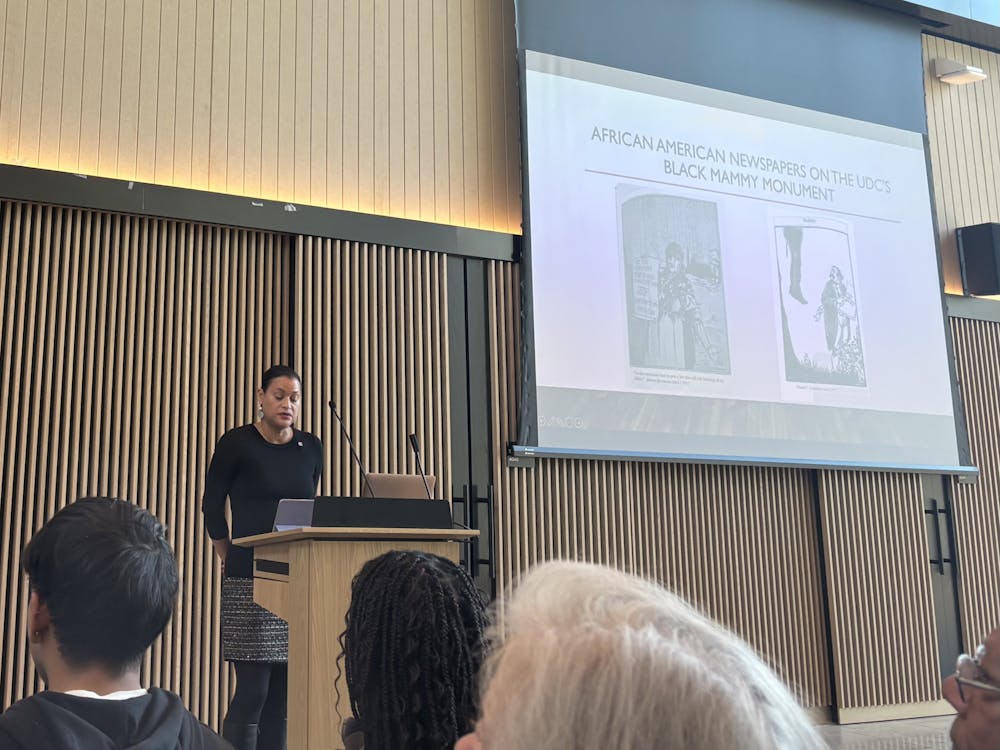
“African Americans were keenly aware of the games of Faithful Slave Monuments, as we can see from some of these cartoons that appeared in Black newspapers,” she said. “One editorial in the black press noted that no subject has brought forth a more unanimous protest except lynching since the Civil War than has the proposed black Mammy statue during an era of Black political and cultural self-assertion of The Harlem Renaissance.”
The event concluded with a question-and-answer session.
In an interview with The News-Letter, freshman Vivian Gan, studying Medicine, Science and the Humanities described her experience participating in the event’s interactivity. Gan highlighted how she appreciated audience members engaging in the conversation.
“I honestly enjoyed the questions the most because it was interesting to see how other people’s perspectives wrapped into what the lecturer was saying,” she said. “[Audience members] showed up to [...] the previous two lectures, so I appreciated context [...] as well because they drew more from the modern era rather than just [the] Confederate statues of faithful slaves.”
Additionally, senior Joshua Pamphile detailed his reflections on the lecture’s exploration of art, memorial and racial power in an interview with The News-Letter.
“The main thing that interested me was probably the way that art was used to beautify oppression,” Pamphile said. “Because I feel like in a lot of readings about [...] slavery and the antebellum style, you don’t really hear so much about the artistic side of oppression more — like the innate brutality and monstrosity of it. So, being introduced to a new [point of view] like that was definitely very interesting to me.”