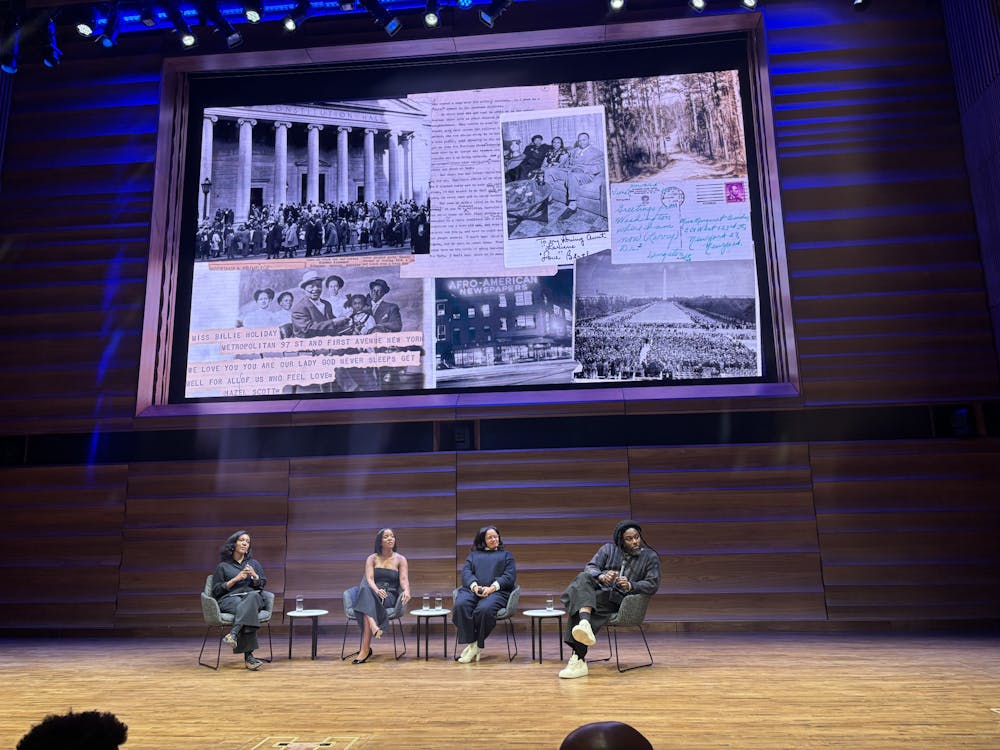
On Feb. 19, the University hosted the “In Living Memory: A conversation on African American Archives” event at the Johns Hopkins University Bloomberg Center at 555 Pennsylvania Avenue. This event was a discussion that coincided with the current Irene and Richard Frary Gallery exhibition, Ceremony: New Works by Lindsay Adams in Conversation with Objects from Johns Hopkins University Sheridan Libraries.
The event began with opening statements from Caitlin Berry, director of the Irene and Richard Frary Gallery. Berry explained the purpose of the archival event, detailing the importance of teaching and learning about relationships with archival materials.
Elisabeth Long, the Dean of the Sheridan Libraries, Archives and Museums, further elaborated on the significance of showcasing archival materials that highlight African American history and culture. She emphasized that these collections provide critical insight into the historical and contemporary experiences of Black communities.
“Sometimes, I think that when people hear libraries, archives and museums, they think of sedate, hermetically sealed buildings where they are always getting shushed. But that is really the opposite of what we want,” she said. “While we — of course — want to keep our collections safe, we equally want them to be used, to be seen, to be read, debated, reckoned with and used in creative ways.”
The Irene and Richard Frary Gallery is a free art gallery that presents rotating exhibitions drawn from the University’s collections in addition to special exhibitions created from partnerships with leading museums and collections. Located in the Hopkins Bloomberg Center, the gallery is open to the public from Tuesday through Saturday.
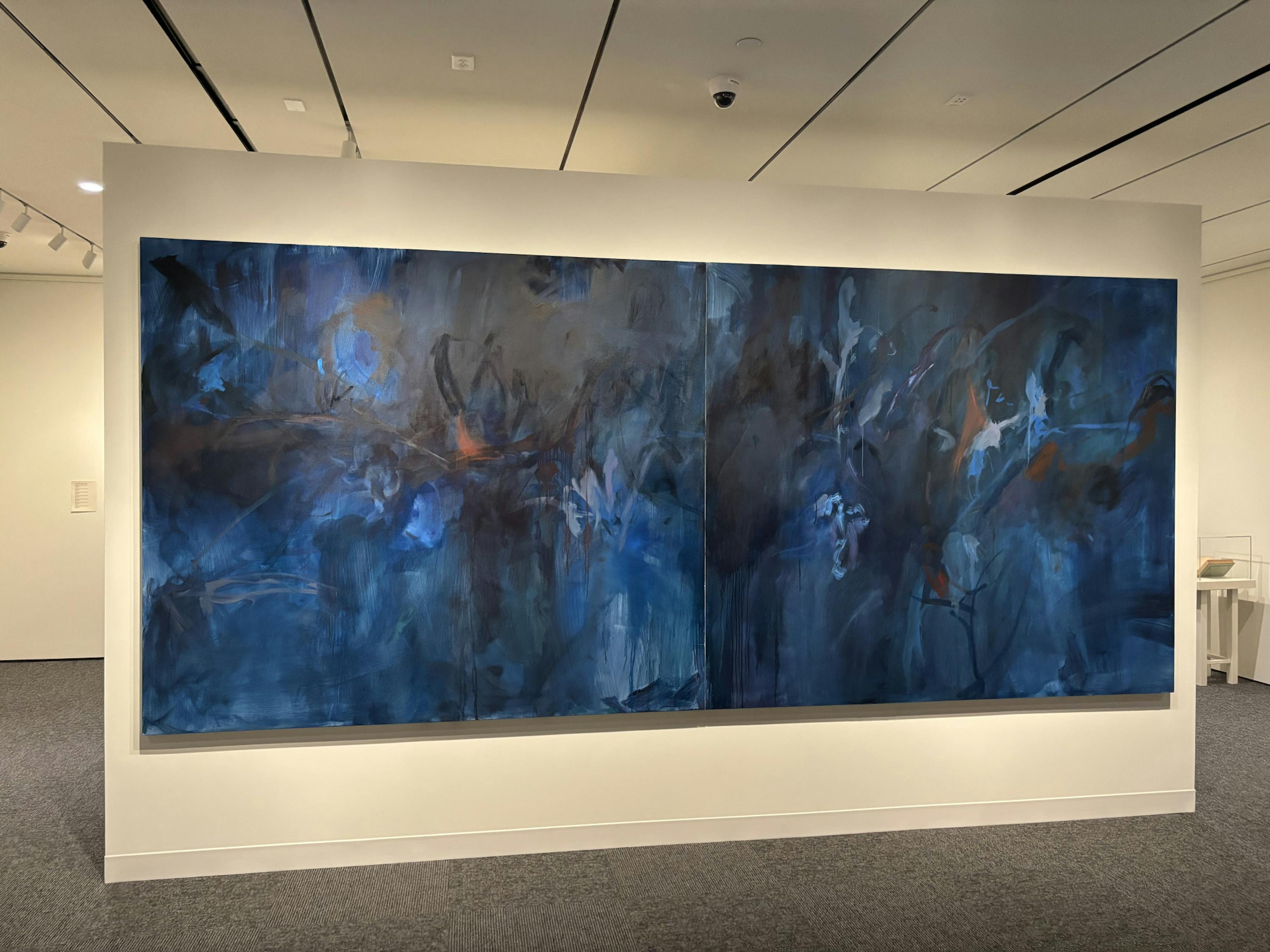
This current exhibition, Ceremony, by artist Lindsay Adams, explores the history of Black movement. As the centerpiece of the showcase, Adams’s painting “Kind of Blue” represents the commitment of individuals to honoring local artists. Inspired by Miles Davis’ 1959 album Kind of Blue, the work reflects a blend of musical influence and visual storytelling to convey rhythm and heritage.
COURTESY OF KAYLEE NGUYEN
“Kind of Blue” by Lindsay Adams
Moderated by Ceremony’s guest curator Claudia M. Watts, the discussion explored themes of memory, family history and the preservation of African American history. In an interview with The News-Letter, Watts discussed her role in organizing the exhibition as well as her goal of facilitating dialogues between contemporary artists and historical archival materials to deepen understanding of cultural heritage.
“This talk really thinks about the archive and Black archiving — and within the exhibition, I paired Lindsay’s works with archival documents from the Sheridan Library’s Special Collections,” she said. “You will see, when you go in [the exhibit], various conversations with postcards, sheet music and programs — all from various points within Black history. There are things from people who are unknown as well as people who were famous — like Billie Holiday and Josephine Baker — and that was really the catalyst for having this larger conversation.”
Individuals featured in the event included Adams, Jason Reynolds and Savannah Wood. Each panelist shared their personal connections to history and the ways in which archives have informed their creative and professional work.
Adams is the gallery’s first solo artist to feature a series of works directly engaging with archival documents. Opening the panel, Adams explained her inspiration and her desire to create pieces that respond to different aspects of the human experience.
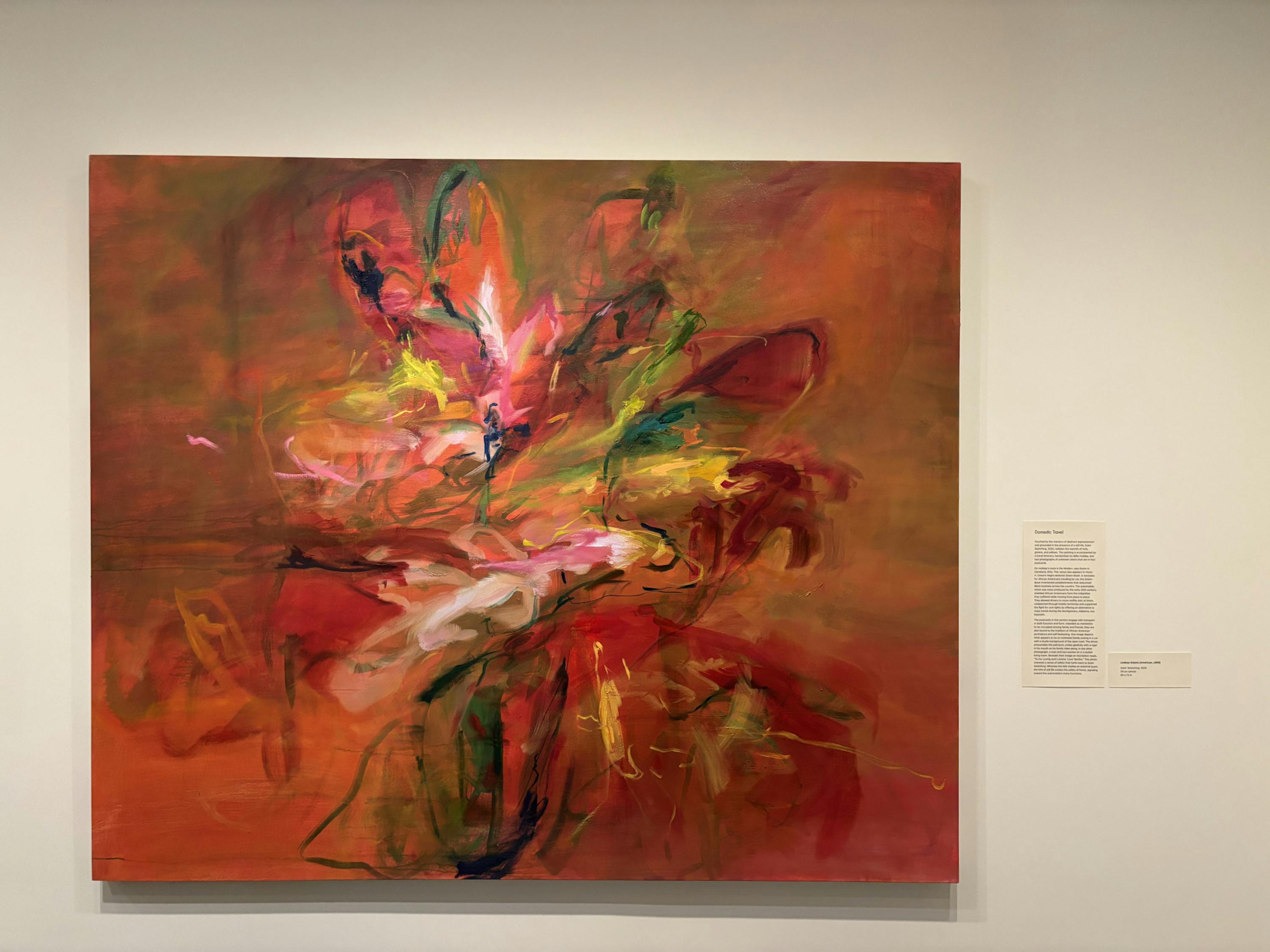
COURTESY OF KAYLEE NGUYEN
“Domestic Travel” by Lindsay Adams
“I do allude to both psychological and emotional landscapes in [my] painting,” she explained. “So part of that is a reconciliation of what makes us who we are... How do we use that through both an emotional lens and a psychological [one]?”
Moreover, Adams stated that her art seeks to create connections between history and contemporary life. She also noted that her work often integrates materials and references drawn from archival sources.
“I was able to do [an] independent seminar, [during] which I went back to seven drawings,” Adams noted. “In those drawings, I incorporated some of the soil from Edenton with the cult wax — and the ink — and was able to bring in the land and the history.”
Wood is a descendant of a formerly enslaved man, John H. Murphy Sr., who founded the Baltimore Afro-American newspaper in 1892. She shared that learning about her ancestors’ work provided her with a deeper understanding of her family’s legacy and the role of Black media in American history.
“It took going to other cities and exploring these other archives to really come back and think about this family legacy,” she said.
Wood further described the emotional weight of connecting with her ancestors and the responsibility that came with preserving their stories. She emphasized the importance of preserving these stories for future generations.
“That’s the fear, right? It’s like when you recognize that you’re supposed to do something but that it is going to take over your entire life, and that you are just going to have to submit to it,” she explained. “And you don’t know what that means yet, but you know it’s going to be life-altering — that’s the fear.”
Jason Reynolds is an author who is deeply invested in tracing his family history through archival research. During the discussion, he described how discovering documents like letters, photographs and legal records helped him connect to his family. Reynolds then spoke on the importance of preserving personal and familial archives for understanding identity and history.
When asked which of his archival documents he considered to be the first, Reynolds detailed the marriage license of his first ancestor post-emancipation.
“[It is] the very first time that we’re on paper — like I own the first example of our love on paper,” he said. “The interesting thing about having pieces like that you get to wrestle with, not only the history of it all, but the way that names worked back then and how [our] names are constantly changing.”
For example, Reynolds explained how one of his early relatives’ names was spoken as “Stone.” Yet, on his marriage license, Stone’s name was written as “Stones.” This instance served as an example of how historical records can both preserve and alter family narratives.
Reynolds then highlighted certain items in the current exhibition, such as letters from Langston Hughes when he was writing Black Nativity. For Reynolds, these acquisitions had less to do with what the person was saying and more to do with the shape of their handwriting. Other additions include Louis Armstrong’s letter to the person who made his lip balm.
Afterward, Watts asked the panelists about their views on the impact of digital catalogs. The panelists discussed how digitalization increases accessibility but cannot fully replace the experience of handling physical archival materials.
“I think that nothing will ever beat analog,” Adams said. “Nothing will ever be like being able to touch something, feeling it and possessing it yourself... The key will always be a balance between [digital and analog].”
Adams added that digital tools are valuable for research, but personal interaction with archives creates a unique emotional and intellectual connection that could not be understood otherwise.
In response, Reynolds echoed the sentiment, noting that archives are not just information but lived experience and describing the way that physical artifacts are able to assist in maintaining continuity between generations.
“Our humanity is wrapped in the boring bits,” he said. “I have a check that Jackie Robinson wrote to his daughter for $20. I don’t know what it was for, right? But I get to live in the black imagination of my ancestors — that is a special thing that I’m afraid we’ll lose.”
Later in the event, Watts asked the panelists to illustrate how the archives allow scholars to experience the past and present simultaneously. She prompted the speakers to reflect on how that notion impacts their perceptions of the future as it relates to the Black experience.
“Just thinking about things that are absent from the archive and the way that having an interiority is actually a strategy that we should hold onto — also that everybody doesn’t need to know everything,” Wood said. “We talk a lot about access in archives — and yes, that’s critical — but for black archives, I think there’s like another layer there that we need to be careful of: how much we’re giving away and how much of our survival is based on what we’ve kept.”
Reynolds agreed and reflected on the notion that secrecy can be protective and empowering in archival practices.
“I agree with this, and I think that our secrets have kept us alive,” he said. “And I think our secrets have kept us enslaved.”
The event then opened to a question-and-answer session with the audience. Members asked questions about preserving cultural memory in personal and community archives.
In response to a question regarding youth engagement with historical archives and preservation, speakers offered advice on maintaining digital and physical records of personal and family histories.
“If there are stories that you care about, then have a backup copy of [them],” Wood advised. “Anything that you have on Instagram, TikTok is not necessarily gonna be there forever.”
An audience member asked about the use of technology as a tool of archiving. He explained that he had a recording of his mother’s voice that he treasured as a direct link to her memory. Listening to it allowed him to experience the emotional nuances of her speech that no transcription could capture.
Adams responded that this type of personal audio archive demonstrates how technology can preserve intimate memories that would be impossible to record otherwise.
“Technology is a mode of accessibility, of bridging a gap between not only the past and the present, but also letting people experience information in various ways. To the point of the voicemails that you have... this device is still working to help you remember the moments that you have had with her,” Adams explained. “Technology can enhance their overall experience of [the moments].”
Moreover, Reynolds emphasized that technology should always complement and not replace human connection to memory and material culture. He noted that while digital tools can store information, the emotional experience of interacting with artifacts and hearing a loved one’s voice cannot be replicated.
“It’s dope, right? But it’s because I think that one thing that is important to know is that it’s actually your mother’s voice, correct?” Reynolds said. “A different conversation [is], if you [said] ‘I had AI recreate my mother’s voice,’ right? The reason that you can feel everything is because it is, and it’s that intangible thing that we can’t quite put our finger on.”
Reynolds’s point highlights the role ordinary, everyday artifacts play in preserving history and how small details carry significant weight.
In an interview with The News-Letter, Eilah Brown-Davis and her husband, Alexander Davis, discussed how paying attention to ordinary moments and objects allows people to see the significance of appreciating the mundane.
“I feel like a lot of times, people will look for their lives to be unique and [for] things to really stand out, and we kind of get obsessed over it — like with social media, we want to capture [ourselves] at our best moments,” Davis said. “But you know what [the best moments are]? When [...] we’re sitting on the couch and we’re watching Love is Blind, those are [the] things that get you through the tough moments.”
Brown-Davis emphasized the importance of family stories, demonstrating how memory can be preserved in ordinary routines.
“I think that [the discussion] was a great reminder, like now more than ever, that as African Americans, our ancestors were so resilient, and now we can look back on that [and] see how that shows up in many different forms,” Brown-Davis elaborated. “Like art, letters [and] music — and it’s so great to be reminded of that, especially in this time.”
Additionally, speaking on family and memory, Germaine Norman, father of Lindsay Adams, shared his perspective on the importance of preserving everyday history in an interview with The News-Letter.
“I think the key takeaway is that all [of] our histories are important and that we should keep track of [them] and share [them] with our friends and family,” he said. “I think [that] I’m going to be more intentional [about] sharing my history and my life with my kids — and my family — things that I haven’t shared before.”