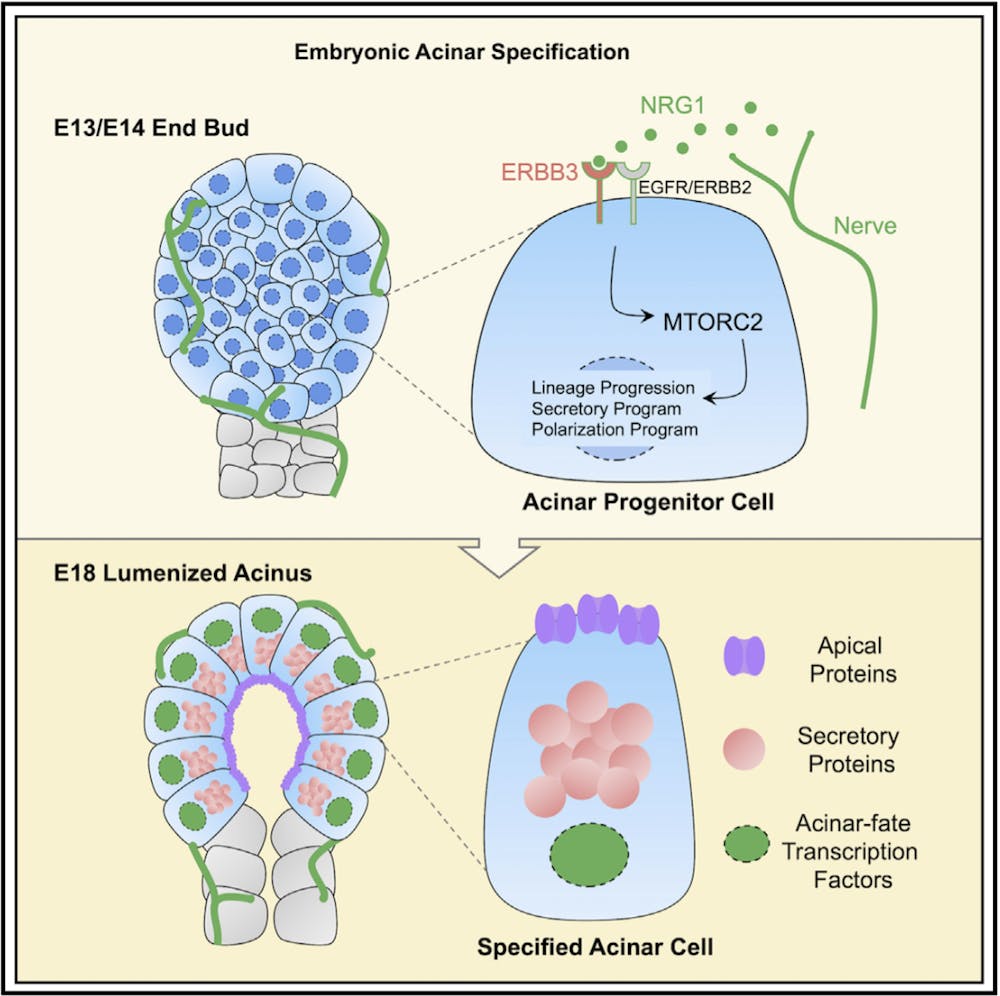
On Thursday, Feb. 19, Ali May, an assistant professor at the Icahn School of Medicine at Mount Sinai presented her research on the various ways tissue resident macrophages shape embryonic salivary gland development as part of the Department of Biology Seminar Series. Through her research, primarily on embryonic salivary glands, May presented her investigation on macrophages and their capabilities to potentially guide organ development, expanding the role of these cells outside of fighting infection and sculpting tissue architecture during the cell cycle.
“I hope you go home today knowing that macrophages are absolutely essential,” May said.
May began by challenging a commonly held view of macrophages as “garbage collectors,” which comes from their ability to engulf and digest dead cells, cell debris and foreign material. Instead, she prompted listeners to think of them as dynamic development cells with the potential to communicate with epithelial cells, nerves and surrounding support tissue. Her decision to ‘redefine’ macrophages in this way stems in part from her postdoctoral work on neurons, where she first saw how immune cells and the nervous system intersect during development.
“[I learnt] what’s being secreted by cells, and what’s guiding development from different receptors on adjacent cells or even on cells themselves,” May said.
By combining live imaging, genetic depletion and organ culture, her lab investigates how various macrophage populations influence branching morphogenesis – the tree-like growth of ducts and secretory units that underlie many glandular organs.
The primary methodology May’s team uses is an inducible genetic system that deletes macrophages during critical windows of salivary gland development. Her group observed that, after depleting macrophages during a critical development window, developing salivary glands had less branching.
“[Usually], you’re going to have smaller end buds and more of them in a highly branched gland,” May explained. “When you have less branching, you’re going to have much larger buds and fewer of them.”
When embryos lack these cells, the epithelial compartment exhibits a visibly abnormal structure called ‘Terminal Buds’ (small spherical ‘end bulbs’), which are a sign of impaired branching morphogenesis.
Her team’s later gene expression analysis further supported this observation. Tissues lacking macrophages showed decreased expression of gene cohorts associated with secretory acinar cell differentiation, ductal cells and other epithelial markers. Essentially, the absence of macrophages not only reduced branching but also hindered the maturation of key cell types that produce and transport saliva.
“Not only are we reducing branching,” May noted, “but we’re hindering differentiation of these essential cells.”
Beyond abnormal structure caused by the epithelial defects, glands without macrophages had developmental effects on non‑epithelial cell types in the developing salivary gland that are developmentally distinct from acinar and ductal epithelial cells.
For example, some genes were shown to be linked to glial and neural cell markers. May believes this pattern provides evidence of the possibility of a distinct nervous system within the gland.
This finding also supports the hypothesis that macrophages help prune neurons during development in other organs. Thus, May perceives neurons as crucial for normal gland development but stresses that they must be precisely calibrated. Her team is now working on neuroscience approaches to potentially uncover how macrophages coordinate epithelial and neuron patterns with the same developing tissue.
“We know that these neurons are also required for development of these structures,” May stated, “and [now] we also know in other tissues that macrophages function in pruning neurons as they grow.”
May then transitioned into a segment on signaling. As a developmental biologist, May tends to think in ligand receptor space.
“[I] ask which signaling molecules are being secreted and which receptors are present in neighboring or even the same cells,” May highlighted. Therefore, to identify candidate communication pathways, her lab mined single cell RNA sequencing data using ligand-receptor interaction tools. In doing so, one factor stood out: tumor necrosis factor (TNF). This is a type of cytokine typically associated with inflammation and injury, and was shown to be in macrophages.
Initially, May suspected that enzymatic digestion for single cell prep might have artificially activated the cells.
“Tumor necrosis factor is not a surprise for macrophages to express… however, we generally think of TNF as a pro‑inflammatory marker in an injury or a disease state within the adult organ. You don’t really think of it as a developmental regulator,” May said.
However, the direct tissue staining confirmed the TNF expression in macrophages near the epithelial compartment. When the team examined the receptor expression over the time of development, they observed a sharp upregulation of the epithelial TNF receptor.
“We thought this was quite interesting… that maybe TNF signaling is playing a role in the maturation of this embryonic structure,” May reported.
Thus, in order to directly test TNF’s effects on epithelial development, May turned to an in-vitro culture system. Using a refined enzymatic protocol, her team isolated the epithelial component of embryonic salivary glands and removed nerves, blood vessels and macrophages. These ‘purified’ epithelial pieces were then cultured. According to May, it would be expected to see the epithelial explants “as little spiders in dishes,” slowly branching over time and forming ducts.
“You can see them undergoing branching and then the formation of buds at the ends of these branches… we also call them cauliflowers,” May explained.
However, in the TNF samples, the glands became much larger and more pronounced in branching.
With added TNF, May says, “We see a significant increase in both the branching and the growth of these glands,” along with “strong dark lines in the center of the branches,” indicating that ducts are “now actually moving to form a lumen.”
May concluded her talk with a major deliberation: salivary glands contain macrophages of dua origin. These include a long-lived yolk-sac derived population and a monocyte-derived population that arrives later in development.
These subtypes occupy distinct niches in the embryonic gland and appear to perform different jobs over developmental time. May displayed live imaging movies where the macrophages physically crossed the basement membrane and encapsulated the entire epithelial compartment. She called this “cuddling.”
“What we can see is that this population can actually cross the basement membrane and enter into the epithelial compartment.. and [then the macrophage] enters and they almost cuddle a cell, and just as they exit, we can see that that cell undergoes cell division.”
The group is still investigating why ‘cuddling’ happens. One major question is whether macrophages are being recruited to monitor cells that are already committed to dividing, or if they are actively triggering proliferation. Nonetheless, this behavior across the tissue suggests that macrophages are not the passive bystanders we once thought of them as, but as dynamic cell counterparts that may be closely linked to epithelial growth dynamics.