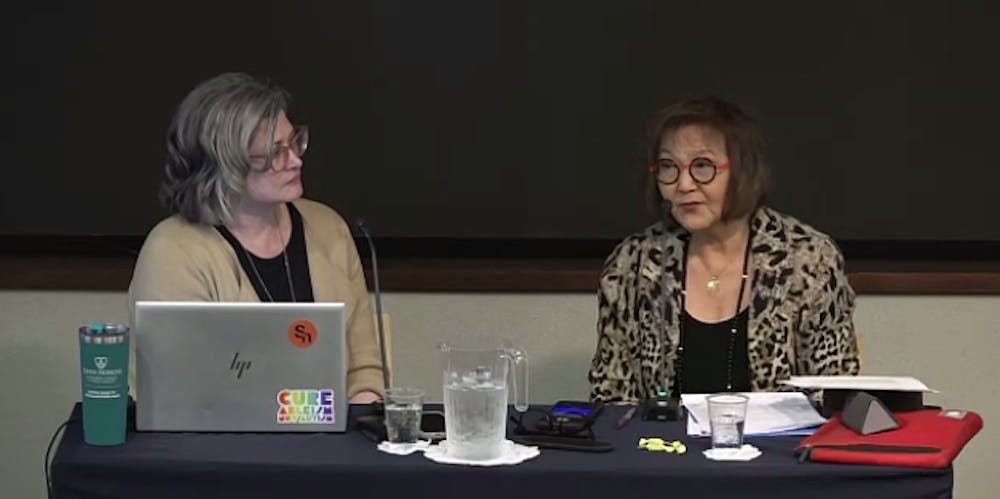
On Thursday, Feb. 19, the Cochlear Center for Hearing and Public Health invited Dr. Charlotte Yeh to talk about the intersection of technology, business and health within the field of age-related hearing loss. This event is part of their broader seminar series that runs from September to April and features speakers with expertise in topics surrounding sensory function, aging and public health. Having been one of the center’s very first inaugural seminar speakers back in 2018–19, Yeh has been a part of the center’s rich history and is also the only speaker they have had back.
Currently, Yeh is a part-time advisor and experienced officer for Cherish, a company that develops intelligent radar-based sensor platforms, and the founder of Yeh Innovation, where she pursues her deep commitment for patient centered care, advocacy for consumer voice in healthcare and the celebration of aging. She has previously held numerous leadership positions where she had done a lot of work with Medicare and Medicaid, in addition to serving on governance and advisory boards. However, Yeh started her career off working as an emergency physician, and shared that it is within the experiences she gained from working as a doctor that ignited her passion for advocacy.
“To me, we tend to focus in healthcare a lot about the what: what is it we need to do, what condition do we have, how do we diagnose this, how do we treat it, [but] I think in this new era, we need to be going back to the who and the why,” Yeh said. “[As an emergency doctor], I would see everyone coming in, and you could see the friction in their day to day living that just couldn’t allow them to follow through on instructions because we didn't understand who they were [and] their experiences.”
These observations as a physician drove her down the path of navigating how to address and minimize friction points primarily associated with healthy aging. Her ongoing work with EssilorLuxottica, the largest global leader in eyewear and med-tech and home to many established brands such as Ray Bans and Chanel, is actively doing so by working to creatively tackle one of the most common and normal consequences to aging: hearing loss.
Yeh started working with them in January 2026 and shared how it had initially surprised her that the companies decided to get into the hearing space. She later explained that the reason they did so was because they wanted to see the culture shift that occurred with vision to be applied to hearing.
“Growing up, you didn’t want to admit you needed glasses. Now, everybody wears glasses, and as you can see, they are a fashion statement,” Yeh said. “That’s really what led to nuanced audio, which is [EssilorLuxottica’s] subsidiary that [creates] hearing aid glasses.”
Yeh personally expressed favor in utilizing these hearing aid glasses herself as she opened up about having some mild drug induced hearing loss. She noted that she also wears glasses on a regular basis and found it difficult to wear glasses and hearing aids simultaneously, mentioning that the hearing aids would often “fly off.” She goes on to explain how this innovation is a prime example of why research revolving around the cooperation of the health care side of hearing and business is necessary.
“You guys are great at seeing stigma and how many people are doing this and that, [but] how many of you are actually, this is where you could cooperate with industry, looking at form factor function and [comparing] open air like a nuanced audio versus over the ear versus in the canal,” Yeh said. “How many of you are thinking: Where are the friction points for adoption? How many of you think about as you progress into cognitive decline mode, and you have hearing loss, they can’t handle the little hearing aids… they go into memory care, nobody checks the batteries.”
By studying these types of questions, Yeh acknowledges that researchers will not only contribute to increasing the adoption rate of these beneficial med-tech products and better health but will also contribute to opening up the marketplace that heretofore was not easily accessible. Additionally, she mentioned how it appears to be that people tend to resort to hearing aids as the ultimate hearing solution, but she encourages researchers to study the supplemental tools to amplify hearing, such as speech to text captioning and facial readings.
Yeh has personally witnessed the potential of speech to text captioning when she had accompanied her dad to the hospital. She shared how at age 95, he had endured two cancers and got a cochlear implant due to profound hearing loss, and brought an iPad with speech to text captioning on it. This technology allowed her dad and the hospital staff to directly communicate with one another. She implied that the staff initially were not drawn to this method of communication, but their perspective did eventually change.
“The second time they came in [they said], ‘where’s that device… I’ve got to talk to your dad,’” Yeh said. “It made it easier, faster… they didn’t have to repeat themselves [and] the best part is, my dad, halfway through the hospitalization, turned to me and said: ‘Do you know, this is the first time they’re not talking to you… they’re talking to me.’”
Yeh also talked about the importance of being able to distinguish between hearing loss and cognitive decline in elderly as she shared another story about her father where she first attributed his growing cognitive decline in communicating with family attention span to developing dementia. However, she decided to get him the Xander glasses, speech to text detection virtual reality glasses and after a couple of days wearing them, she immediately noticed that he was starting to communicate again. She used this experience to illustrate why it is worthy to further research into the relationship between hearing loss and dementia and how technology and even AI can be used to distinguish between the two.
“I can see the use of AI in monitoring people longitudinally to then begin to say the correlation of what appears like cognitive decline and hearing loss… to say, at what point do we want to distinguish and figure out what's the right treatment,” Yeh said. “Everyone goes to the drugs but the drugs for dementia might not [solve the problem] if the [patient’s] problem is hearing loss.”
In addition to this example of how AI can be a useful tool in hearing and aging care, she suggested that there are a myriad of other implications that are waiting to be explored, such as how AI can be useful in evaluating somebody in terms of their dexterity, vision, hearing etc. Overall, she reminds researchers to actively think about the application of the data they have collected and how it translates into the business side of things in order to make a real impact.
“We need you and we need you to do this,” Yeh said. “So, please do not lose that passion because, like I tell you the stories of my dad, these are real people who need what you know and how to apply it to real world experiences. So, if you want to have an impact, make sure to understand who your audience is, your end consumer.”