Lately, it feels strange to walk into class as if everything is normal. To sit in lecture halls, laugh with friends and plan for the future while so much is happening beyond campus walls. The world doesn’t pause just because we’re students, and yet sometimes it feels like we’re expected to let it.
Across the U.S., entire communities are being targeted. There is growing hostility, a lack of empathy and a selective concern for who deserves safety, dignity and compassion, as shown by immigration raids that have separated families, protests erupting in cities across the nation and the growing political divide that makes conversations feel more like battlegrounds than effective dialogue. Parents being detained while their children wait at home not knowing when, or if, they will return. Communities march in the streets, demanding accountability, fairness and basic human dignity. Across the country, protests have been met with heavy police presence, arrests and, in some cases even, violence, deepening the fear and mistrust many already feel. The tension is no longer abstract; it is visible in our neighborhoods, on our campuses and in the headlines that many of us scroll past each day. Watching it unfold, I’ve realized that silence, even when unintentional, is not neutral. Neutrality still sides with the oppressor, whether we want it to or not. We cannot afford the comfort of silence; in moments like this, choosing not to act is still a choice, and it is our responsibility to stand on the side of justice.
Before coming to college, I didn’t fully understand how much our voices mattered. I didn’t realize how powerful a community could be, or how dangerous apathy is when it becomes normalized. College teaches us to think critically, but it also challenges us to look beyond ourselves, to recognize that we are part of something larger than our individual schedules, grades and routines. At Hopkins, the people I’ve met — especially my closest friends, Evelyn and Faith — have shaped that realization. Our conversations go beyond assignments and exams; we talk about what is happening across the country, about immigration raids, protests and the growing political divide. Sharing values, questioning each other and reflecting on our roles in all of it has shown me how meaningful dialogue can be. At the same time, I have also encountered a different perspective — classmates who, because they do not feel personally affected, say things like, “Well, it’s not happening to me, so why would I care?” Hearing that forced me to confront how privilege can create distance, and how easily silence can be justified when injustice feels far away.
It’s easy to say, “I don’t watch the news for my mental health.” And for some, that choice feels necessary. But the truth is that millions of people don’t get that option. They can’t turn off the headlines because they are the headlines. Their daily lives are shaped by policies, violence and discrimination that don’t disappear just because others choose not to look.
We live in a country that prides itself on diversity, yet more and more, it feels like diversity is being treated as a threat rather than a strength. You might not be directly affected, not yet, but that doesn’t mean this moment doesn’t concern you. History shows us that indifference allows injustice to grow quietly, until it’s impossible to ignore. In the 1940s, more than 120,000 Japanese Americans, two-thirds of whom were U.S. citizens, were forcibly incarcerated in internment camps during World War II under Executive Order 9066. Many lost their homes, businesses and livelihoods, while much of the country remained silent. During the era of Jim Crow, racial segregation and voter suppression were upheld for decades, sustained not only by lawmakers but by widespread societal acceptance and inaction. Even in Nazi Germany, the persecution of Jewish people escalated gradually — from discriminatory laws like the Nuremberg Laws of 1935 to the genocide that killed six million Jewish people — in part because too many people chose not to intervene when the warning signs were clear.
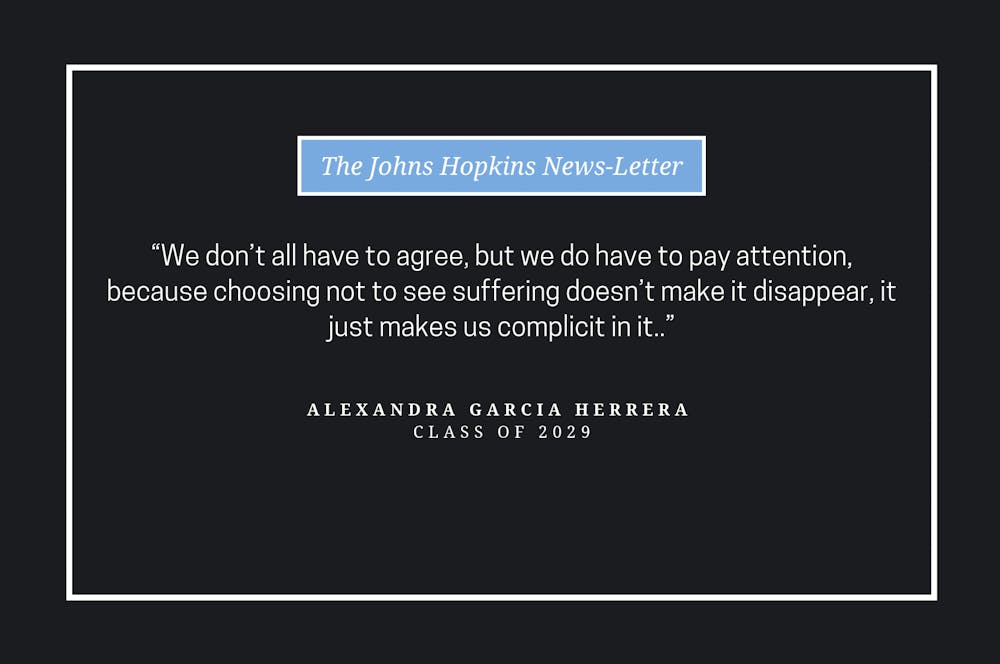
Coming to class after everything happening in the world may feel uncomfortable, and it should. That discomfort is a reminder that we are human, that we are connected and that we still have the power to care. We don’t all have to agree, but we do have to pay attention, because choosing not to see suffering doesn’t make it disappear, it just makes us complicit in it.
What scares me most isn’t just what’s happening, but how quickly people move on. How easily anger fades into indifference, how empathy becomes selective and how suffering turns into background noise. We scroll, we sigh and then we keep going. But for those whose lives are being disrupted, threatened or erased, there is no moving on. No pause button. If college teaches us anything, it should be that awareness is not a burden, it's a responsibility. Caring does not mean carrying the weight of the world alone, but it does mean refusing to look away from policies that impact immigrant communities, debates over reproductive and LGBTQ+ rights, and the growing unrest playing out in protests across the country. The smallest act of courage right now might simply be choosing to care out loud. Because history is shaped not just by those who act, but by those who refuse to stay silent.
Alexandra Garcia Herrera is a freshman from Laurel, Md. studying Chemistry.