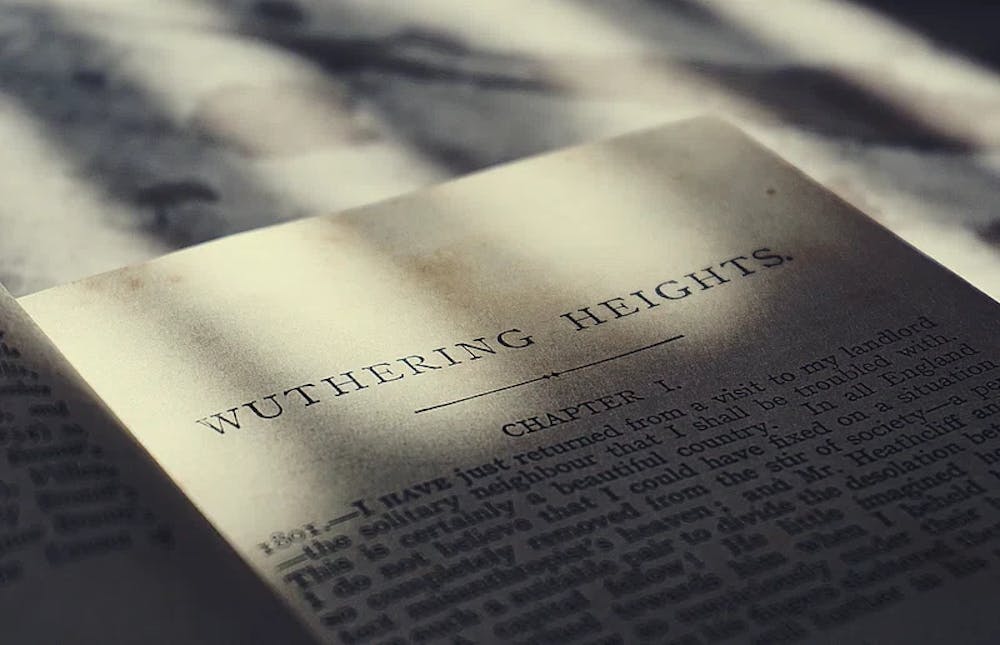
It comes as no surprise that Emerald Fennell, the daughter of a wealthy jewelry baron, gravitates toward stories drenched in excess. While she certainly brings copious amounts of style with her shocking and provocative films, a common critique of her works is in their lack of substance. Her films A Promising Young Woman (2020) and Saltburn (2023) allude to commentaries on the #MeToo movement as well as wealth and class struggles, respectively, that never actually present themselves, and her latest venture, “Wuthering Heights” (2026), completes this trifecta of disappointing discourse bait — films designed less to mean something than to make everyone argue about what they think they meant.
In her interpretation of Wuthering Heights, Fennell chooses to focus on the “sado-masochistic” romance between Catherine and Heathcliff, who grow up attached at the hip after Catherine’s father, Mr. Earnshaw, brings the young boy in. Mr. Earnshaw’s issues with drinking and gambling turn him into an abusive father, with Heathcliff bearing the brunt of it in an attempt to protect Cathy, stoking a deep bond that grows into a mutual obsession. When she marries Edgar Linton for security and status, Heathcliff disappears, only to return years later, having discovered loads of money, a razor and a slutty earring. Thus begins their torrid affair, entangling the Lintons in their toxic games until Catherine dies due to a miscarriage, tearing the lovers apart for good.
Since the initial casting announcement, the internet has been ablaze with opinions on Fennell’s choice to cast Jacob Elordi (who you may be shocked to learn is white) as Heathcliff, and Margot Robbie (who you are definitely shocked to learn is 35) as Catherine. Heathcliff is canonically described as a “dark-skinned g*psy,” and the racist attitudes of the other characters contribute greatly to his characterization as an othered boy and was a large reason why he and Catherine could not freely love one another. Fennell chooses to make this entirely about wealth and circumstance, eliminating the most interesting layer of their adolescence.
Beyond race, Fennell’s choice to age up the actors took me out of the viewing experience for the first half of the film. Since Catherine and Heathcliff are teenagers, Catherine in particular is childish, petulant and cruel, and this characterization is maintained in the movie. I just could not believe that a grown woman (Barbie, at that) would act so superior over her childhood playmate and awkward sister-in-law, yanking Isabella’s hair when she expressed interest in Heathcliff. Even though Catherine is intended to be an unsympathetic character, even the nastiest adults have a bit more decorum.
Despite this, I was very drawn to the visuals and the performances. The attention to detail in the camerawork and set design has come to be a Fennell specialty, and I did feel the movie magic. The highly detailed wallpaper of Cathy’s room in Linton’s house being patterned with Robbie’s own skin was very intriguing — although someone cleverer than I will have to explain its symbolism — and the stop-motion title sequence in braided hair was a nice touch.
Hong Chau’s performance as Nelly was incredibly compelling, and although she is made to be the villain in Catherine and Heathcliff’s story, she acts as a stand-in for the audience the entire time — I felt personally affronted when Catherine told her that she had never been loved. Alison Oliver was a real show-stopper as Isabella, taking a role clearly intended to be comedic relief and turning it into my favorite performance. It takes a lot for me to still like a character after seeing her enthusiastically bark like a dog (unfortunately, I am not speaking figuratively here), but somehow she made it work.
Charli XCX’s soundtrack definitely exceeded my expectations, and I’m intrigued to see this direction from my favorite Club Barbie. In the context of the film, however, it was a bit too on-the-nose. Might Catherine be feeling trapped in her marriage with Linton? If the montage had been silent shots of her dissociating I may not have picked up on it, but thankfully I was listening to lyrics like “I shouldn’t feel like a prisoner” and “can’t breathe without you here.”
Ultimately, however lovely the cinematography and acting, the film is reminiscent of a Subway Surfers play through with an AITA Reddit story playing in the background. Fennell seemed to believe that the only way we would get through the movie was with bright colors and shock factor. And what’s worse is she may be right.
In this Fandango interview, Fennell claimed that a faithful adaptation of the novel was “not possible” due to its “dense and complicated and difficult” nature. Instead, she created the story she envisioned when she first read the novel at 14, according to this Vogue interview.
It’s kind of crazy of her to publicly admit that she pictured this epic story of generational trauma and vengeance as a “sadomasochistic love story” with “explicit” overtones (they kissed once) as a teenager, but there’s probably something to be said here about stones and glass houses, so I’ll leave it at that.
Fennell had previously faced criticism over refusing to acknowledge that Saltburn was a The Talented Mr. Ripley knock-off, and it seems she’s over-corrected. But even if she hadn’t titled this film “Wuthering Heights,” (the quotes don’t save her) the story on its own remains particularly uncompelling. When you advertise a movie as “the greatest love story of all time,” you have to deliver, and a reference to Romeo and Juliet does not an epic romance make.
In frustrating contrast with the cinephile’s wet-dream cinematography (and Fennell’s Oxford English Literature degree), the marketing fully embraced the “smooth brain-ed-ness” of the plot. Warner Bros’ use of Booktok buzz words like “close proximity” was a lazy way of getting butts in seats, though it definitely worked, generating $83 million at the box office opening weekend, reflecting the sorry state of media today. Not every film needs to be deep or meaningful, but it would be nice if filmmakers could respect their audience with subtlety and take a commentary further than the superficial every now and again. Fennell instead squandered a golden opportunity to bridge the divide between literature snobs and casual romance enjoyers. I’ll get off my soapbox now, but this movie was not “‘porn’ for women.” It was porn for Emerald Fennell.
Was I successfully rage baited by this “adaptation”? Yes. But Fennell’s superficiality and mishandling of her source’s thematic elements in favor of flashy aesthetics is simply a symptom of a much more serious disease: It is art in the age of TikTok.
TLDR: In the immortalized words of bk on Letterboxd, “Emerald Fennell to film is what Colleen Hoover is to literature.”
Editor’s Note, 2026: In a previous version of this article, Emerald Fennell’s name was misspelled, and the title of the movie was formatted incorrectly. The News-Letter regrets these errors.