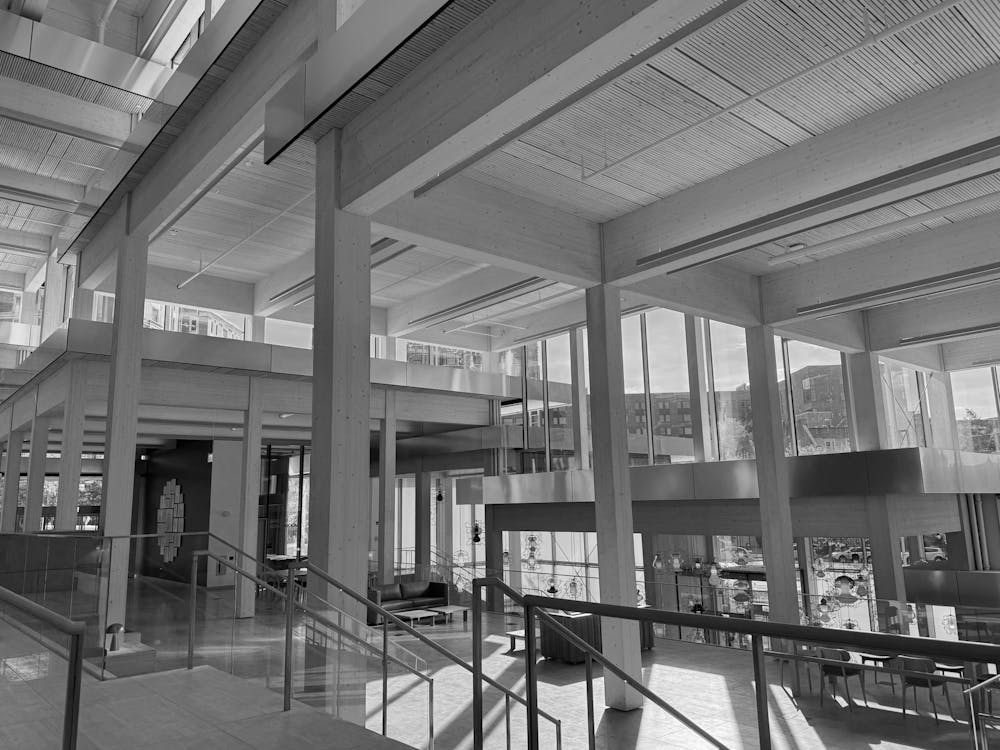
To begin the 2025-2026 school year at Hopkins, the long-awaited Bloomberg Student Center (BSC) opened as a self-proclaimed “vibrant hub where connection and discovery thrive.” From expanded dining options to a litany of table games, the BSC offers much more than a student space. “Whether you’re here to meet friends, share ideas, host an event, or simply take a break,” the center’s website claims, “[BSC] is designed to be a home base for connection and discovery.”
However, BSC’s role as a social hub has been overshadowed by a lack of available study spaces on campus, causing students to use the building for their academic needs. The University should not push against these preferences and let students use the space as they wish.
When Milton S. Eisenhower (MSE) Library renovations began in the summer of 2024, its ensuing closure caused a significant decrease in study spaces. A survey by The News-Letter in October 2024 found that a majority of students were discontent with the closure of Homewood’s main library. When students were asked how MSE’s closure has impacted them on a scale of 1 to 10, the average rating was 7.41.
While the University expanded former study locations and offered new spaces to compensate for MSE’s absence, such as the MSE Annex, The LaB and additional study spaces in Hodson Hall, these temporary solutions did not make up for the loss of the library. Thus, when the Student Center opened in August 2025, students were excited for a new 150,000-square-foot facility that would serve both as a hub for student life and also a place where they could relocate their studies. Another survey by The News-Letter in October 2025 showed that over half of the students who visit the BSC use the space for studying.
Yet, students attempting to study in their new space were met with loud music and events. Whether the purpose of this behavior from University administrators is to foster a less stressful campus culture or designate the area as social as opposed to academic, they have only made student autonomy on campus more difficult.
An Instagram reel posted by jhustudentlife during Fall 2025’s reading week explicitly depicts students’ frustrations with the inability to properly study at the BSC, and encourages students to relocate to The LaB, one of Hopkins’ innovative student spaces near the Homewood Apartments. When official channels normalize the idea that the BSC is not a viable space to study during reading week, it reveals that the University is actively urging students to not work in the building. When students are under academic pressure, this is frustrating.
In an interview with The News-Letter, sophomore Ember Simmons shared that she was “kicked out of [a multipurpose room]” while studying for Organic Chemistry, and “the custodian that kicked [them] out had told [them] that … Hopkins doesn’t want [them] to study in the Student Center, and that’s why all the tables are at an uncomfortable level and that they’re playing music really loudly, constantly.” This interaction further elucidates the idea that the University follows an institutional choice with their design of the space and prioritizes the image rather than accessibility, comfort and desired use for the space.
At this point, it’s necessary to take a step back and ask, “Why is the Hopkins’ administration so opposed to the use of BSC as a study spot?” The push might be an attempt at shifting student culture toward recreational activity and away from intense academic rigor, especially at the University’s newest, most forward-facing student amenity. Student culture, however, cannot be molded, controlled and contained.
Even with Hopkins actively working to promote alternative study spaces, the BSC still sees a large volume of students who choose to use the space for studying. The fact is that the culture of BSC is currently inextricably tied to work, and as long as Hopkins tries to actively weaken that culture, the center will perpetually be in a crisis of identity, and the student body will be unable to use the space to its fullest capacity.
While it’s understandable that Hopkins wants a certain amount of control over how campus spaces should be used, that control must not come at the expense of students’ needs. Prioritizing recreation during a time where there is a dire need for accessible study spaces sparks frustration within the student body while simultaneously sending the wrong message about the University’s academic priorities. The BSC was designed as a place to gather, create, engage and recharge, but ultimately, it is a hub for students. Within reason, the student body should decide what they use the BSC for and not feel pressured to conform to the University’s vision of a certain campus culture.
Students have demonstrated their capability to do so in the past. When MSE was still operating, it was established practice that noise level decreased as you went down its floors. This rule was not enforced by the University but was rather a product of culture, shared expectations among its students and collective norms of the space. The Hopkins student body was selected for their academic and personal merits: they are more than capable of effectively dictating how they want a space to be used, and the culture at MSE is one example of this.
With MSE set to re-open in early 2027, students need more places where they can focus on their studies and their academic goals. The issue is not whether the BSC can be a social hub. That’s what it was designed to be and it can act as that while simultaneously acknowledging students’ need for functional study spaces. If a shift is targeted, the University should realize that it starts with the students, not with administrators. By signaling that work is unwelcome in the BSC, the University will only further aggravate the student body. Hopkins needs to act as a campus that prioritizes both student life and academic success, and providing students the freedom to dictate how they wish to use the BSC is the way to do so.