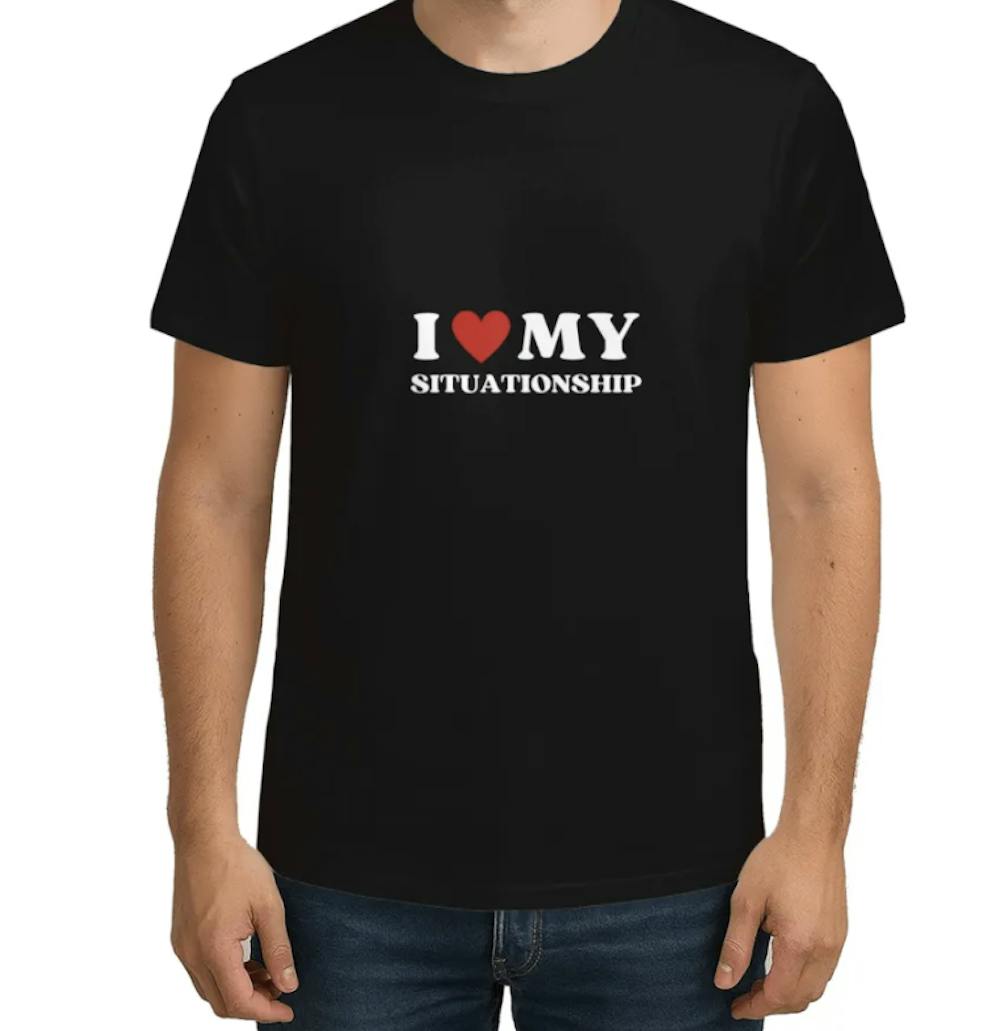
I hate everything about them.
The very concept makes me want to curl up into myself and dig my head into the sand. The mere fact that situationships exist as an idea floating out there in the world deeply pains my heart every day that I am aware of it.
And not just that, situationships have literally been all I’ve ever known. It seems like they are the unavoidable intermediate stage inherent to chasing intimacy. I couldn’t tell you any other way to find romance in this world. Do you know how much that hurts me inside?
Back when I had an unhealthy obsession with 500 Days of Summer (which is still a great movie), I attempted to ease this existential pain by directing my frustration at “my generation.” I would emerge from my little tent in the woods to shake my fists at the clouds, screaming about “kids these days” and how “nobody my age knows how to love anymore.”
As salty as it was, talking stages, text ratios and read receipts really can’t exist without newfangled SMS messaging and the little, iOS-powered pocket nightmares we all carry around. So, I don’t think I was entirely off track.
The danger with nostalgia, though, is that it is far too easy to believe that all bad things are new. AI is new and it is destroying critical thinking. Spotify is new and it is destroying the music industry. Short-form content brainrot is new and it is destroying our attention spans. If the internet did so much damage to us, then it only follows that situationships must be a brand new invention of Gen Z, right?
Unfortunately for me, I just don't think that’s true. My idealistic nostalgia is for an era of social dynamics that never existed. Even when phones had to be routed through switchboards, I’m sure some poor soul was tearing their hair out at night wondering if Becky on the other line really liked them or not. As much as I’d like to blame my fear of flirting on the “ills of our age,” I think it’s really just a me thing. It’s always been bad out here, and wishing to go back to a time before the polio vaccine won’t make my life any better.
The fundamental problem is that people (read: I) want it both ways: We want the clarity and certainty of explicit, reciprocal interest but the stability of just going with the flow and responding with some mundane text back. What keeps us all stuck in this inertial path to situationships is just how terrifying it is to be the first vulnerable one. The situationship is a game of chicken where whoever breaks the pretense of nonchalance first risks heartbreak. We would rather stay in noncommittal purgatory than mess everything up by wanting something more.
Even though situationships are nothing new, this part — the paralyzing stigma around authenticity — is. We rarely ever express passion anymore, and vulnerability has turned into a surefire way to come on too strong and scare people away. This is more than just a collective unspoken decision to all play the “situationship” chicken game; the very social perception of emotional transparency has changed.
To talk about your feelings, even if it is practically necessary in order to build a strong foundation for vibrant interpersonal relationships, is taken as a sign that you care too much. In this adversarial model of talking stages, we see that both people lie somewhere on the scale of “date to marry” to “simply seeking attention” and to be closer to the former than the other person is to risk coming on too strong, ick-ing them out and blowing everything up. Everything would be much easier if both people just (pretend to) not care that much and follow the vibes. Asking anybody for answers to the “what are we” question is not a harmless external observation, it is a strong implication that you are too invested and caught too many feelings.
The end result is a general unwillingness to even engage with difficult questions on a personal level. Even in the safety of our own internal monologues, the monsters that are “what do I want from this?” or “how do I feel?” have become tabooed out of serious consideration. The issue is that this internal ignorance combined with the external stigma against vulnerability creates a self-enforcing cycle. We refuse to talk about it, so we don’t ever have to think about it. We refuse to think about it, so we don’t ever get to talk about it.
This is not love, this is performance perfected.
Take, as reference, the phenomenon of male performativity. The reason listening to Clairo is so performative is because these men don’t actually believe Second Nature’s melody is particularly delightful or that her music is even genuinely good; they believe that the mere act of having Charm’s album art on their home screen will signal to other people (particularly, women) that they are a certain type of person: a softer, more sentimental boy. It is not just the deception that makes this behavior frustrating, it is the totalizing perversion of a profoundly authentic art into merely a signal to others that these men are playing by the rules of the right social game.
In much the same way, we have begun to perform both passion and love. We go through ritualized procedures and say just the right things — not to curate loving, thoughtful relationships, but to maintain the status of being taken — to have an Instagram account to show to our friends.
When we engage with situationships like universally mandated rituals, we rip them away from the deeply emotional nature of romantic relationships. We choose to willfully ignore the other person’s undoubtedly complex internal life and flatten them into their favorite color or Spotify Wrapped or whatever other menial piece of information they reveal in those protracted texting sessions. More than that, we flatten ourselves in this process: never revealing anything about ourselves past surface-level small talk and choosing to play by the unspoken rules for fear of heartbreak, all the while turning ourselves into the sacrifice of this modern-day ceremony.
All we are for each other is a symbol: a symbol to the rest of society that we are capable of being “normal” enough to attract people romantically. To not be able to participate in this game — to never experience a relationship — is to have something “wrong” with you. You don’t want to have anything wrong with you, do you?
I guess I have something wrong with me. I don’t think it should be this way, and I don’t think it has to be this way. I’ve had too many people agree with my periodic crashouts about this topic to believe that I’m the only person who thinks this way. I am not unique, but the issue is that it’s always a moment of weakness on my end that sparks this conversation. I’ve heard countless people agree with me, but I’ve never seen a single other person even float a similar idea on their own accord. I always have to be weird first.
I’ve chosen to let that happen, to let myself laugh too hard at my friends' jokes and be a little too loud about my current favorite album. Honesty and vulnerability are not things we have to hide from other people. The help that got me through my hardest times came from my friends willing to be vulnerable back. My happiest memories are the stupid conversations I hold with my friends about my most suppressed secrets.
Note that we don’t owe this vulnerability to everybody. Sometimes we really do have to keep ourselves safe in dangerous situations. Sometimes professional relationships or power dynamics preclude such rawness, but we should still strive for this type of unfettered connection everywhere we can.
It is scary. Being the first one to drop something personal will be hard, but if we are to build lasting relationships with each other — if we are to love in its most vibrant, most activating sense — then we must be willing to take that step into the dark and reach our hand out as far as we can. I promise you, if you take this type of radical honesty with you, you will begin to see how much life there is to live, even outside of romantic relationships. Your heart does not have to stop at the edges of your phone’s display.
Steve Wang is a freshman from Missouri City, Texas majoring in Biomedical Engineering. He is an Arts & Entertainment Editor for The News-Letter.