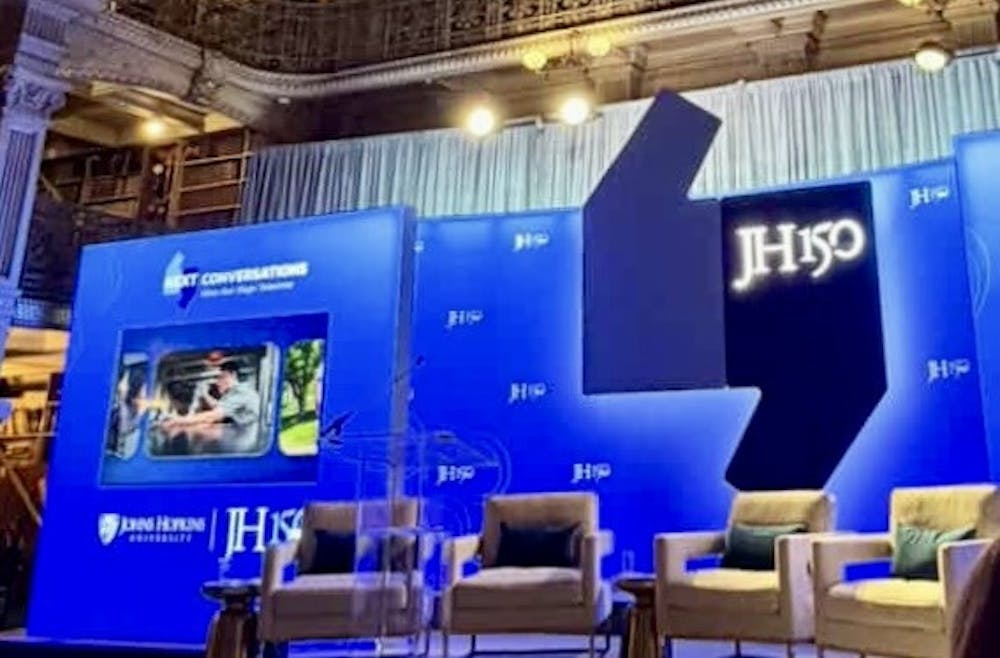
In honor of its 150th anniversary, Hopkins launched the “Next Conversations” series on Feb. 18, held at the George Peabody Library. Bringing together classicist Karen ní Mheallaigh, philosopher Jenann Ismael and Nobel-Laureate astronomer Adam Riess, the session moderated by Sean Carroll sought to tackle the complex conundrum of how humanity can find its place in an ever-expanding universe.
Brief initial addresses by the University President Ron Daniels and Mission Area Executive for Space Formulation at the Applied Physics Laboratory (APL) Jason Kalirai reaffirmed the institution’s belief in looking towards the future, and specifically towards the sheer vastness of our cosmos. Space exploration is a field with historic ties to Hopkins; the first color image of Earth was possible thanks to the contributions of the APL.
The panel discussion straddled the lines between the varied disciplines of the faculty members involved. Aptly beginning with philosophy, Ismael grappled with the question of how humans could claim to understand any of the universe at all.
“Maybe the universe everywhere is made of the same kind of stuff, obeying the same kind of laws, so that we can, by studying stuff that we do have immediate access to, discern laws that govern everything in the universe. [But] there's no guarantee that that's correct. It just happens that as far as we know, our universe is structured like that, and it was that insight that made science as we know it now possible.”
Picking up on the thread of how scientists strive to decode the cosmos, Riess brought a cosmologist’s perspective on why the universe remains worth studying, looking at our understanding of science as almost akin to a sweater.
“We're tremendously curious about some of the things that don't fit in the universe… I'm most interested in the loose threads on the sweater. You know, sometimes you pull them and they just come off. And sometimes they unravel the sweater,” he said.
This spirit of inquiry is reflected in threads running back millennia, as addressed by Mheallaigh when considering the thoughts of Greek antiquity.
“The cosmos, it's a beautiful word in ancient Greek. It means beautiful order… It's the very word that we have in cosmetics… When they looked at the system, they saw order, and then they connected that with all sorts of other systems of order, like political or internal order. So they saw connections between the way we live, ethically and politically and socially; how we interact with one another in societies.”
By contrast, Riess described cosmologists to be almost like cartographers: carrying forward the attempts made by ancient civilizations to quantify the world around them, though foregoing those civilizations’ searches for beautiful harmony in the universe. Nonetheless, even the end of the universe itself, be it through heat death or a “big crunch,” has captured human interest, as Ismael pondered. Representations of this essentially aesthetic quality of the universe have enraptured the human imagination since the Homeric era, discusses Mheallaigh.
She specifically honed in on the shield of Achilles as a representation of the universe: a state of being both inside and outside existence at once. Other cosmological metaphors, though perhaps less literary, have also permeated the popular consciousness. Riess appreciates the likening of the expansion of the universe to the rising of raisin bread, with the raisins growing further apart from one another.
Of course, there remain those phenomena which still remain beyond scientific understanding. For such scenarios, Mheallaigh turns to the writings of Seneca, a philosopher and advisor to Roman Emperor Nero.
“Seneca did this incredible thing. He said, ‘No I disagree with Aristotle. We don't know enough yet. I don't think Aristotle is right, but we won't know until someone in the future answers the question,’” Mheallaigh stated. “Our knowledge is incomplete. And for me, that generates a sense of that kind of intellectual humility… and that seems to me to tear open a membrane between antiquity and the future. It's like I'm waiting back with Nero for someone out there in the future to answer the questions to the universe.”
Approaching the question of science’s limits from a broader philosophical stance, Ismael remained optimistic that science would be able to eventually provide these answers.
“One of the things about science is that nobody knows the answers to these questions,” Ismael began. “All of my money is on science being ultimately able to understand these questions… not because we know what the final science looks like, but because science won't be completed until it does. So there's no reason to think there's no set of laws that will encompass and show the human being to be completely a part of the fabric of the universe.”
After briefly tussling with the difficult challenge of life beyond the Earth, the panelists tackled the scientific systems that define the boundaries of human discovery. Ismael described it as a massive mathematical framework where each new piece of the puzzle came one step closer to reconstructing it into something more accurate.
Yet, an essential aspect of the conversation was acknowledging that the framework could not remain isolated unto itself. Still, there remains a tremendous difficulty in truly bridging the gaps between different fields, as Riess describes when thinking about his day-to-day work.
“I mean, when we talk interdisciplinary, we're like, oh, talk to the mathematician, the chemist, like that. Oh, my God, engineers? There are interesting questions as we talk about these philosophical questions that sometimes come up in our work, like, how do I think about this cosmological principle? How do I think about Occam’s razor? These are philosophical questions that I think if I stop and think about it more, I would go and visit [Ismael and Mheallaigh’s] offices.”
Nonetheless, there remains hope for more synergy in the future, with the professors acknowledging Hopkins to be one of the most interdisciplinary universities they have worked in. As the panel came to a close — with the promise of the next panel in the series being one focused on solving the hunger crisis — this essential spirit of connections across departments and subjects resounded as a concluding statement.