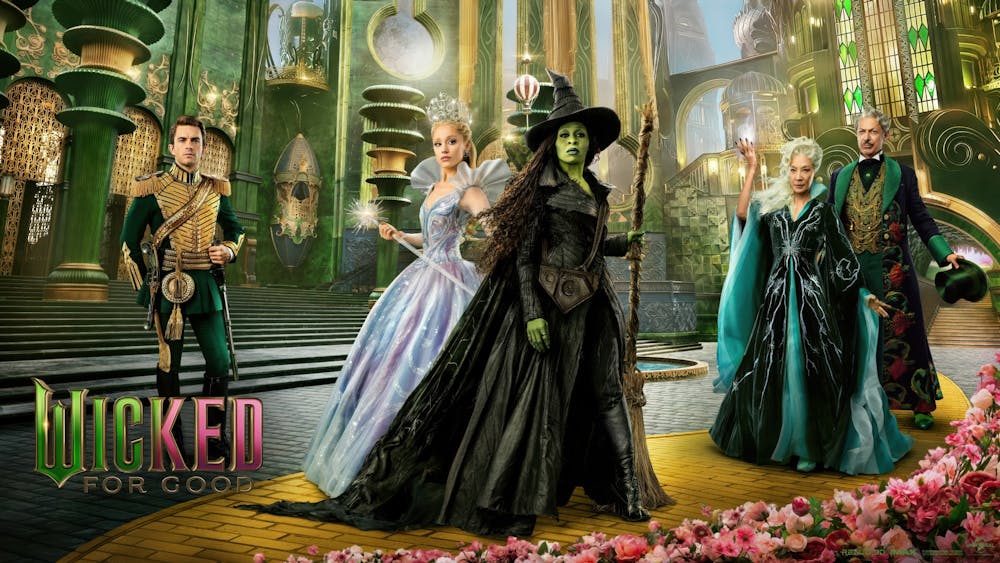
Following the soaring climax of “Defying Gravity” from 2024’s movie adaptation of the cultural phenomenon that is the Broadway musical Wicked, audiences everywhere have eagerly anticipated John M. Chu’s interpretation of the divisive Act 2. In Wicked: For Good, which landed in cinemas on the Nov. 21, the director delivers a spectacle that is... somewhat good?
Wicked: For Good continues the story of Wicked, which is a spin on The Wonderful Wizard of Oz where Elphaba, better known as the Wicked Witch of the West, is discriminated against for her green skin. She eventually finds companionship in a cast of characters at Shiz University, most notably G(a)linda, who later becomes Oz’s Good Witch. After learning some devastating truths about her idol, the Wizard, Elphaba vows to fight against him in defense of the animals of Oz. The sequel to the first film, better recognized as Act 2 of the musical, explores political upheaval and tumultuous relationship dynamics introduced in the first film, especially centering on the friendship between Elphaba and Glinda.
Longtime fans of the stage show are unlikely to be surprised by the more tepid reception the sequel has endured thus far: Wicked has an infamously weaker second act, with many of its iconic tunes and story beats taking place during Act 1. The film, although over twice the length, remains faithful to its source material for better or for worse.
Inevitably, many of the story’s weaknesses carry from stage to screen. While many of the ways the plot ties into that of The Wizard of Oz are lovable winks to the audience, the attempt to shove in the fundamentally incompatible plot unnecessarily stifles the chance for Wicked’s original story to become fully fleshed out: the Wicked Witch of the East plotline in particular has never felt very organic. The sequel ramps up the political and darker elements touched upon in the first film, pushing the fascistic undertones of the Ozian government and the commentary on propaganda to the forefront without grappling fully with the ideas spotlighted. By the second time Fiyero waves around a gun to assist a dramatic escape, the cracks in the suspension of disbelief begin to appear.
If I can offer any defense, the film does succeed at stating the essence of its thesis statement: that propaganda, public opinion and the squabbles of those in power hold greater sway than the truth alone. Do not be fooled by the broomstick: for all her magic, Elphaba wields very little meaningful ability to enact the changes she strives for, especially in comparison to a certain someone with no magic at all. While Chu does sweeten the ending, he retains the ultimate tragedy of Wicked, and most importantly, the promise that at the end of it all, there is hope that the characters won’t “let good be just a word.”
The movie’s small changes do improve the shift in focus from the first act’s college shenanigans to more complex relationships and political intrigue. For one, Elphaba is actually seen trying to help the animals that drive her motivation throughout, including with a new song that ironically opines “There’s no place like home.” The focus on the love triangle is also mercifully reduced from Broadway, although I must express disappointment that its strongest moment — a reprise of “I’m not that Girl” transitioning directly into “As long as you’re mine” — is sadly discarded in the film.
The “Wonderful” sequence must be especially commended: The movie presents a far more convincing version of Elphaba’s brief initial temptation to put her cause to rest, and likewise through a cleverly edited sequence juxtaposing Glinda’s and Elphaba’s situations makes her reaffirmation much more compelling. This also marks one of the few times the movie bursts with color; for a film with such strong ties to perhaps the most famously technicolor cinematic achievement, most of Wicked: For Good looks washed out and dull, watering down the impressive achievements in practical effects and costuming behind the scenes.
The movie’s slower pacing also introduces tonal whiplash that the audience did not have time to grapple with in the stage show’s breakneck pacing, with the few comedic sequences feeling misplaced with the generally dour mood.
Luckily for the movie, the key emotional beats are anchored by the film’s best songs (which were always a saving grace for a musical). “No Good Deed” explodes with desperation, a booming orchestra chasing to keep up with Cynthia Erivo’s powerful vocal showcase. Ariana Grande does an excellent job with the complex characterization of “Thank Goodness,” although the cleverly incorporated depth of emotion is reduced when the later ballad “Girl in the Bubble” clunkily renders the subtext overt. Fortunately, the emotional climax “For Good” is about as good as a farewell duet gets in musical theater: say what you will about Grande and Erivo’s endlessly memetic press tour, but pink does go well with green.
Wicked: For Good is far from perfect, and I would wager many will hold the first part much closer to their hearts. Nonetheless, it has a place as a suitably expanded and bombastic character-driven second half culminating in what is, at its core, a tragedy about a society unwilling to accept those that are different. It is made with clear heart and love for the story that shines through despite its stumbles, and it is worth the watch for longtime fans and those seeking to complete the first film’s journey.
And yes, I would be lying if I said I didn’t smile when I saw the final shot.