As the world turns its ears toward Stockholm for this year’s Nobel Prize announcements, we have a chance to reflect upon and analyze the intertwined history of the esteemed prize-giving body with our university.
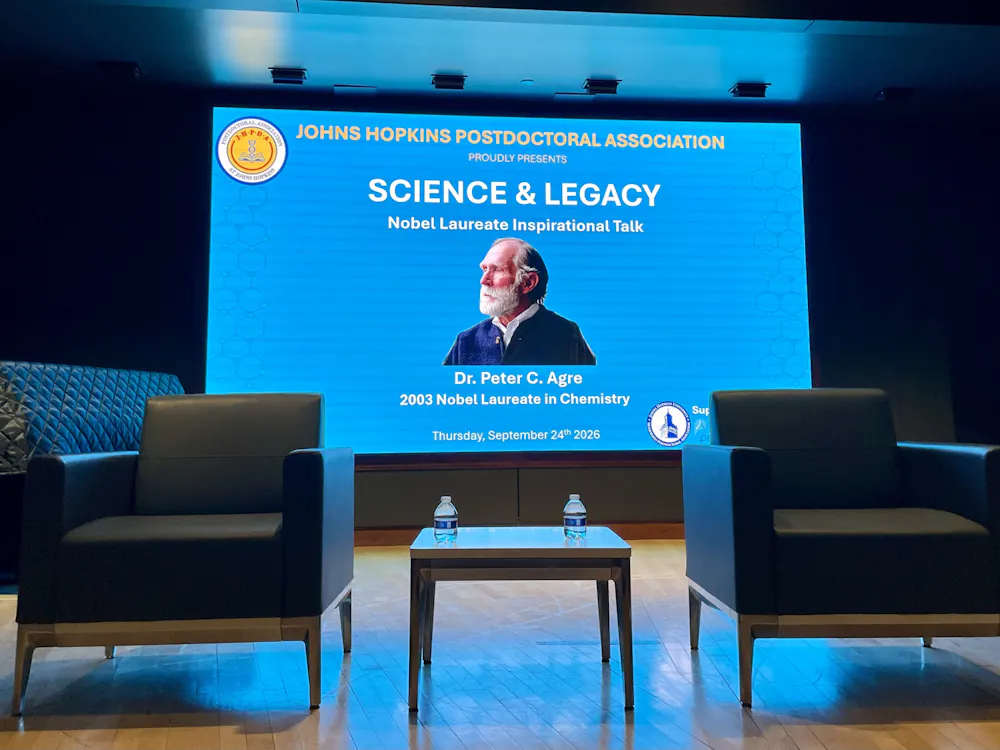
Though the exact criteria through which certain victors can be “claimed” may vary, Hopkins itself officially lists 29 affiliated winners as of September 2026. These winners span each category awarded, except for the prize in Literature, which has thus far eluded our community. These include — in decreasing order of the number of prizes linked to Hopkins — Physiology or Medicine, Physics, Chemistry, Economics and Peace. Of the three prizes for scientific fields, which will be the focus of this article, Hopkins claims connection to 24 winners. Notably, all Nobel laureates currently serving as members of the faculty — Peter Agre, Gregg Semenza and Adam Riess — fall under this number.
To sketch a timeline, the Nobel Prize was first awarded in 1901, around 25 years after the University’s founding, with the first Hopkins associate receiving the award in 1919 (specifically Woodrow Wilson, winning for peace). James Franck would win the honor in 1925 for his analysis of the electron, and he later became a professor of Physics at Hopkins from 1935–1938.
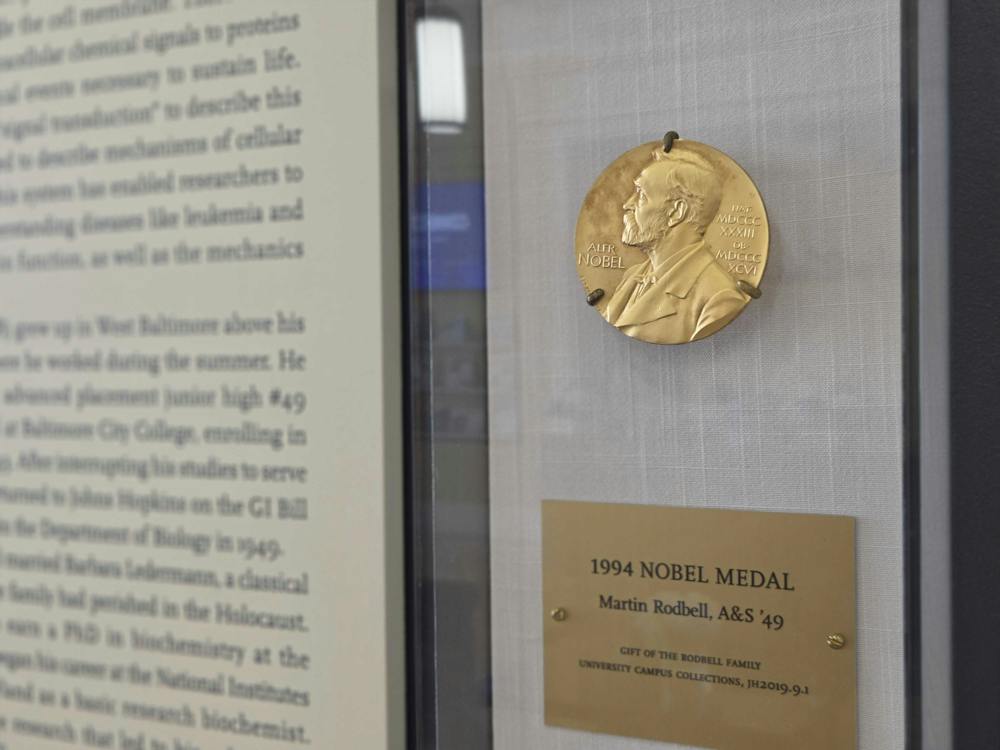
That said, the earliest winner of a scientific honor to have received a degree from Hopkins was Thomas Hunt Morgan, who completed his doctorate in Zoology at the University in 1890 and was awarded in 1933 for his foundational work with chromosomes. Tallying the count, 11 alumni who completed a degree program at Hopkins have received the recognition for their achievements in science. Of these alumni, 10 received their Ph.D. or M.D. at Hopkins, while two — Francis Peyton Rous (who received both his B.A. and M.D. degrees from Hopkins) and Martin Rodbell — acquired their undergraduate degree at this institution. It is worth noting the University’s status as the first research university in the United States, having offered undergraduate programs alongside graduate programs since 1876 despite its initial emphasis on the latter.
At the time of his award in 1933, Morgan was affiliated with the California Institute of Technology. Following that line of thinking, if we were to trace the affiliations of awardees, Hamilton O. Smith and Daniel Nathans in 1978 mark the first winners to have received the award while affiliated with Hopkins at the time, winning in Medicine for the discovery of restriction enzymes and their applications. Of the 24 laureates in science, 8 have won while holding a faculty or adjunct position at Hopkins, with 6 of them being recognized in the 21st century.
Perhaps of greater interest than the affiliation of awardees at the time is what prizes were awarded for scientific research conducted at Hopkins. While delineating the exact boundaries between contributions from specific institutions can be a difficult, if not downright impossible, task, several awards mark notable findings obtained at the University. These include research leading to the discovery of aquaporins and restriction enzymes, key work on cells adapting to oxygen availability and significant innovations in our understanding of the visual system. Previous Nobel laureates have praised Hopkins as an environment in which to conduct prize-winning research, with Semenza explaining in a Hub staff report, “That's why I've stayed here my whole career, because I think this is the greatest place to do research”.
These research opportunities have continually attracted talent, as seen with Shimon Sakaguchi, who won the Nobel Prize in Physiology or Medicine last year and conducted postdoctoral studies at Hopkins — although he has not been officially listed as an affiliated awardee by the University. Contributions by Hopkins scientists that were not directly recognized by the Nobel committee, such as several experimental physicists who assisted in work on the Higgs boson, have also been identified. Similar, less evident connections meriting additional notice are seen with other figures such as Hopkins alumni James Muller and James Cobey, whose experiences and education as medical students at the University played a role in their establishments of Nobel Peace Prize-winning organizations.
Regarding current affiliates of the University, several have achieved other awards that are often linked to future Nobel laureates. For example, many winners of the Wolf Prize — such as Solomon Snyder, who conducted extensive research at Hopkins — have gone on to win Nobel Prizes. Graduates and members of the faculty like Bert Vogelstein, a professor of oncology, have also won several awards of note such as the Lasker Award and the Breakthrough Prize.
In extrapolating any further conclusions from the data discussed here, prospective analysts must be wary of certain considerations. The Nobel Prize is an awards system based on annual selection by committee, and it has been accused of carrying its own biases and blind spots as well as being subject to internal politics. Its criteria, including traditional limits on the number of awardees and a refusal to award posthumously, further constrain its scope. Furthermore, the recognition (or lack thereof) of winners as university affiliates can be contested in several cases, as with Sakaguchi.
Interrogations of our history with the award offer specific findings which, when applied with care and judgement, may yield broader insights and raise important questions about the University’s engagement with the vast tapestry of the scientific endeavor.