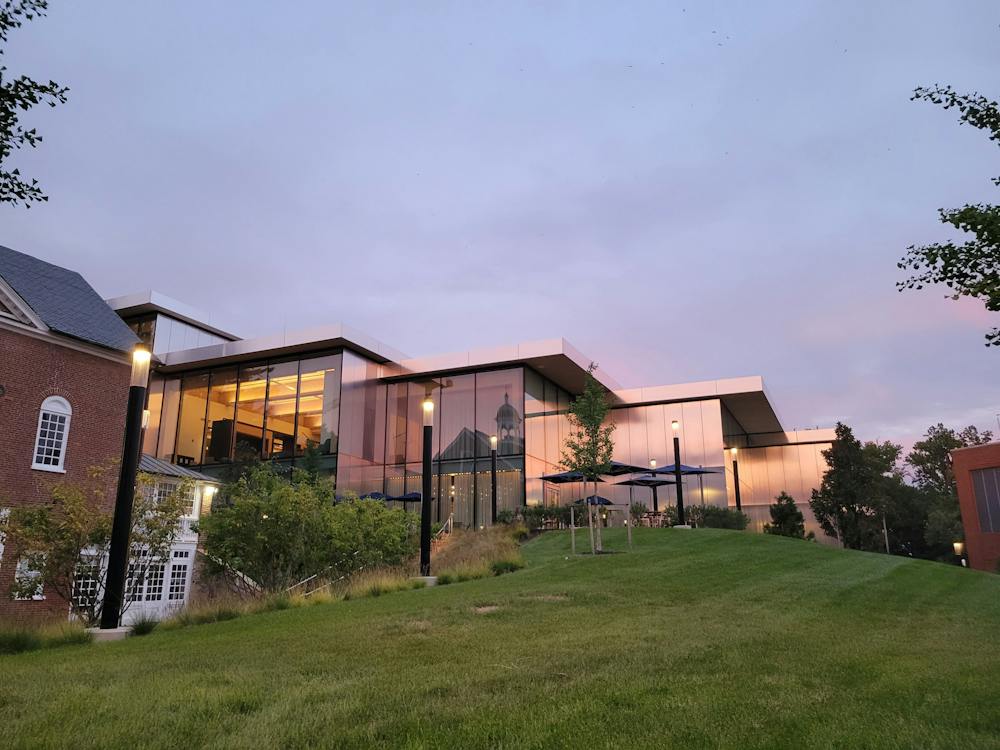
On August 25, 2026 Hopkins celebrated the one-year anniversary of the opening of the Bloomberg Student Center (BSC). The building was developed to serve as a centralized gathering space where students could eat, study and socialize, and, according to a University spokesperson, was designed with the goal of satisfying student needs. The origins of BSC, however, date back more than a decade. A presentation from 2014 that was recently emailed to The News-Letter laid out detailed plans for what would eventually become BSC.
University student centers are not a modern development. English universities like Oxford and Cambridge have had student unions since the early 1800s, while Houston Hall, built in 1896 at the University of Pennsylvania, was the first modern student center in the United States. Other universities followed this trend, establishing student centers throughout the 20th century.
The growth of student centers on college campuses nationwide reflects the increasing emphasis universities are placing on fostering student life outside of the classroom by encouraging students to to socialize. By housing dining halls, meeting rooms for student organizations, event venues and study spaces in one centralized location, student centers help promote a stronger sense of community.
Past student centers
Nonetheless, unlike its peer institutions, Hopkins did not establish a formal student center until 2025, a fact that the University administration was cognizant of while planning the BSC. Yet the problem that the BSC was designed to solve is nearly a century old. For generations, Hopkins lacked a formal, centralized gathering space. Some buildings emerged as informal student centers merely because they combined various functions, but none of them lasted as comprehensive student unions.
For instance, Levering Hall, which opened in 1929, had a cafeteria, meeting spaces, student publication offices — such as for The News-Letter — event spaces, social activities and more. Later, it became a space for civil rights activism and political discussion due to the work of Chester Wickwire, Levering Hall’s Executive Secretary from 1953 to 1984. However, Levering was originally built as a non-Hopkins affiliated YMCA and remained as such until 1969.
Merrick Barn, the building behind Brody Learning Commons, also served as a center of student life in the 1900s. Its three floors contained lunchrooms, a barbershop, The News-Letter office and theater performance rooms. However, following several donations in the 1980s, the building was renovated primarily for theater, ending its role as an informal student center.
In 2001 the Mattin Center was introduced as a building for the arts, including dance studios, music practice rooms, rehearsal spaces, Swirnow theater and the Digital Media Center. Similar to Merrick Barn, Mattin mostly served the arts community and was eventually demolished in 2021 to make way for BSC.
Charles Commons, now called Scott-Bates Commons, which opened in 2006, was also an effort to introduce more student spaces and to transform the area into a college town, like Georgetown or Harvard Square. However, the project faced mixed reactions by students and the nearby community, who criticized Charles Commons for being architecturally inconsistent with the surrounding neighborhood, concentrating more students in residential areas and limiting student independence due to its housing and dining model. Today, the building is a dining hall and second-year dorm.
For the most part, these various buildings did not fulfill the purpose of a student center like those of other universities. At other campuses, student centers were more than just a central space: they became the origins of campus movements. For example, Cornell students occupied their student union (Willard Straight Hall) in 1969 to protest systemic racism and the lack of a Black Studies program, and NYU students performed a similar occupation at their student center (the Kimmel Student Center) in 2009 to protest their university’s budget and tuition policies.
Ultimately, Hopkins fell short of creating true student centers with these attempts. Their solution was to create BSC. BSC today remains primarily a study area, contrary to the administration’s stated goal of creating a student union that would foster a vibrant community. However, with the renovation of the Eisenhower Library and the resulting shortage of study spots, students have had few alternatives.
In an interview with The News-Letter, Sophomore Aishani Garg explained how she mainly utilizes the BSC.
“I mostly use it for studying and the ambiance, and to get good local Baltimore food that’s better than the dining hall. I also like how we can rent rooms for our clubs,” Garg said.
BSC’s construction plan
Hopkins formally announced plans for a new student center in March 2019, when President Ronald J. Daniels introduced the project during a campus party on the Beach. The announcement followed a long campaign for a student center by the Student Government Association (SGA), which began in 2016 and included a formal proposal, a peaceful rally and a student referendum.
The administration framed the new student center as a response to student concerns. A University spokesperson described the process of planning BSC in an email to The News-Letter.
“Before design began, JHU partnered with a consulting team to conduct a year-long exercise to gather input from students about what they wanted in a student center. More than 1500 participants attended the 18 formal engagement sessions,“ they wrote.
However, in 2014, several years before SGA’s campaign, the University was already outlining plans for a student center similar to what the BSC is today. In a presentation emailed to The News-Letter from a trustee meeting held on December 11, 2014, the Hopkins administration identified the need for a student center and advocated for the creation of one.
“We heard: ‘There is no center of gravity for student life programs.’ ‘Students do not have enough spaces for fun.’... ‘Students lack a focal point.’ ‘Student services should be more accessible and consolidated,’” the presentation stated.
In the presentation, the University also examined student centers at other top-ranking colleges, emphasizing that Hopkins was one of the few in the top 15 U.S. universities without a student union.
“Our research shows that when compared to the Ivy+ and other peer schools, JHU's student life facilities are not on par with most,” the presentation stated.
The presentation also analyzed precedents at other institutions, examining the facilities each building had and displaying several pictures of their interiors and exteriors. Then, the presentation meticulously listed the pros and cons of current buildings at Hopkins.
In August 2021, the University broke ground on BSC. It was originally scheduled to open in the fall of 2024, but it was delayed to January 2025, and then to summer 2025. Four years after groundbreaking, BSC officially opened on August 25, 2025.
In an email to The News-Letter, a University spokesperson described the reasons for the multiple delays.
“During construction, far more bedrock was discovered on the site than anticipated. Additionally, to achieve sustainability goals and provide an accessible facility inclusive to all, the design team’s solution buried much of the building into the hillside, requiring more excavation than originally envisioned,“ the University spokesperson wrote. “Bedrock was chipped away in a manner that minimized noise and vibration so as not to disturb our students and the surrounding community, slowing construction as a result.”
BSC represents a significant change in student life at Hopkins. For nearly a century, students relied on buildings with specific functions – BSC was the first building formally designed to bring many of those pieces together under one roof. However, the history behind the BSC is complicated, from construction plans beginning in 2014 to student campaigns beginning in 2016. Today, a majority of students use BSC for studying instead of its intended functions. Ultimately, the role and legacy of BSC is still to be determined amid Hopkins’ long history of student centers.