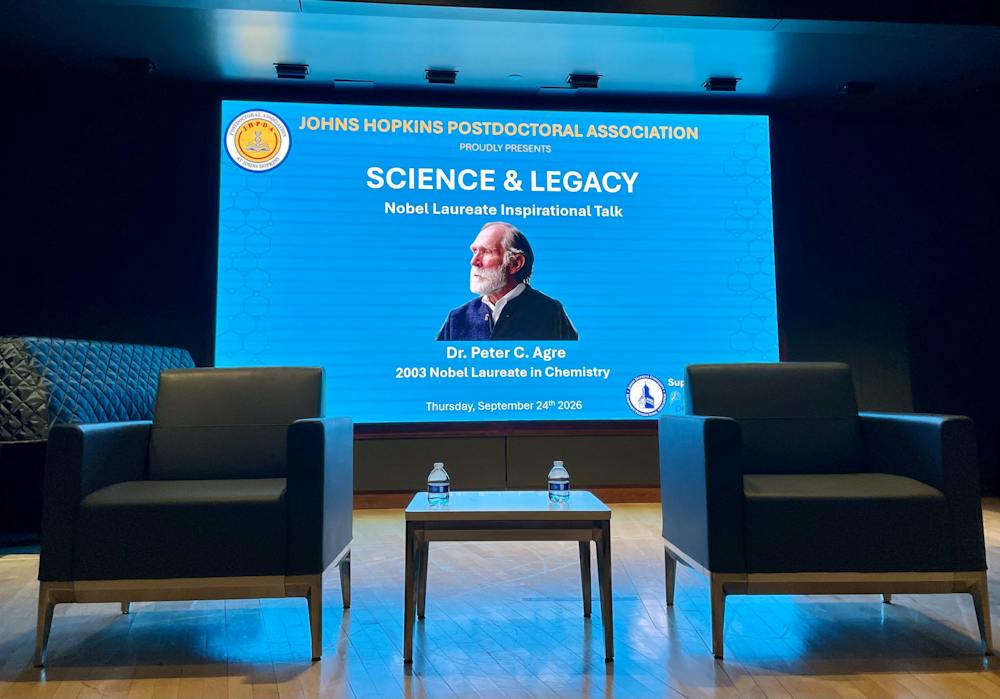
In 2003, the Nobel Prize in Chemistry recognized Peter Agre for his discovery of aquaporin water channels, which serve various essential functions throughout the human body, from concentrating urine in the kidneys to regulating water movement in the brain, eyes, skin and sweat glands. Yet, this breakthrough, so fundamental to our present understanding of the inner workings of life, was anything but the achievement of one scientist working alone. On Thursday, Sept. 24 at the National Postdoctoral Appreciation Week keynote at the School of Public Health, Nobel laureate Peter Agre reflected on his journey to the discovery of aquaporins and the irreplaceable human beings who inspired him along the way.
Agre opened his talk by challenging the notion of the Nobel Prize as the achievement of a lone scientist. After sharing a humorous anecdote in which he credited his wife for much of his success, Agre distilled his message into four words: “Nobody does it alone.”
Interestingly, one of Agre’s most consequential collaborators was not a scientist at all. It was luck itself. The path to unveiling aquaporins arose from an unexpected finding. His laboratory was studying red blood cells when they encountered a mysterious 28-kilodalton protein.
“The discovery of aquaporin[s] was a total serendipitous observation. Anyone who tells you there was genius is really pulling a fast one because it was an example where a scientist ran into a lucky observation that was not anticipated,” Agre said.
But chance alone did not elevate the mysterious protein into a scientific breakthrough. Rather than focusing solely on his own role, Agre repeatedly highlighted the mentors, postdoctoral fellows and collaborators whose observations pushed the research in unexpected directions. Notably, when Agre had first identified the mysterious protein, John C. Parker, his clinical mentor at the University of North Carolina at Chapel Hill at the time, recognized its prevalence in water-permeable biological systems and was the first to suggest the possibility of water transport across membranes.
“When I explained [to Parker] what this protein was like, and that it existed not only in red blood cells but renal tubules and in the roots of plants, it’s like a light bulb went on over his head. [Parker] smiled and said, ‘These are interesting because these are water-permeable membranes.’ I’d never considered water transport… and so we sought to test this hypothesis.”
With a possible function for the mysterious protein finally in mind, Agre turned to the next question: Could they prove that it actually transported water? Just as Parker helped provide the hypothesis, another collaborator would help produce the experimental evidence. Gregory Preston, Agre’s first postdoctoral fellow, helped perform the decisive frog oocyte experiment to test whether the mysterious protein could actually transport water, demonstrating a dramatic increase in membrane water permeability associated with expression of the then-mysterious protein.
“That was extraordinary… Greg’s enthusiasm and can-do attitude made it happen,” Agre emphasized.
Demonstrating that aquaporins could transport water was only the beginning. Agre and his collaborators next sought to understand where these channels were expressed throughout the body and what physiological roles they played. Søren Nielsen, a postdoctoral fellow from Denmark, became instrumental in connecting the newly identified water channel to kidney function.
“Søren was a brilliant scientist. He localized, with great precision, the locations of the aquaporin-1 protein. It’s in the proximal nephron of the kidney,” Agre recalled.
Nielsen’s work helped demonstrate how aquaporin-1 allows water to move across renal epithelial cells, contributing to the kidney’s ability to concentrate urine. But Agre and his team soon found that the family of water channels extended far beyond the kidneys. Namely, aquaporins transport water in the eye, brain, sweat glands, skin, adipose tissue and liver, demonstrating connections to cataracts, brain edema, thermoregulation, skin hydration and metabolism.
As the known functions of aquaporins expanded, so did the network of researchers Agre credited with uncovering them. Looking back at a photograph of his laboratory, he pointed to a group of postdoctoral fellows from eight different countries.
“They’ve all contributed in important ways to the story,” Agre said.
Beyond recognizing the researchers who contributed to the aquaporin story, Agre reflected on what emerging and experienced scientists alike could take away from his journey. Since serendipity played a central role in his own career, he emphasized that researchers can put themselves in a position to recognize unexpected findings.
“You can’t engineer luck. But to some extent, you can increase your chances by being technically observant... If something unforeseen shows up and you’re very careful, it might be important to take another look.”
At the same time, Agre cautioned against treating every unexpected result as a breakthrough. He suggested that scientific curiosity must be balanced with the willingness to let go of findings that cannot withstand rigorous testing. Accordingly, he emphasized the value of discussing uncertain findings with other researchers.
“Having colleagues you can talk to and get wisdom from expands the database that you have to draw from.”
In many ways, Agre’s advice reflected the same lesson as that of his account of the aquaporin discovery: science does not progress in isolation. The importance of collaboration also emerged in the broader celebration of National Postdoctoral Appreciation Week. During the event’s opening remarks, Johns Hopkins Postdoctoral Association Co-President Jose Francisco Delgado Jimenez highlighted the role of postdoctoral researchers and their mentors in advancing scientific discovery.
“Every day, postdocs enrich Johns Hopkins with countless ideas. Guided by our mentors, we develop research proposals, produce scientific publications, build collaborations and drive discovery towards a meaningful impact.”
Although Agre stood before the audience as the Nobel laureate whose name has become closely associated with the discovery of aquaporins, much of his story centered on the people who helped make that discovery possible. From an unexpected protein to a Nobel Prize, Agre’s journey echoed the four words with which he began his talk.
“Nobody does it alone.”