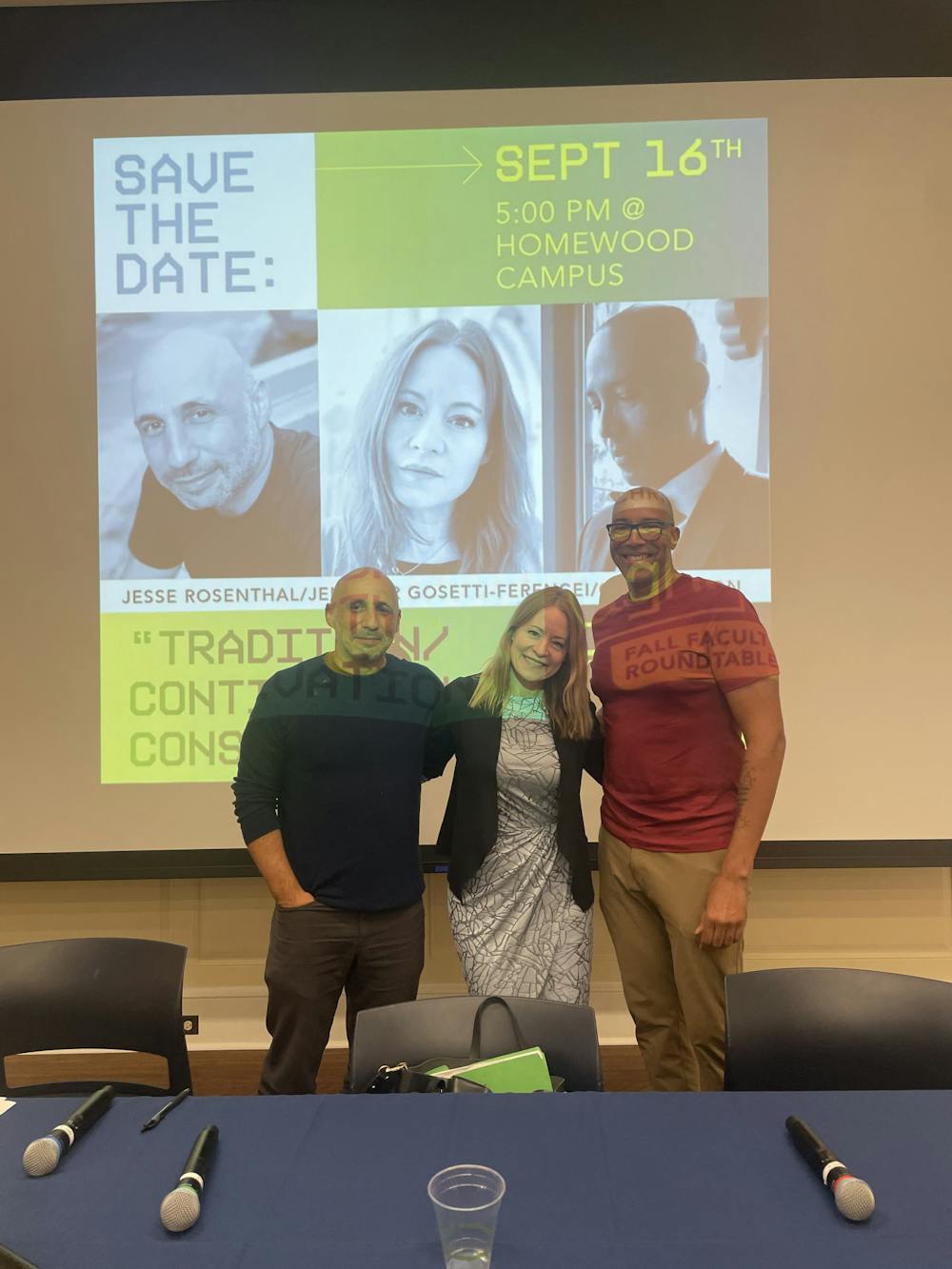
On Sept. 16, we gathered around for the 2nd annual Alexander Grass Humanities Institute (AGHI) roundtable. Despite the event being only two years old, AGHI director Jeanne-Marie Jackson hopes to make it a tradition, partly to encourage disciplines in the humanities to converse over foundational concepts, partly to have an excuse to hold cocktail-esque parties.
The theme for this year’s roundtable consisted of three parts: tradition, conservation and continuity. Jackson introduced the event and asked the panelists, each from a different department, to consider how any of the three concepts might have echoes within their fields. The panelists included Associate Professor Jesse Rosenthal of the English Department, Professor Jennifer Gosetti-Ferencei of the German Modern Languages and Literatures Department and Associate Professor Christopher Lebron of the Philosophy Department. Drawing on Christian theories of hermeneutics, German Idealism and virtue ethics, the discussion spanned from ancient Greek tragedies to 18th and 19th century novels, tracing a continuity across disciplines and throughout time.
The first speaker, Rosenthal drew from his specialization in the Victorian novel and novel form to analyze the etymology of the English word “tradition.” Much of his work studies literature of the 18th and 19th centuries, and the publication of his first book Good Form: The Ethical Experience of the Victorian Novel was covered by The News-Letter nearly a decade ago.
Rosenthal began with the multifaceted nature of his topic.
“Tradition,” Rosenthal said, “is the water we swim in, the tool we use, and the object we critique.”
What’s interesting for Rosenthal is how the concept of tradition has passed through all of these different identities throughout time. While the term has its first known use in 1384, but Rosenthal observed that its undergone massive changes in popularity in the time since.
“The very idea of a great tradition — the idea that a tradition, in any sense we understand it, is great at all — is not old-fashioned. It was strikingly new,” Rosenthal said. “The elevation — even the use in English — of the term ‘tradition’ was an innovation of the late nineteenth century and the early part of the twentieth century.”
For proof, Rosenthal compares the few and far between appearances of “tradition” in the works of Jane Austen, Charles Dickens and early literary criticism to the overwhelming use of the term in the published work of Professor Jackson, literary critic Frederic Jameson and himself.
What could explain the dark spot in use lying between its original conception in the 14th century and its popularity in contemporary criticism? Rosenthal traces the connection between “tradition” and Catholicism; starting in c. 1425, the word referred to “doctrine... which, though not explicit in the Bible, is believed to derive from the oral teaching of Christ and the Apostles and to be divinely revealed.” Tradition, relying on the divinity of priesthood, would’ve stood opposed to Martin Luther’s Protestant Reformation and the belief in sola scriptura.
Perhaps, Rosenthal theorized, there might be a connection between England’s Protestantism and the disappearance of the word “tradition” in English novels. He pointed out that when the word was used, it did not usually have the positive definition of a grand passing-on.
“Even George Eliot,” Rosenthal said, “through most of her career, used the term simply to refer to the superstitions and folk wisdoms of her rural characters.”
Tracing the associations of “tradition” throughout a period of English history, Rosenthal brought to the table varied literary and religious traditions pertaining to tradition.
On the other hand, Professor Gosetti focused her discussion on the other two topics: conservation and continuity. Her work combines literary study, philosophy of the imagination and the environmental humanities with methods of thought from 19th and 20th century Continental Philosophy such as phenomenology and existentialism. The themes of conservation and continuity appear in Gosetti’s two book projects at the moment, one of which is on the possibilities of creativity — the nature of imagination — and the other which is focused on critical ecology — the imagination of nature.
For the first book project, the question of continuity is important for the realm of imagination and its products — literature.
“Through imagination,” Gosetti said, “the literary work speaks across time, space and differences by evoking worlds that, while diverging in variable degrees from any real world, rely on familiarity with some world or other, and literature remains readable insofar as it still evokes dimensions of a common world.”
Thus, imagination is what carries and continues the “common world” into the space of a literary text, yet the creative aspect of imagination allows for a departure and discontinuity from this common world into something wholly new and un-real.
Naturally, conservation takes on a very particular meaning in critical ecology, the subject of Gosetti’s second book project. Continuity still plays a part; she analyzes the problem of imagining nature as discontinuous and separate from humans. In the time of the Anthropocene, it is indeed hard to imagine nature without the influence of humans, and a path forward in conservation requires understanding the continuities between the two.
Yet as much as the possibility of “becoming-animal,” as French philosophers Gilles Deleuze and Guattari would say, sounds somewhat hopeful, Gosetti cautions us against the belief that we can easily and wholly assimilate into nature. While writers and poets like Rainier Maria Rilke have attempted to capture the perspective of animals for our understanding, nature also has the agency to resist our stories about it. The history of humanity’s negative impact on the planet stands between an easy understanding of the two as one.
But the stories we tell about nature are nonetheless extremely valuable despite their possible pitfalls.
“Literature can be a resource for an ecological aesthetics responsive to the earth that avoids the hubris of claiming to speak for it,” Gosetti concluded.
Literature, it seems, can and must balance on the tightrope between continuity and discontinuity, speaking of without speaking for, while inching toward a deeper understanding of our world and what should be done with it.
Similar to Gosetti, Lebron approaches the themes with a perspective toward action and the future. Working primarily in political philosophy, Lebron specializes in “social theory, the philosophy of race, and democratic ethics.” Continuing the connection between shame and racial discrimination from his first book, The Color of Our Shame: Race and Justice in Our Time, Lebron looks back on Greek traditions of morality to help elaborate on the problem of racism in the United States today.
Lebron begins with an evocative formulation from African American writer and essayist James Baldwin’s “Down at the Cross/Letter from a Region in my Mind.” Baldwin finds something fundamentally wrong, a kind of ignorance, in the ethical disposition of white people; thus “whatever white people do not know about Negroes reveals, precisely and inexorably, what they do not know about themselves.”
But what consists of this ignorance? Lebron answers this question using political philosopher Alasdair MacIntyre’s After Virtue, which argues that modernity has lost the concept of certain ancient moral values, and that reviving an older vocabulary can help us describe our own ethical situation.
Taking up the tragedy of Oedipus Rex, Lebron argues for the ancient virtue of shame. Oedipus’ incestuous sins were not understood to him at the time as sinful and thus draw the shame of not understanding what one is truly responsible for. Yet when all is revealed, Oedipus understands himself to have not met his own standards of morality. Lebron finds a parallel in the contradictory situation of the United States.
“The most profound feature of racial inequality,” Lebron remarked, “is its presence in a society whose stated philosophical values explicitly deny the legitimacy of that kind of inequality.”
The United States’ contradiction in understanding itself to be liberatory yet acting otherwise — this is what Lebron diagnoses as shamelessness.
“Oedipus is in a sense completely free to live shamelessly, yet he is not free to live shamelessly and at the same time to live a good life or claim to have integrity, to be whole,” Lebron said.
Shamelessness lies in the hipocracy to act one way and claim another, but recognizing shame is an important motivator to act.
“The story of Oedipus makes clear that his shame is reflective and not present in his ethical make-up for its own end,” said Lebron. “It serves a distinct purpose which indeed turns Oedipus outwards: he is the cause of multiple catastrophes and he must find a way to respond appropriately.” The traditional virtue of shame becomes the way for a path forward; Lebron thus argues for freedom through tradition.
The roundtable ended with an engaging Q&A session and open socializing. If you happened to have missed this year’s AGHI Roundtable talk, you might find the tradition continued next year.