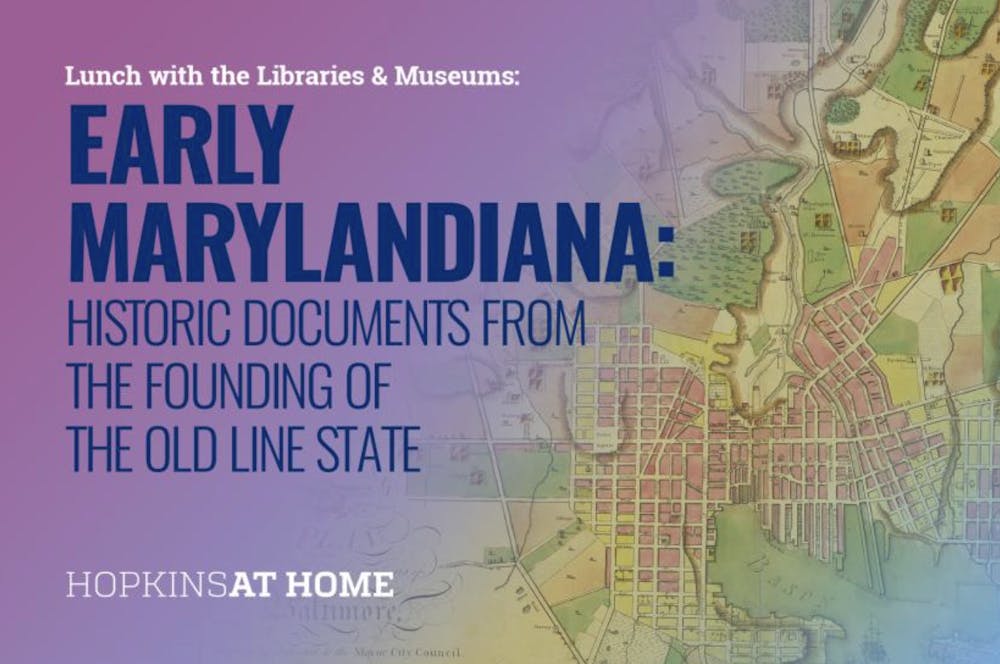
On Friday, April 10 the Virginia Fox Stern Center at Hopkins hosted “Early Marylandiana: Historic Documents from the Founding of the Old Line State,” as part of the Lunch with the Libraries & Museums discussion series. The talk focused on Maryland's colonial foundations and spotlighted selected historical documents and their role in explaining the state’s early history.
The presenters were Arle Havens, Isabelle Avci and Kathryn Stutz. Havens is the curator of rare books and manuscripts at the Virginia Fox Stern Center for the History of the Book at Johns Hopkins’ Sheridan Libraries. Avci and Stutz are both graduate students and Stern Center Graduate Student Curatorial Fellows at Hopkins. Avci is a Ph.D. candidate in the History Department, studying early history in Western Europe, and Stutz is a Ph.D. candidate in the Classics Department, studying ancient Greek and Roman narratives.
During the lecture, the presenters showed and analyzed various primary sources, including maps, novels and pamphlets from the John Work Garrett Library at the Evergreen Museum & Library. This specific collection highlights Maryland’s early colonial history, in celebration of the semiquincentennial, or 250th anniversary, of the signing of the Declaration of Independence and the sesquicentennial, or 150th anniversary, of the founding of Hopkins.
Havens began the event by explaining that Garrett aimed to collect any works published before 1700 that mentioned Maryland, expanding on the collection that his father had previously started.
“[Garett] built [his father’s 17th century collection of Maryland publications] to 209 [items] by the time of his death. Most of the books were bought individually at auction, except fora very propitious sale of the estate of a New Yorker who used to be a Baltimorean, and he nabbed 15 all at once,” Havens said. “These books are so incredibly rare, some of them exist in only a handful of copies, and they only exist in large part... at the Evergreen Museum and Library.”
Havens then showed a book from Garrett’s collection, Thomas Harriot’s A Briefe and True Report of the New Found Land of Virginia, which is one of the earliest known accounts of the Chesapeake Bay and Virginia. Havens described that Harriot traveled with John White, an illustrator, to document the lives of the Indigenous populations of Chesapeake Bay and Virginia.
Next, Avci transitioned into presenting a Dutch map from 1651 that shows competing territorial claims in the Mid-Atlantic coast. She emphasized that it can be interpreted as a different medium that presents similar ideas as Harriot’s book.
“It’s worth thinking of this — what we would call a map — almost as a text as well, because it’s giving the same information that Harriot is giving in a larger ethnographic work, but in these little visual snapshots,” Avci said. “[There are] representations of Indigenous technology. These canoes are labeled, and this is how they are made: the canoe is dug out and burned out with fire.”
Afterward, Avci displayed a later edition of John Smith’s The Generall Historie of Virginia. Because this edition was printed in 1632, the year of the chartering of Maryland, it includes all three monarchs who spanned the period of the founding of Virginia and Maryland. Avci specifically pointed out King Charles I, because Maryland received its name in honor of his wife, Queen Henrietta Maria.
When Havens asked Avci who the audience for this work was intended to be, Avci responded that on one hand, it is directed toward wealthy monarchs who had the money to support colonial efforts. However, on the other hand, it is also directed at anyone who could be persuaded to back John Smith’s efforts, as he often amplifies his own role, expertise and experiences in the book.
Avci then moved on to showing A Relation of Maryland (1635), which is a promotional pamphlet for Maryland that also includes copies of the charter. She explained that Maryland was chartered by King Charles I in 1632 and granted to Lord Cecil Calvert, also known as Lord Baltimore. His father, George Calvert, initially wanted to establish the colony, but he died just days before the charter was granted, which is why it went to his son, Cecil, instead.
Avci emphasized that the purpose of this work is to convince people to settle in Maryland. She described how the text included packing lists regarding the specific clothes, food and household tools people should bring to Maryland, emphasizing its practical purpose.
“And so we ask ourselves, well, what do these people know about Maryland while they are being asked to do this?” Avci said. “And this book is supposed to give [information] to them in simple terms and in great detail... [for example,] chapter seven is titled ‘Instructions and advertisements for such as shall intend to go or send to plant in Maryland’ [which is] very direct and clear.”
Finally, Stutz presented The Golden Fleece (1626) by William Vaughan. However, he wrote the work under the pseudonym “Orpheus Junior,” which is a reference to Orpheus, an ancient Greek poet who could charm all animals and plants. Stutz highlighted that Vaughan’s purpose was to market the New World as a perfect place that settlers should move to.
“What William Vaughn is doing is picturing [the New World] as [an] idyllic location, or at least a location that is a source of great wealth,” Stutz said. “The golden fleece in question is a reference to the story of Jason and the Argonauts... This particular image is what William Vaughn wants to imagine for colonization of the New World. It's a place where you will go and find a golden fleece to bring back and decrease the type of poverty that he's seeing around him in Wales.”
The last work spotlighted in this lecture was Robert Hayman’s Quodlibets, which translates to “Whatever you will” in Latin. Stutz explained that it is one of the first texts written in the New World, showing what life in the colonies was like.
The event concluded with a question-and-answer session.