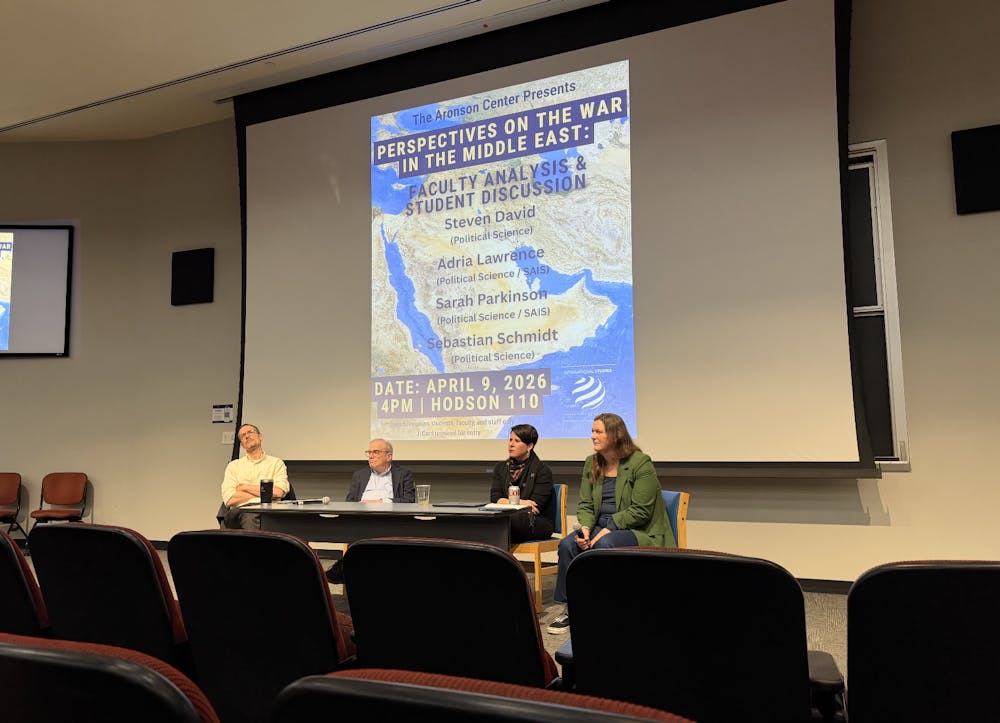
On Thursday, April 9 the International Studies program’s Aronson Center hosted a panel discussion titled “Perspectives on the War in the Middle East: Faculty Analysis & Student Discussion.” The discussion featured Steven David of the International Studies department, Associate Professor of Political Science Sebastian Schmidt, and Aronson Associate Professors of International Studies and Political Science Adria Lawrence and Sarah Parkinson.
The Aronson Center is an organization aimed at connecting Krieger School of Arts and Sciences undergraduates with the School of Advanced International Studies in D.C. Headed by Lawrence and Parkinson, the center regularly hosts events targeted at informing the greater Hopkins International Studies community regarding current events.
According to Parkinson, who organized and participated in the event, the purpose of the conversation was to consider the causes and implications of the war from a political science perspective.
“[We] put this panel together in part because, if you're talking about a war between the U.S. and Iran and an additional war between Israel and Lebanon, this is obviously a huge issue in global politics from a political standpoint, a military standpoint, a human standpoint, an environmental standpoint and a moral standpoint,” Parkinson said at the beginning of the discussion.
Each of the speakers then gave a short description of their views on the topic and how those views are informed by their area of expertise.
First was David, who began by mentioning that his early work focused on forcible regime change, a subject particularly relevant to the current war and, more broadly, U.S. foreign policy. He explained that the three main objectives of the war — denuclearization, regime change and military placidity — are distant and unlikely results given the current status of peace negotiations, despite his agreement that regime change is favorable. He concluded that diplomacy would have been a more favorable route.
David also discussed the importance of the closing of the Strait of Hormuz by the Iranian military as a tactical advantage that will be difficult for the U.S. to overcome.
“[Iran] can close the Straits of Hormuz, by which 20%, roughly, of oil and gas exits. It doesn't have to destroy every last ship, it doesn't have to have sophisticated weaponry, it doesn't have to have large numbers of troops — it can just threaten an occasional attack on an occasional tanker, and the straits are closed,” David said. “These are international waterways that are vital to the world, and now it seems to be in the hands of Iran. Thank you, Donald Trump and friends.”
Lawrence then gave an overview of her stance. As her studies are largely focused on comparative analysis, she described similarities and differences between previous U.S. invasions in the Middle East — namely in Iraq in 1991, Afghanistan in 2001, Iraq in 2003, Libya in 2001 and Syria in 2014.
The first similarity she cited was that U.S. presidents have consistently adopted anti-war platforms during their campaigns and early in their terms, while later in the timeline of the invasion they typically adopt more military-focused agendas.
“Once in power, the temptation to use American military might in the Middle East and North Africa has proven almost impossible for any president to resist,” Lawrence said. “We have a very powerful and big military, so when issues arise, it's easy to choose a military option.”
Lawrence also mentioned that regime change has been a consistent objective during these interventions, claiming that domestic unrest in the target countries has empowered administrations to exact invasions under the assumption that federal turnover will be simple.
“George W. Bush famously said that we would be greeted as liberators in Iraq. Donald Trump looked at the protests that happened in Iran and thought that it was plausible that military action would lead the Iranian people to overthrow the government,” Lawrence said.
On the unique factors present in the ongoing war with Iran, Lawrence described a lack of communication by the administration to Congress, strategy experts and the American people regarding the intention to strike, and therefore a lack of clearly articulated goals. She also noted a difference in rhetoric; while in the past, presidents have typically spoken about civilian casualties as something to avoid, Trump has repeatedly used the threat of targeting civilians for strategic purposes. Lastly, she mentioned the difficulty the U.S. faces in trying to achieve its goals, given the unique ability of the Iranian regime, compared to previous adversaries in the Middle East, to damage the U.S. in return, namely through the closing of the Strait of Hormuz.
“The goals were to destroy Iran's capacity to build nuclear weapons and to change the regime, and none of those goals have been achieved,” she said. “If anything, I could argue that they've been undermined, and that Iran, I would agree, is now negotiating from a place of strength.”
The next speaker was Schmidt, who researches the projection of U.S. military power through bases across the world and the organization of the U.S. military through the combatant command system. He described the cost calculations of the U.S. military, emphasizing a perceived pressure among authorities to utilize the resources and sites the U.S. has placed in the Middle East and elsewhere.
“After the first Persian Gulf War, you have long term development of logistic centers, of infrastructures, of massive radars, and the development of what's called a Combined Air Operation Center in Qatar,” Schmidt said. “There's no tight causal logic here, but we're involved in a lot of wars in the Middle East because we're there, because of the bases.”
Schmidt also described the structure of military action around secret leasing agreements of U.S. bases through executive action without the input of Congress, making it difficult to analyze the projection of U.S. power from a logistical standpoint.
Parkinson then began by discussing lesser-known issues related to the conflict from her perspective as a researcher of organization mobilization in geographic areas experiencing crises. She first mentioned how the war impacts global food prices.
“Approximately 35% of the world's fertilizer travels through the Strait of Hormuz,” Parkinson said. “You have fertilizer prices rising, which has implications for food prices, which has implications for domestic stability and our ability to eat the food that we like. This is already affecting farmers in the United States, they're already seeing the price of fertilizer rise — this is going to affect other countries as well.”
Parkinson also discussed the danger of the production and release of AI propaganda by the Iranian Military Guard, potential coordination between the Russian and Iranian military forces and humanitarian crises born from conflict.
Another student asked about public perceptions of the Trump administration and U.S. foreign policy in general, to which David responded.
“The last time Congress declared war was World War II, over 80 years ago, and Congress was vested with the only authority to declare war,” David said. “The fact that America has gone to all of these wars without congressional declaration is a real problem, not just for the Republicans, but for the Democrats as well.”
In an email to The News-Letter, Parkinson explained how the faculty participants were selected for the discussion.
“Some faculty we would have loved to have included weren’t able to make it on short notice, which is simply the reality at this time of the semester,” Parkinson said. “We’re extremely aware that no event can cover every aspect of the war and felt that scoping the event to political science and presenting a number of in-depth, experienced, research-based perspectives was one of many productive ways to organize a discussion.”
Lawrence expressed the importance of hosting the event in an email to The News-Letter, both as a means of summarizing the main issues involved and providing an opportunity for students to get involved in a scholarly discussion on the subject.
“I believe it is important to provide historical context to understand contemporary events, and that’s what I aim to do during the panel,” Lawrence said. “We also wish to provide opportunities for students to raise questions and offer their own comments. Dialogue on important events within the university community is crucial for understanding and thinking about war, including its cause, effects, and how citizens can respond to acts of the government.”
In an interview with The News-Letter, Charlie Langendorf, a freshman studying International Studies, explained what he learned from the event.
“I think a lot of our classes are focused on specific issues that don’t necessarily talk about current events, so it was really nice to hear the people and the professors that I respect from class talking about the stuff that’s happening today,” Langendorf said.
Chris Zhang, another freshman attendee intending to major in International Studies and Political Science, described similar takeaways in an interview with The News-Letter.
“It was a really good experience, there was a lot of diversity in the perspectives being given on the Iran conflict. Being able to hear all of them was really nice and really informative in regards to everything in Iran right now,” Zhang said.