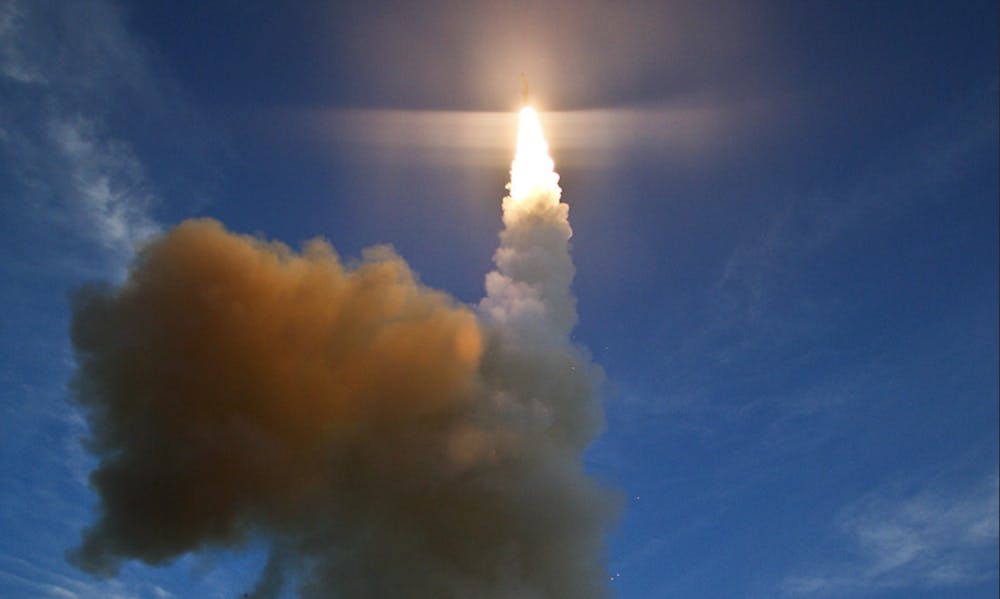
The Applied Physics Lab (APL) is a university affiliated research center (UARC) in Laurel, Maryland. Developed as a temporary institution in 1942, the lab was intended to create aircraft technology for World War II. Today, the APL continues to operate, working in the fields including but not limited to global health, cyber operations, missile development and spacecraft formulation. Their mission states that, in addition to working to improve scientific discoveries, they are organized to address “unique sponsor” needs and find solutions to the “nation’s most complex challenges.”
The APL receives around 67% of its federal funding from the Department of Defense (DOD). Some of the APL’s projects are released, but the vast majority of information about the APL’s work is classified due to its mission.
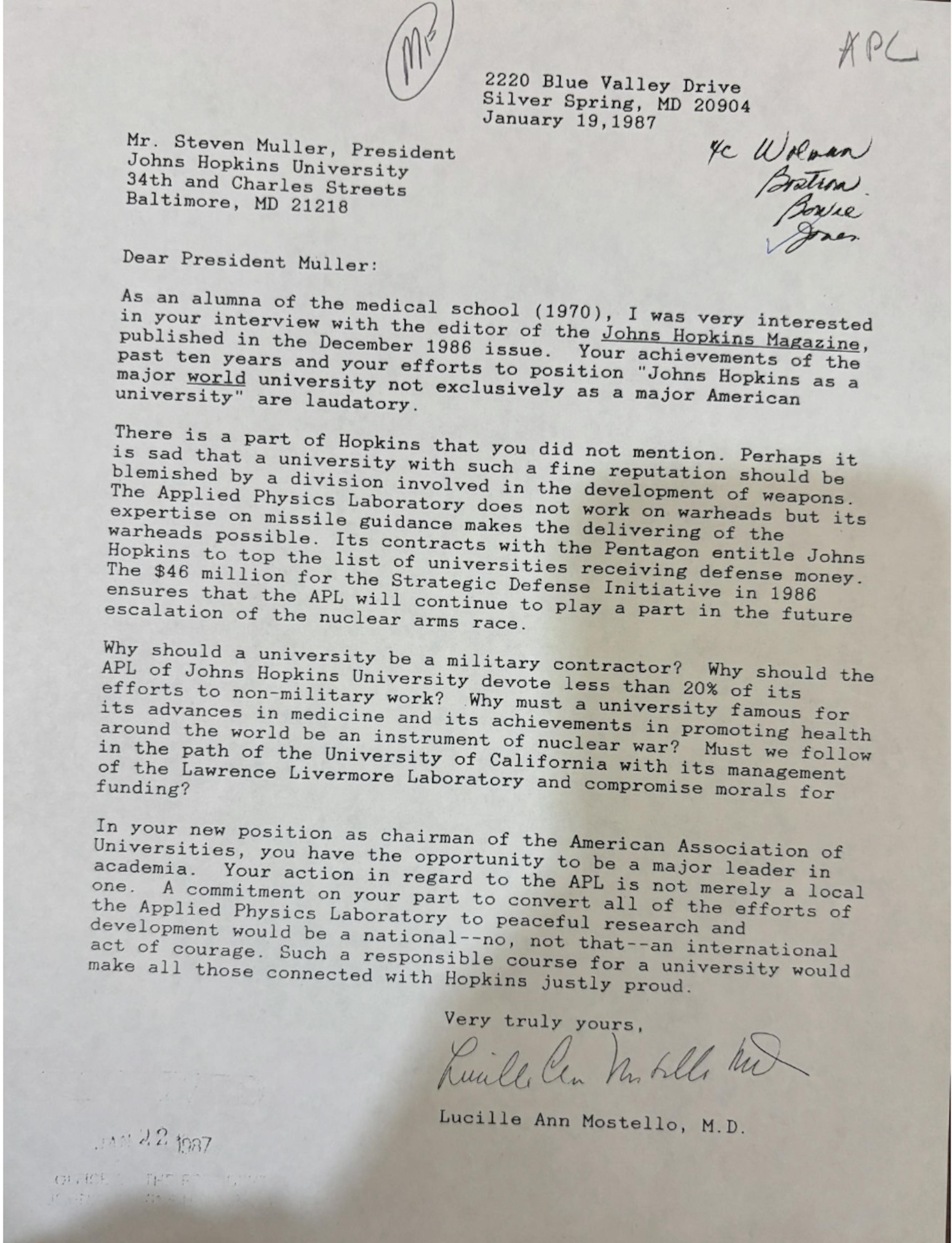
Due to its involvement in US military conflicts, the APL has generated controversy among some students and faculty in light of modern military conflicts, especially due to the APL’s affiliation with a University centered on health research. For example, in 1987, Lucille Ann Mostello, a School of Medicine alumna, wrote a letter to the former president of Hopkins, Steven Muller. Mostello claimed that the APL blemished Muller’s claim that Hopkins was “a major world university” and “not exclusively as a major American university.” Mostello described an alleged contradiction in Hopkins’ reputation as a leading health research institution and contributor to the creation of nuclear weapons through the APL.
COURTESY OF HONORA MURATORI
Mostello's letter to President Muller. This letter was obtained from the Office of Public Information/News and Information Records.
Even today, the language of “nation” in the APL’s mission contrasts the University’s mention of “world” in their general mission. Hopkins’ broader mission statement outlines the goals of educating students, encouraging research and bringing “the benefits of discovery to the world.”
A History of Protests
The APL has long been a student-criticized institution at Hopkins. In the 1970s, at the peak of the anti-war movement due to U.S. involvement in Vietnam, Hopkins students demanded the University to end its contribution to the U.S.’s “military industrial complex.” These demands included the dissolution of the Reserve Officers’ Training Corps program, responsible for training college students for a military career, and banning military recruiters from campus.
Students also advocated banning classified research and converting the APL into an institution invested in civilian research. Specifically, students called for diverting APL’s funding to “socially benevolent research” in public health. The University banned military recruitment following protests outside Levering Hall, but the demands for changes to the APL were not met.
Similar movements occurred across college campuses. In 1973, the Charles Stark Draper Laboratory divested from MIT after students demanded non-involvement. At Stanford University, the Stanford Research Institute shifted from military research to civil-oriented projects following student protests.
There were several protests against the APL from September 1986 to early 1987. An APL demonstration summary describes protests from November of 1986 to January 1987. Demonstrations occurred on November 11, November 26, December 22, January 6 and January 14. The November 11 and January 14 protests resulted in arrests for trespassing.
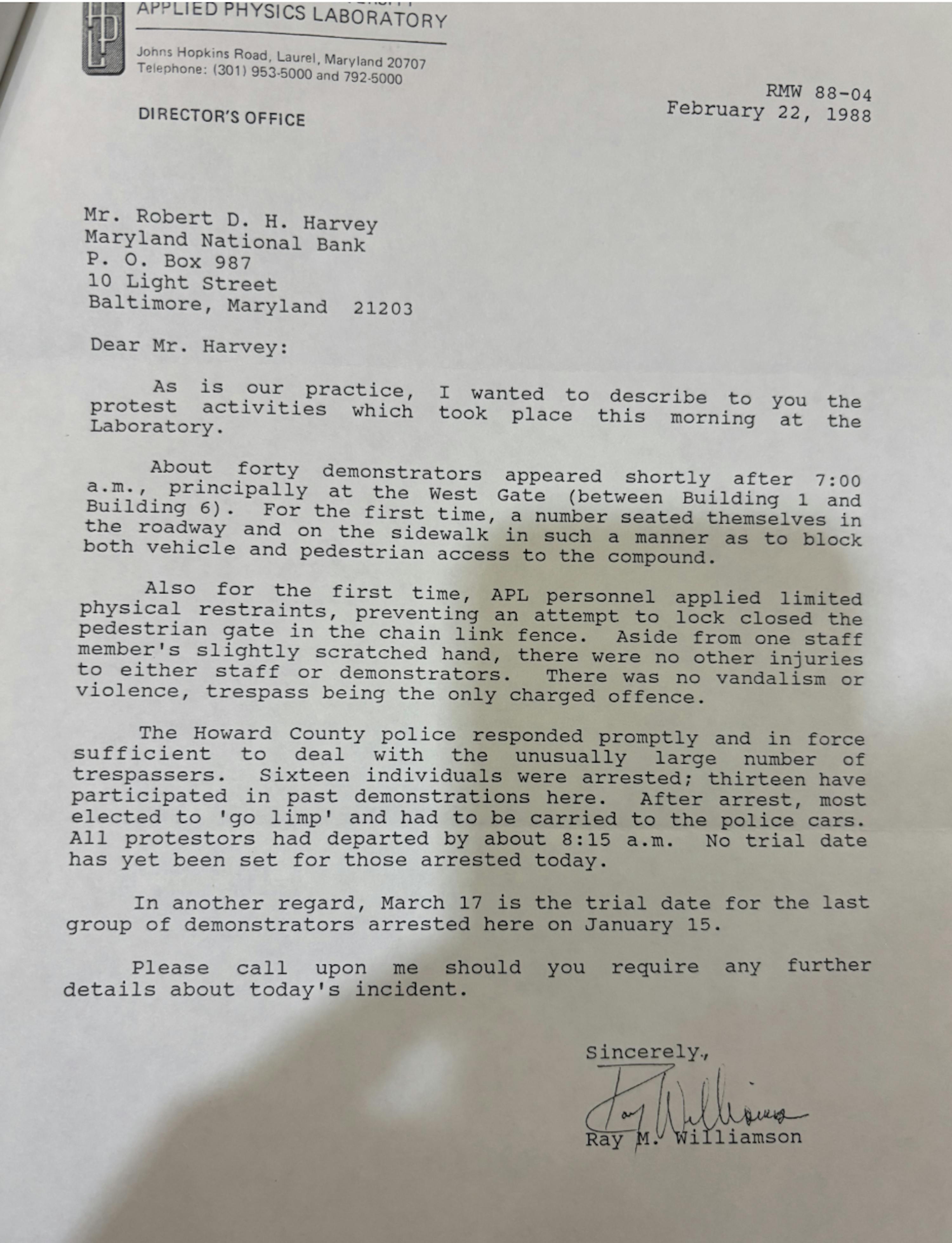
In February of 1988, another letter describes a 40-person protest where “APL personnel applied limited physical restraints” to demonstrators to prevent them from locking a gate. Sixteen protestors were arrested, several of whom chose to “go limp” and were carried into police cars.
COURTESY OF HONORA MURATORI
APL correspondence describing a 40-person protest against the institution. This letter was obtained from the Office of Public Information/News and Information Records.
Recent Controversies
On February 28, a U.S. military Tomahawk missile hit a school in Iran, with US officials stating their intention to hit a nearby naval base. The attack resulted in the deaths of 175 people, most of whom were children. Since then, it is estimated that the US has used over 850 of these missiles throughout the conflict. This has raised concerns about the possible depletion of the U.S.’s remaining weapon supplies. Other outcries point to the effects of the quantity of strikes as an indicator of humanitarian crises in attacked nations.
The development of the Tomahawk missile began at the APL in the 1970s. The missile was tested from 1976 to 1978, during the peak of the Cold War. The U.S. developed the missile, intending to counter rising Soviet military power. The weapon was designed to make precise and flexible strikes and was part of the U.S.’s larger movement to lower the risk of long-range missiles by eliminating the need for pilots. The Tomahawk was developed with terrain-following radar, GPS guidance and targeting updates.
In 2002, the APL announced that they “played a key role” in developing a new generation of Tomahawk missiles: the Navy’s Tactical Tomahawk. The APL reiterated that they “played a major role” in developing software that characterized the missile’s guidance, navigation, aerodynamics and communications systems. News of Tomahawk is not featured on the impact page of the APL’s website.
Due to the APL’s contribution in the Tomahawk missile development, a group of University community members (faculty, staff and students) has formally called on the University to start an investigation, with experts in international humanitarian law, into APL’s role in the February 28 attack. These individuals seek to understand if the APL’s research and technical support violates the principles of distinction, proportionality and precaution under humanitarian law conventions. The findings of this investigation are requested to be made public.
RTX Corporation, formerly known as Raytheon, is the current manufacturer of Tomahawk missiles. As one of the five biggest defense contractors in the US, RTX Corporation supports 90% of DOD and commercial space launches. In October of 2024, when the company faced charges for fraud and bribery, for inflating prices of weapons for sale to the U.S. and bribing sales in Qatar, they chose a deferred prosecution agreement. RTX Corporation paid the U.S. government a total of $950 million, avoiding a formal indictment. While the APL frequently works with the RTX, citing them as their primary contracting agency in several announcements, the extent of their involvement in RTX corporation affairs is not well-documented.
Upon asking University administration about recent controversies regarding APL’s contribution to the Tomahawk missile’s development, a spokesperson reiterated APL’s mission, as listed on the website, and directed attention towards previous public statements on the Tomahawk missile.
Some students have shared their unawareness of APL’s controversy, stating their primary knowledge comes from the University itself. A sophomore Mechanical Engineering major, choosing to comment under the pseudonym “Lindsey,” described their limited knowledge of the APL in an interview with The News-Letter.
“I know the APL is research-based and involved with defense and aerospace,” Lindsey said. “[Hopkins] markets the APL through the Life and Design Lab.”
In an interview with The News-Letter, another student, a freshman Chemical and Biomolecular Engineering major, choosing to comment under the pseudonym “Alex,” shared their knowledge based on being on APL’s mailing list.
“It’s really good for internships for engineers. We need to try to get the internships because it's really competitive,” Alex said. “It also gets a lot of funding from the government.”
The student did not know any connection between the APL and the US’ current war in Iran.
Approximately half of Whiting engineering students on the professional track go into aerospace or defense after graduation. According to the Imagine Center’s “first destination” survey, the top employers for these Whiting graduates are BAE Systems Inc., Boeing, Collins Aerospace, the DOD, the APL, Lockheed Martin, Northrop Grumman, Raytheon Technologies, RTX Corporation and the U.S. Navy. The APL’s recruitment of Hopkins students operates within the context of broader patterns of University and national defense collaborations. APL’s recruitment methods promise innovative opportunities and experience with technical projects with “real-world impact.”
Janvi Madhani, a PhD candidate in astrophysics and community organizer, spoke at an “Extractive Histories of Johns Hopkins” panel at the Homewood Friends Meeting House. Madhani spoke about how APL has furthered imperial ambitions and how University students must understand APL’s connection to the broader institution.
“I think it's really important for people to research what the APL has been complicit in, and not even complicit, but what the APL has manufactured. I think the story is really clear that Hopkins has been a primary manufacturer of U.S. imperialism – I think that's a really important narrative for students to know before they join Hopkins, when they join Hopkins, while they work at Hopkins,” Madhani said. “It is to know that what you are contributing to is a very explicit relationship with U.S. imperialism. These warfare technologies have been used everywhere. These are very active contributions to this project of empire.”