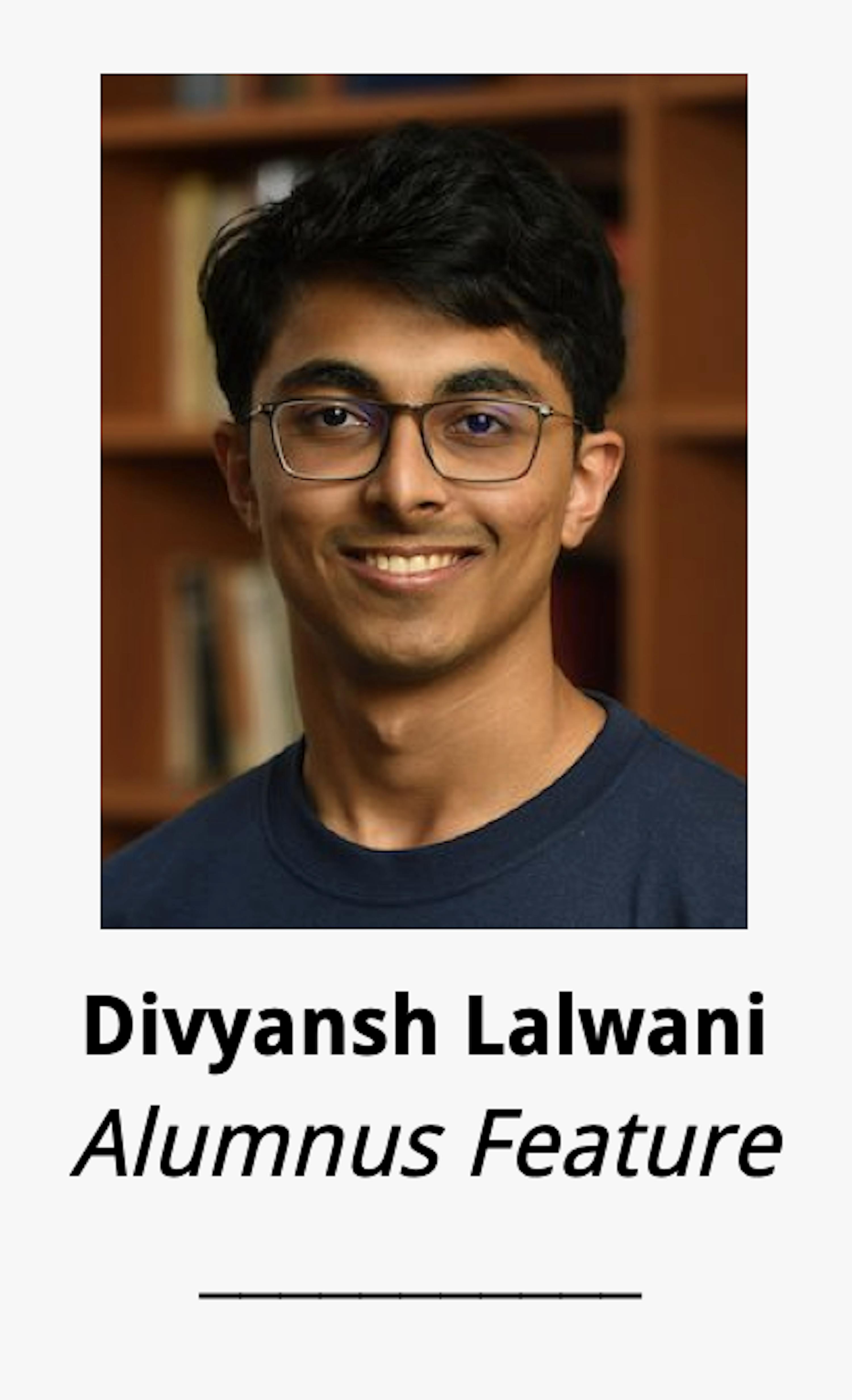
Divyansh Lalwani, a recent Biomedical Engineering and Applied Mathematics and Statistics graduate, recently released “overlay,” a software that reduces the effort that comes with switching screens by relying on overlays, content that lays on top of the overall screen. In an interview with The News-Letter, Lalwani described the program and the journey that led to its creation.
Lalwani became interested with entrepreneurship in his junior year, specifically connecting it with his existing interest in brain-computer interfaces and the bandwidth and the throughput of communication, increasing communication on an interface level.
“I was into the AI boom, pretty early on, training classifiers, like in high school. [So, I thought] anything adjacent with bridging traditional software as a service with something AI would be really cool. Then, I thought, ‘Okay, why not make a transcription service, where I could press a hot key anywhere on my operating system and just speak into my computer, it would just get typed out?’ I think that would save a lot of time,” Lalwani said.
Through this experience, he was able to develop his software skills that eventually assisted him in creating his first app, AutoQuill.
“AutoQuill was this open-source version of this other app that I really liked at that time called Wispr Flow, so I built a fully feature-rich app, made it open-source, launched it on social media and got a good bit of traction,” Lalwani said.
To continue expanding on AutoQuill and meet new people in the software space, Lalwani spent the summer of his junior year in San Francisco. One feature he worked on was extending the voice capabilities of AutoQuill.
“My thesis then became, ‘Okay, I've already made the way you communicate with the computer [to have] higher bandwidth. How do I make it so that when you use your computer, when you use your computer, you do more useful work in less amount of time, increasing the bandwidth of interaction with your computer?’” Lalwani explained.
Lalwani pinpointed context-switching as a major obstacle in reaching optimal productivity, specifically in the situation of switching tabs and navigating through the windows present on a screen. One solution could be having multiple monitors, but Lalwani acknowledged the financial cost of such an option with the need for switching still present.
Instead, with overlay, Lalwani decided to focus on overlays to reduce the friction of switching between contexts. overlay has four overlays: speech, notes to quickly jot down thoughts without switching screens, an AI chat and lastly, a browser.
“How do I make it so that I only get a window when I want it without covering my entire screen that I’m currently working on, and I can make it disappear when I don't want it [anymore], so cognitive load isn't completely transferred to another window? That’s the power of overlays. They appear when you want them there, and you can just hide away when you don't want them there. And that's what my vision is with overlay, as overlays are probably the best way to reduce the friction in the current work that you're doing.” Lalwani said.
One of the next steps for Lalwani include increasing the number of users for overlay to get as much feedback as possible to tweak and improve the software based on the users’ experiences. He targets 10,000 users at the moment.
Lastly, Lalwani offered some advice for similar aspiring software engineers and entrepreneurs.
“There's a lot of noise that comes with trying to build something, and you want to incorporate so many things [that] you don't know where to start, but it's never been easier to find answers. It’s much harder to ask the right questions like ‘What should I build?’ or ‘Who do I want to help?’ and ‘How can I build the most useful thing that I can possibly build, not just in line with my skill, but also my values?’ So, interfaces were super central to what I wanted to work on, and developing software that directly does that is very gratifying,” Lalwani said.
Lalwani also encouraged the option of taking an unstructured gap year or summer to meet new people, go around and build new projects. He especially recommended San Francisco as a place to grow and learn, as Lalwani credited his time there during the summer after his junior year to be formulative for him.