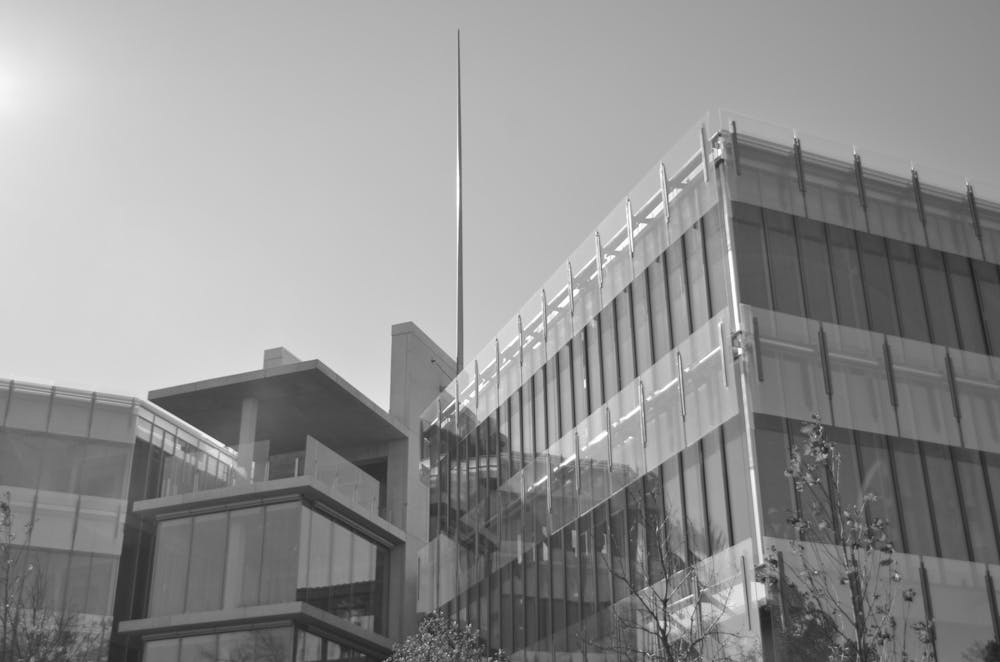
The Stavros Niarchos Foundation (SNF) Agora Institute describes its mission as follows: to “support open dialogue, active debate, and collaborative efforts to address public problems” and to “strengthen democracy through these efforts.” Its Visiting Fellow program aims to support this mission by providing selected candidates with funding to pursue independent projects designed to promote democracy. This year, Johnnie Moore, head of the Gaza Humanitarian Foundation (GHF), a controversial aid outfit condemned by humanitarian groups for its militarization of assistance for civilians, was selected as a 2025–26 SNF Agora Visiting Fellow.
Moore’s appointment has faced backlash from the Hopkins community. Students have demonstrated, circulated petitions and emailed the institute’s director, Hahrie Han, to call for the immediate revocation of his fellowship. As University administration remains unresponsive to criticism, The News-Letter wishes to echo the concerns of the student body. Johnnie Moore’s appointment as a Visiting Fellow and the SNF Agora’s refusal to engage with student concerns are antithetical to the democratic values that the institution purports to uphold.
The GHF, which closed in December 2025, was under scrutiny from the international community due to its lack of transparency about its funding sources and its close association with the Israeli government. Prior to the start of the GHF’s operations in late May 2025, aid distribution sites in Gaza were run by the United Nations (U.N.). However, these U.N.-backed sites faced allegations from the Israeli government that Hamas was diverting large amounts of its aid, ultimately resulting in its replacement by the GHF. According to the U.N., over 859 people were killed near GHF distribution sites as of August 2025. Over the course of its operations, food distributions were managed by private, anonymous entities and were located in areas that required recipients to travel long distances to reach, rendering them vulnerable to gunfire and attack.
As the leader of a foundation that has faced widespread condemnation from humanitarian organizations, Moore does not uphold the mission of SNF Agora or the University as a whole. As chairman of the GHF, he is directly associated with the deaths of hundreds of civilians. These accusations raise important questions about his commitment to impartiality in the distribution of humanitarian aid and, thus, his commitment to democratic values.
SNF Agora has also demonstrated a limited adherence to its own commitment to civic engagement by ignoring student concerns. While administrators repeatedly emphasized their commitment to dialogue, they declined to answer substantive questions that students raised about Moore’s appointment as a Visiting Fellow.
While Han attended a Student Government Association (SGA) meeting on Nov. 11 to discuss concerns about the matter, she refused to comment on the specifics of Moore’s appointment. During the meeting, she explained that she hadn’t responded to over 50 student emails advocating against Moore’s presence on campus, as they had gotten lost in her spam folder. Furthermore, in an interview with The News-Letter, junior Eli Lesher shared that he emailed Han six times in mid-November to schedule a meeting. According to Lesher, after he elaborated on his concerns and raised a question during the SGA session, however, Han canceled the meeting and did not respond to further emails.
The institute’s lack of response to criticism subverts its commitment to civic engagement. For an administrator tasked with facilitating dialogue, allowing dozens of emails from concerned students to slip through the cracks suggests a deeper issue of neglect and irresponsibility and institutional carelessness, all of which undermine SNF Agora’s commitment to dialogue. These incidents also raise larger questions about the institute’s openness to constructive criticism. It currently does not provide a reliable avenue through which the student body can raise concerns about its operations. Implementing a student advisory board, which used to exist before the pandemic, as Han mentioned in the SGA meeting, would be a significant step in addressing this problem.
A fellowship appointment at Hopkins carries significant institutional weight. SNF Agora fellows are not only endorsed as voices that are aligned with the institute’s mission, they also represent the University publicly. Due to this visibility and legitimacy attributed to Visiting Fellows, appointments to the fellowship demand clear, substantive criteria. Without ethical standards, the fellowship risks becoming detached from the values that it is meant to uphold.
Political involvement alone should not disqualify someone from the fellowship. As students have emphasized, political affiliations do not delegitimize a candidate, but rather the ethics of their actions. Moore’s humanitarian crimes are not in accordance with SNF Agora’s commitment to democracy, both because they violate a core ethical standard and because they demonstrate a clear lack of neutrality in aid distribution, which is contradictory to values of democracy.
The absence of ethical standards has real consequences. Without clear expectations for fellows, students are left without a framework to understand or challenge appointments that appear to contradict the institute’s mission. Establishing transparent, mission-aligned criteria would not only strengthen the legitimacy of fellowship appointments but also reaffirm SNF Agora’s stated commitment to dialogue, accountability and civic engagement.