On Thursday, Feb. 5, the Center for Social Concern (CSC) held a discussion on Rebecca Skloot’s The Immortal Life of Henrietta Lacks as part of its Hop Talks series. The event was held from 6 to 8 p.m. in Levering Great Hall.
Willow Goode, the civic life specialist at the CSC, introduced the event.
“The books we choose are chosen with intention,” she said. “Since Baltimore is our community and our home, we prioritize work that reflects the lived experiences of the people [in our community].”
Goode then directed the attention of the attendees to cards that were on each of the tables. Each card had a list of constructive dialogue principles. The principles included letting go of winning, getting curious, sharing stories, navigating conflict with purpose and finding what is shared. Goode asked that everyone abide by these principles throughout the discussion. Additionally, there was a member of CSC staff at each table to guide the discussions.
Jellema Stewart, the associate director of community engagement at the CSC, served as a guide at one of the tables. She read through the questions that each table was prompted to work through.
Did you know of Henrietta Lacks prior to coming to Hopkins?
Bella Rowe, a junior at Hopkins, said she read “The Immortal Life of Henrietta Lacks” when she was in 10th or 11th grade after she got the book as a Christmas gift.
Siyeon Joo, a freshman, also read the book in high school when she was living in a majority Black community in Louisiana while attending a majority white school. This experience informed and complicated her reading. Since coming to Hopkins, she admits that she is reminded of the book’s stories about Hopkins as a medical institution whenever she goes to the medical campus.
Stewart was surprised that students had been exposed to Lacks’ story so early in their lives. Stewart attended a liberal arts university in New York and lived in Buffalo afterward. There, she felt the racial segregation deeply; Buffalo is considered the sixth-most-segregated city in America. Stewart decided to move to Baltimore to raise her son. She explained that it was important to her that he grew up in a city where people had conversations about the city’s general history and Black history.
The conversation transitioned to a discussion about Hopkins’ new East Baltimore Bloomberg School of Public Health building. Participants discussed how the massive construction project is taking place surrounded by infrastructure that requires money and care.
Ashwarya Sharma, a graduate student at Hopkins, pointed out that Hopkins’ medical campus sits in a predominantly Black community, as will the new public health building. Sharma talked about taking the bus from Charles Village to the medical campus and seeing members of the community yell expletives at Hopkins buildings. Members at the table emphasized the need for Hopkins students, faculty, staff and administrators to do community outreach that involves listening to community members’ needs.
As a member of the Hopkins community, how did this book change or deepen your perspective on the institution’s historical relationship with Baltimore?
When Stewart asked if students felt like they were part of the problem, each one said that they felt guilty. Kirsten Amematsro, a junior at Hopkins, explained that she felt pressure to make change as a student in Baltimore.
Joo, who is considering transferring to a different university, explained that she wishes she had understood the extent of the fraught relationship between Hopkins and the Baltimore community before she had committed to studying here. Although she recognizes the important effort that entities like the CSC are making, she wishes the university administration were bolder.
“I want them to do more,” she said. “I want Ron Daniels in the streets.”
One of Joo’s biggest criticisms of Hopkins is that its students become educated without learning how to be socially conscious. This is particularly concerning to her when it comes to preparing future medical experts — people with jobs that involve practicing ethical research and patient care.
Amematsro commends her professors who talk about Hopkins history. However, she does not think that learning about this is enough to prevent Hopkins from making the mistakes it has made in the past. Amematsro brought up Hopkins’ new AI building, its environmental consequences and the community outrage it has inspired.
“We’re repeating history,” she said. “The Baltimore community is so mad at us. This is the exact problem we’ve always had.”
Stewart reminded the students to think about whom the new Hopkins establishments serve. Participants were especially interested in discussing the location of new Hopkins buildings as a method of acquiring a certain demographic of patients.
Stewart also encouraged students to be cognizant of how they feel when they travel through different communities because how they feel is likely similar to how neighborhood residents feel. When Stewart takes students to different Baltimore First sites, she asks them to look out the bus or car window as they travel. She believes there is a lot to be gained from simple exposure.
How do we see the legacy of Henrietta Lacks in the current dynamics between Hopkins and the Baltimore community?
Sharma explained that throughout her experience studying medicine, she has found that the medical community’s knowledge often leads back to research using Lacks’ cells. It pains her that the field of medicine could benefit so greatly from Lacks’ body without giving anything back to her or her family.
Coming from California, Sharma also explained that Baltimore’s complicated racial history is present everywhere.
“I can feel that segregation used to be a thing here,” she said. “I’ve never felt a community that’s as tumultuous as Baltimore before.”
Joo spoke about the Legacy Project, an organization that allows volunteers to record the oral history of elders in a senior center. Joo recently learned that the senior center is in the building in which Henrietta Lacks grew up. Participating in this project is one way that Joo hopes to preserve the legacy of other community members.
Stewart emphasized her belief that understanding history matters for whatever field you’re going to go into. She also stated that if you graduate as the same person as when you started college, you are going about your education wrong. She was hopeful about legacy preservation after seeing the student turnout at the Hop Talks event.
“The fact that you’re here shows me it hasn’t ended,” she said.
What should retribution look like for Henrietta Lacks and her family?
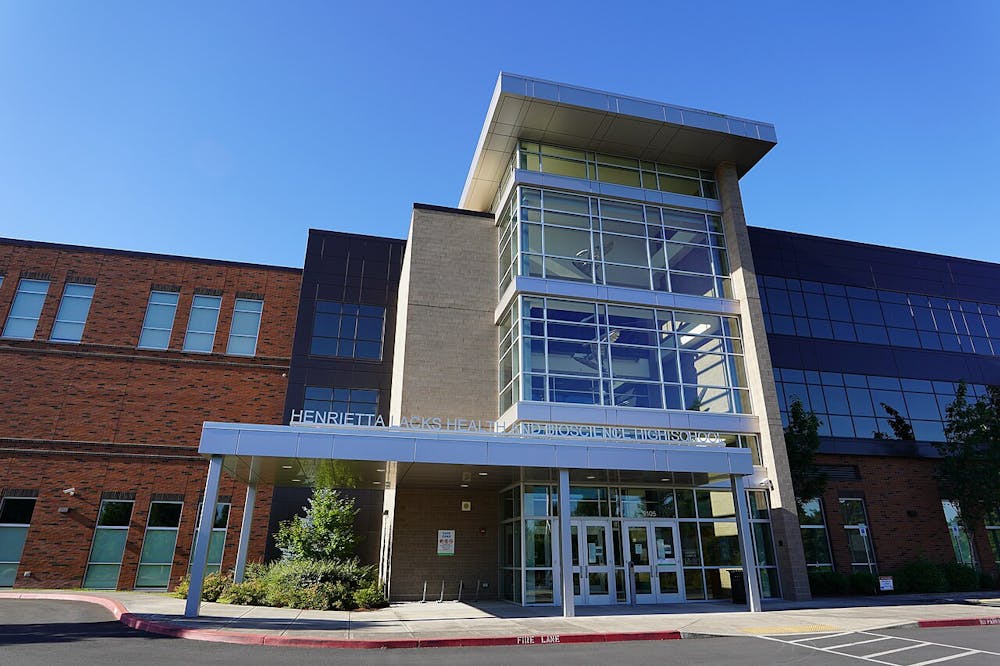
Sharma recently learned about the Henrietta Lack building on Hopkins’ east campus. Everyone at the table agreed that, although a symbolic effort is important, the building does not seem like an adequate gesture to offset past injustices.
The Legacy of Henrietta Lacks page on the Hopkins Medicine website, celebrating the new building, first states that “Johns Hopkins Hospital was one of only a few hospitals to treat poor African-Americans,” claiming to be progressive for treating Black patients. Then, rather than admitting failure for their role in Henrietta Lacks’ exploitation, Hopkins describes their role passively while emphasizing the impact of the use of Lacks’ cells.
Stewart wondered if complete retribution will ever be possible. The table discussed the possibility of more visible symbols, like a statue. They also explored ideas like scholarships and policy initiatives that would promote diversity at Hopkins.
Amematsro discussed the possibility of emphasizing community engagement during orientation. She recalled learning about the “Black Butterfly” in Baltimore, a concept that describes the racial segregation along district lines. Amematsro considered what it would look like to provide freshmen with action steps in addition to a historical overview. Stewart wondered if something as simple as a “common read,” a book read by all the freshmen over the summer before orientation, could help educate and unify the student body.
The event concluded with an exit ticket that prompted attendees to reflect on the skills they used, the information they learned, and the questions they still have.
In an email to the News-Letter, the CSC offered a candid explanation for one of the purposes of this Hop Talks event. By discussing Henrietta Lacks, the CSC hopes to directly address the intersection of the consequences of the university’s research with its accomplishments. What makes the university complicated is that these two factors are inseparable.
“JHU has accomplished groundbreaking medical innovation alongside significant harm, exclusion, and mistrust, particularly within the Baltimore communities,” they explained. “The story of Henrietta Lacks is one example of how medical progress often came at the expense of marginalized individuals who were denied autonomy and recognition.”
Editor’s Note, 2026: A previous version of this article contained a misspelling of Amematsro’s surname. The News-Letter regrets this error.