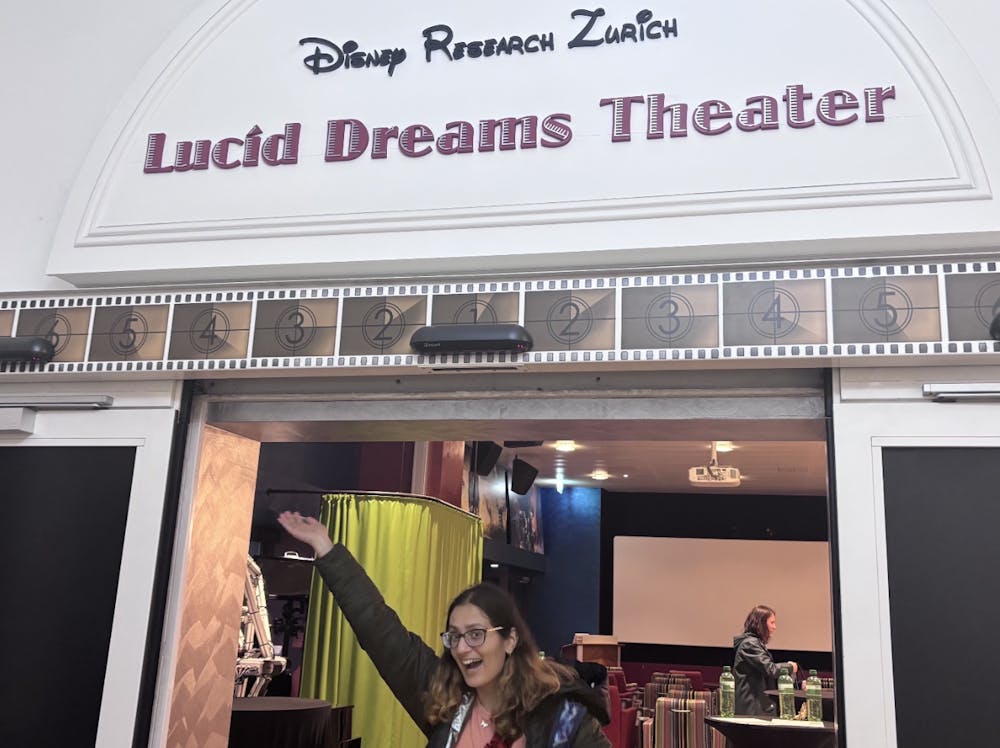
Ikshu Pandey is a postbaccalaureate research assistant at the Rowland Institute at Harvard and a Fulbright recipient committed to studying the nexus of neuroscience and materials science for medical innovation. She is also dedicated to fostering equity in STEM and healthcare through her global advocacy work. In an interview with The News-Letter, Pandey reflected on her passion for interdisciplinary research and the effect of Fulbright experience, which have solidified her desire to create collaborative, globally informed solutions in neurodegenerative disease and healthcare engineering.
The News-Letter: What inspired you to apply for the Fulbright program, and was there a defining moment that made you commit to pursuing it?
Ikshu Pandey: I started Hopkins in 2020, so we were part of the COVID class. If there was a time for me to study abroad, it would have probably been my sophomore year because I was a Neuroscience and Materials Science and Engineering double major on the pre-med track. So, [sophomore year] is the only sweet spot for studying abroad, before you go too in-depth into your electives because those are the classes you can take abroad. However, because of COVID, I could not.
The second big thing is, after reaching graduation, I decided not to apply straight to medical school because I wanted the opportunity to utilize my dual major skill set and kind of explore if I'm going to be pre-medical, MD, or PhD. I wanted that opportunity to apply my skillset. I talked to my Principal Investigator (PI) at Hopkins about it and he recommended me to look into some opportunities abroad.
One of the major things I wanted to do was research, particularly research at the intersection of neuroscience and materials engineering. Just like I had done at Hopkins. I really committed to it when I found a PI in Switzerland who matched my interests and proficiency in language. I have advanced French proficiency, and I wanted the opportunity that I missed in undergrad to study abroad. I also wanted that work experience and a trial run of what a researcher full-time would look like.
I did a lot of research throughout my undergraduate years, even throughout my summers. But that's different from having a project that you can devote your energy to full-time. I'm also incredibly passionate about healthcare, healthcare inequities and representing marginalized populations after being in Baltimore. I was curious as well to see if the healthcare inequities I saw in Baltimore transitioned to a place like Switzerland, even if Baltimore and Switzerland might not have a lot in common (at least from an outside perspective).
In Baltimore, I created an organization called StigMed to help and wanted to interact with a healthcare system in another country. It was a good mix of the MD-PhD experience and just aligned well with my proficiencies in language and extracurricular interests. That's why I decided to pursue the Fulbright.
N-L: Could you briefly walk me through your Fulbright project and research focus?
IP: [During my undergraduate], I studied blood-brain barriers from a neurodegenerative perspective and looked at characterizing the barrier in response to aging and Alzheimer's disease. This was important because in Fulbright, I studied brain barriers from a neuroinflammatory perspective, which was [in relation to] Alzheimer's disease. [Both these perspectives] were two sides of the same coin because neurodegeneration is in tandem with neuroinflammation. These things both exacerbate each other and relate to each other in general.
For my Fulbright project, I was studying the choroid plexus brain barrier in Alzheimer's disease. The reason I chose this is because it's historically overlooked. People do look at the blood-brain barrier and [its capacity] as a shuttle for getting drugs into the brain. Furthermore, I was studying the choroid plexus barrier as an area where there can be neurodegeneration, inflammation and a potential pathway contributing to the mechanisms of Alzheimer's disease prior to clinical presentation. This is crucial to investigate because many tangles and plaques that have been clinically removed haven’t been able to ameliorate the symptoms of the condition. So, it's our hope that studying these changes [and choroid plexus brain barrier] beforehand could be used as biomarkers or shed light on the processes happening before.
N-L: How has Hopkins supported your research exploration and independence?
IP: One of my favorite parts about Hopkins is how everyone has access to research as soon as they say they want to. In my case, that was when I came to campus my freshman spring semester. I was in Prof. Peter Searson's lab throughout the entirety of my undergraduate studies. I really loved how, at first, I was helping with a postdoc's project relating to Lyme disease, but then I was able to gain independence.
I was able to do things autonomously by coming in on the weekends. I learned so much by myself about designing microfluidic chips and confocal imaging techniques. All of these things were essential to my Fulbright application because I demonstrated a proficiency in techniques that they could use immediately as soon as I got to Switzerland without having to train me.
I was one of three students in the inaugural neuroscience honors thesis program, and my independence in lab allowed me to gain the skillset to lead the Alzheimer's brain barrier characterization project. This was another reason why my PI was so willing to sponsor me. This transitioned to me completing this three-faceted project in Switzerland and design my own assays, like I did at Hopkins. In addition, I had experience writing grants when we needed to submit the grant application for Fulbright, so I was able to use these skills.
N-L: How has the Fulbright experience shaped your worldview and future work?
IP: Huge impact in a lot of different ways. At a more personal level, it was great to be in a country that values community and work-life split. Being able to take advantage of your extracurricular opportunities outside of work was huge because Switzerland is a nature hub. Every single weekend, most people go out into the mountains or go skiing. From that perspective it was cool; I had never hiked before, and I had never done these things.
Another impact was seeing how disenfranchised populations like refugees were coming into the country with the same healthcare fears that the people in Baltimore. I realized these issues are global and that the initiative I found in Baltimore is not restricted to Baltimore. Also, despite the different health systems and the different perceptions, these issues do stay consistent and thus need to be solved from more of a global perspective.
In terms of my future work, Fulbright got me the opportunity I have currently. While I'm applying to medical school over the next cycle, I'm also a research assistant at Harvard. I am continuing the exact research I did in Switzerland and applying the model that I pioneered, have ownership over in this lab here, and working with collaborators that I worked with in Switzerland. All of these experiences have made a direct impact on what I want to do, and I'm also open to pursuing [new research opportunities] abroad, which is something I wasn't before Fulbright, because I've seen how much is also out there.
N-L: What advice do you have for students who want to apply for a scholarship or follow a path like yours in research?
IP: The Fulbright was never on my radar and taking time off was never on my radar. But, the skills I have gained and having the experience to do something so scary, so young has been really invaluable. I have grown a lot over my year abroad in ways that I didn't even think about.
One of the big things of going to another country is realizing you are all by yourself now. I feel like post-graduate is always like that, but being abroad is different because you're adjusting to so much at once. I have become more confident in who I am, and also if I want to do something, I just go and do it — whether or not I have people to do it with now. All these things tie directly to the scholarship I pursued and being open to things I wasn't necessarily as open to.
I would say if you're looking into research, medicine, or medical research, there's no harm in just putting yourself out there. I would genuinely encourage students to explore, especially while you're at Hopkins. Try things that you hadn't tried before. Go straight through or take some time off. I don't think I regret it and no matter what path you choose, you'll get the skills that you want to get. However, don't be afraid to choose a path that people haven't taken because I was a little afraid about doing that, and I think I gained so much from it.
Also, when it comes to scholarships, Hopkins puts you in a really good spot to have a lot of things that differentiate you, like having ownership, being able to engage with people, getting treated like equals on some level from research and academic perspectives... So, sell yourself and highlight what you've done. I was a little nervous about doing that in my grant applications, but I've really learned to lean into what makes you different because those are the things that these fellowships are looking for. They don't want just a cookie-cutter applicant.