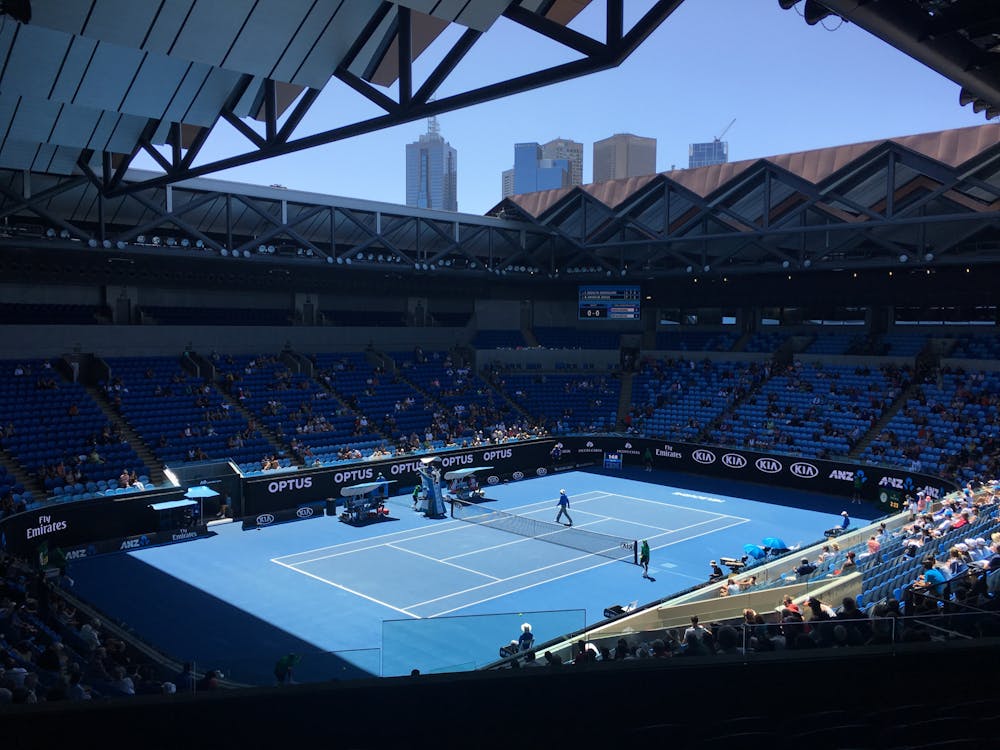
From heat to heartbreak to history in the making, this year’s Australian Open (AO) brought it all. Using new marketing strategies incorporating interactive fan experiences in the opening, AO quadrupled the 7,543 who sat in for qualifying matches in 2025 to a whopping 29,261 this year. Beyond the heightened audience excitement off court, the high-intensity later stages of the tournament proved to fans worldwide why AO remains the battleground for where champions are made.
Nothing short of a heartbreak
The hot favorite Aryna Sabalenka solidified her dominance, dropping zero sets going into the final. Yet, when the lights shone the brightest, tension could not be met as she fell 4–6 in the third set despite leading 3–0 against fifth-seeded Elena Rybakina earlier in the set. This marks Rybakina’s second Grand Slam title since the 2022 Wimbledon final, and more notably, an avenging turnaround from her loss in the 2023 Australian Open against Sabalenka. Rybakina’s run this January was not an easy one, taking out the No. 2-ranked Iga Swiatek in the quarterfinals. The 26-year-old Rybakina also calmly stepped up to the occasion against Jessica Pegula, who had eliminated the Women’s 2025 Australian Open Winner, Madison Keys. Additionally, American player Amanda Anisimova, who was the only player to overcome all four women’s Grand Slam champions in her 2025 breakout season, saw herself out in a quarter-final exit against Pegula.
This tournament result will serve as a mental test for Sabalenka, who faces her second consecutive loss in AO’s finals and moves to an 50% win rate in the eight Grand Slam finals she has played.
Sabalenka, a dominant hard-court player who won both the 2023 and 2024 Australian Opens, will remain as the top WTA-ranked player and will try to maintain her position.
Marathons under the Melbourne sun
On the men’s side, #1 Carlos Alcaraz’s seventh Grand Slam win made history for the greatest number of wins before the age of 23 and the youngest to sweep the career Grand Slam. This marks his first grand slam since splitting with his coach, Juan Carlos Ferrero.
Novak Djokovic entered the AO on the trek for the 25th Grand Slam, on his way to breaking the tie with Margaret Court for the most number of Grand Slams. The remarkable 38-year-old legend competed toe-to-toe with the #2 player and last year’s AO winner, Jannik Sinner, in a contest over four hours. This matchup was particularly a change of course, considering the past three grand slam matchups have built on the “Sincaraz” rivalry as the top two dominant forces of the tour. Even with Djokovic’s loss to Alcaraz in the final, Djokovic has now moved up to the #3.
Carlos Alcaraz weathered a gritty matchup against Alexander Zverev, whose powerful serves were a problem even for the #1 player. The match drew controversy, however, when a disgruntled Zverev argued against the time stoppage prompted by a medical timeout, claiming muscle cramping could only be treated in normal break times, to which Alcaraz explained it as needing attention from a physiotherapist for right adductor discomfort.
This controversy over timing was reflected by the arena roof closure during the Jannik Sinner vs. Eliot Spizzirri third-round matchup, where Sinner took advantage of the heat rule to recover from cramping and powered his way back from a deficit. On the other side of the net, Spizzirri stood strong, having trained in Texas heat in even more severe environments. The eight-minute delay at a pivotal break point that could have put him up 3–1, combined with an additional 10-minute cooling break before the fourth set, leaves plenty of questions about how the match’s momentum might have shifted. Spizzirri’s AO performance contributed to his rise of 14 places in the rankings, reaching a career-best world #71. Reflecting on the experience, he admitted, “to kind of feel out my game and go toe-to-toe with him, yeah, it felt good.”
Rising stars
One notable match shoutout comes from the young Learner Tien, who dismantled former top-ranked Daniil Medvedev 6-4, 6-0 and 6-3. Though his impressive run came to a stop in the quarter final, opponent Zverev applauded Tien’s playmaking level and gave a shout-out to Tien’s coach, Michael Chang, a hall of famer. Tien follows in Chang’s footsteps as the youngest American man to reach the quarterfinals at a Grand Slam event since 2002. Dedicated time on the court and continuous exposure will prove his seat among the best players, and a climb in ranks is looking bright for the up-and-coming *learner.*
Also, shoutout to amateur Jordan Smith, who fought his way to glory against tour professionals in AO’s one-point slam, leaving the arena one million Australian dollars richer, with an additional $50,000 for his local tennis club.
Call for action
Young American superstar Coco Gauff had a shocking quarter-final loss to Elina Svitolina, in less than one hour of play. In frustration, Gauff smashed her racket when leaving the court. This scene was captured and posted, raising questions about the extent to which players’ privacy and potential mental health should be protected. This also connects to the question of which measures should be enforced regarding what can be broadcast to the public. Following the release of the viral video, Gauff was backed by fellow top WTA players, including Iga Swiatek and Jessica Pegula. As much as tournament organizations and venues value off-court camera footage to increase audience engagement with ‘behind the scenes,’ these actions detract from private moments of vulnerability or emotion and restrict the time and space often needed after tough matches.
Another emerging point of discussion is whether wearable fitness technology designed to provide detailed health assessments should be allowed. Hesitancy arises from security and ownership concerns about personal biometric data, as well as from its strategic use as a competitive advantage. Supporters say that the data in high-intensity matches would aid real-time analysis preventing potential injuries or giving insight into how players could best recover, especially when their bodies are under duress from long travel commitments and extreme weather conditions.
Concluding note
An intense month of high-intensity matchups and buzzing competition... and it’s only the beginning. As the tours slowly transition into the clay season for early spring, all eyes are set on the French Open.