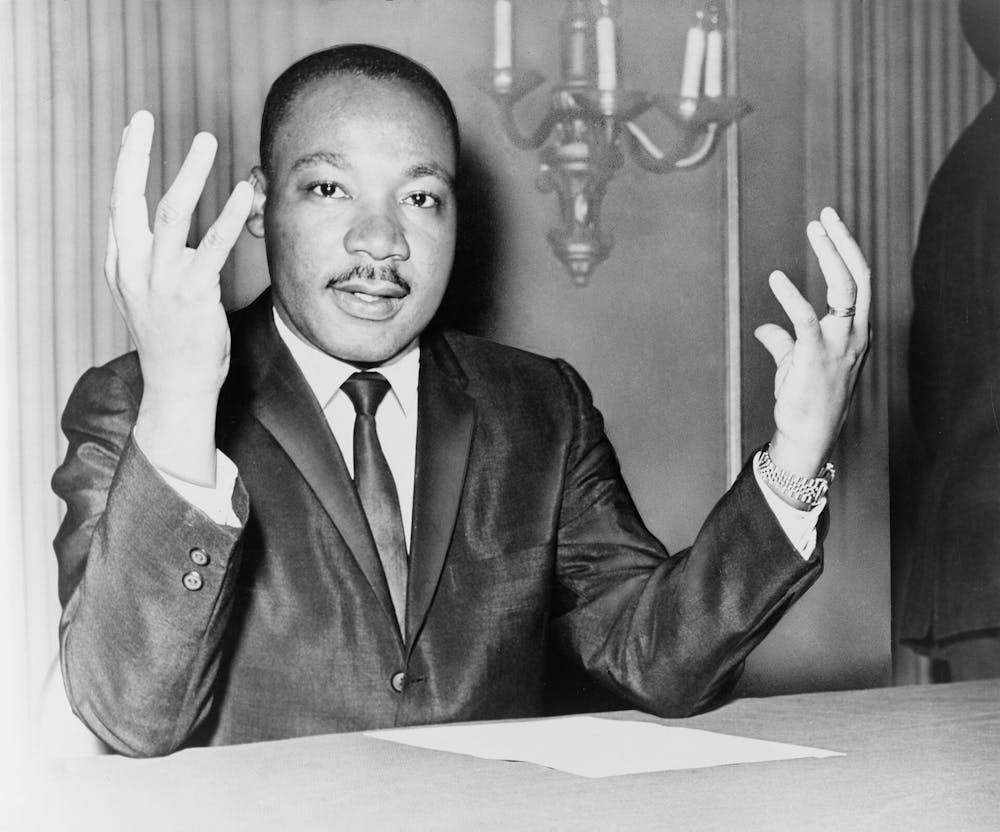
Anicca Harriot, a postdoctoral researcher at Johns Hopkins specializing in tissue engineering, was recently awarded the Martin Luther King Jr. Award for Community Service at Hopkins’ Martin Luther King Jr. Commemoration on Jan. 16. This year’s theme for the award was “Impact: The Power of Communities.” As the CEO of Vanguard: Conversations with Women of Color in STEM, #VanguardSTEM for short, Harriot has greatly contributed to the community of women and non-binary people of color pursuing careers in STEM-related fields.
#VanguardSTEM was founded by Jedidah Isler, who was the first African American woman to receive a PhD in astrophysics at Yale. Noting the lack of acknowledgement of African American, Indigenous and Latina women in STEM, Isler wanted to create an online space where these women in STEM could come together, resulting in the #VSCommunity. In an interview with The News-Letter, Harriot explained this struggle.
“As Black, Indigenous, Latina women in STEM, oftentimes you're the only one in your department, or the only one at your institution, but there are many of us spread across institutions throughout the US."
Harriot joined #VanguardSTEM as a social media coordinator at the end of her undergraduate degree. Having been diagnosed with a rare blood clotting disorder as a teenager, Harriot experienced first-hand the lack of representation of diverse ethnicities in research, since all the studies conducted about her disorder only included white men as participants.
“And as a 15-year-old Black girl, it was immediately apparent to me that there wasn't very much I could gain from that," she said.
In contributing to #VanguardSTEM and conducting tissue engineering research to model disease progression, Harriot is battling both sides of this issue. #VanguardSTEM’s many programs are centered around addressing three primary problems rooted in this underrepresentation: the lack of access to education, the absence of community for African American, Indigenous, and Latina women in STEM, and the minimal recognition given to these scientists, despite their notable contributions. These disparities are reflected in the NSF’s published statistics, showing that, despite making up around 30% of the US population, less than 10% of doctoral degrees have been earned by Black, Indigenous, and Latina women in the past 10 years.
To ensure their programs are truly impactful, Harriot and the #VanguardSTEM team listen to student voices of marginalized communities. Their team includes graduate students, who keep them informed about the current needs of students developing their careers. This input has resulted in programs such as Hot Science Summer, which provides funding for the #VSCommunity to pursue research projects. One such research project was led by Egondu Umeobi, who had a goal of investigating mining-caused water and soil contamination. With #VanguardSTEM’s support, she has been able to raise awareness of the negative impacts of mining through her publications, allowing her to focus on land remediation efforts.
Similarly, their Wikimedia Fellowship Program advocates for #VSCommunity scientists, giving post-baccalaureate students the opportunity to interview women of color in STEM, write about their research and help develop assessments to quantify the impact of #VanguardSTEM’s Decolonized Mentoring framework. This framework prioritizes collaboration, diverse perspectives and acknowledgement of political influences in the field of research.
Harriot mentioned the “What does a scientist look like?” experiment and argued that the researchers that appear in media are not representative of minorities.
“When you're reading an article in NPR, the Associated Press, and they're talking to a scientist, who are they talking to? And is it representative of these groups, as well as are they being acknowledged as experts?" Harriot described.
Various sources provide funding for these initiatives, including National Geographic, the Gordon and Betty Moore Foundation, Wikimedia Knowledge Equity Fund and direct donations. Still, funding remains a challenge. Harriot also explains that there are additional difficulties in running #VanguardSTEM.
"Every single person on the #VanguardSTEM team is a full-time scientist. So we all do this in addition to our daily obligations. And we do this work as volunteers," she pointed out.
To ensure a healthy work-life balance, Harriot and the #VanguardSTEM team maintain open communication and patience when deadlines interfere with one another, prioritizing the quality of their projects over quantity. This healthy work ethic has preserved passion throughout #VanguardSTEM projects, preventing burnout. Reiterating the importance of passion, Harriot advises students to pursue community service projects that speak to them.
"Find the one that resonates with you the most and the one that you feel that you can contribute your skills to in the most meaningful way,” she recommended. “You never know what amazing opportunities will arise because of that."