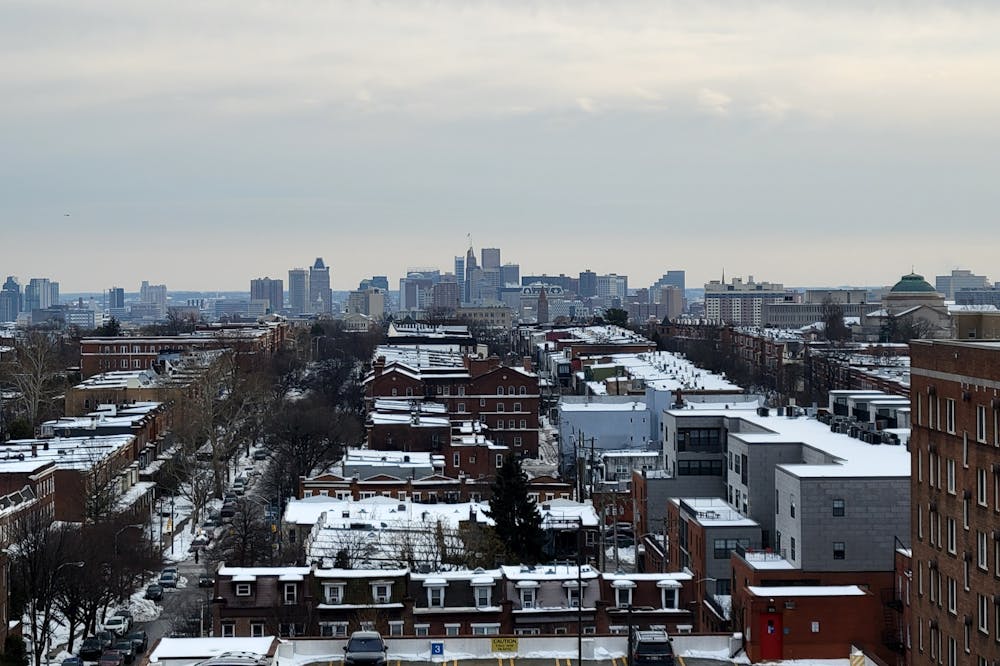
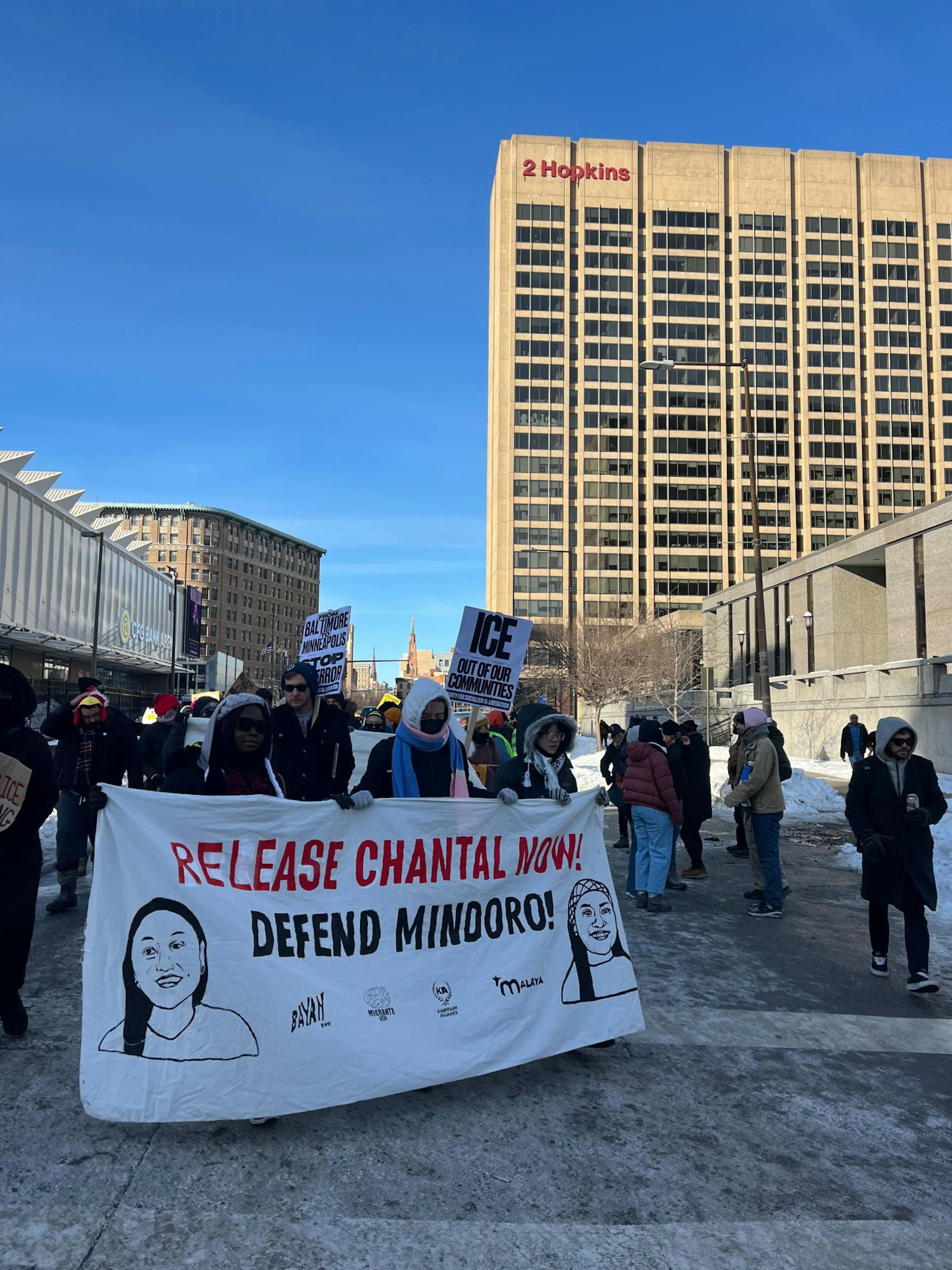
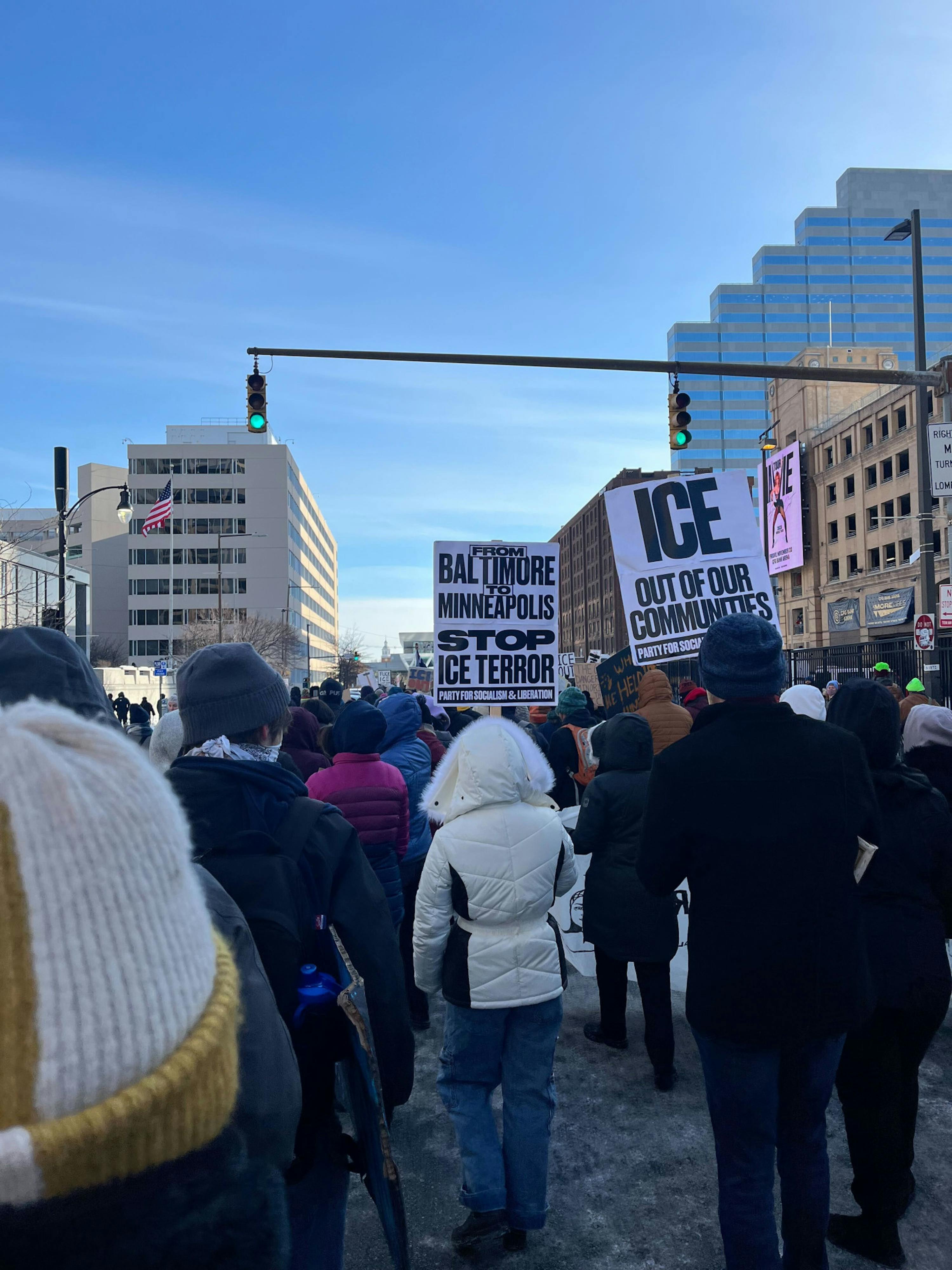
On Jan. 30, demonstrators gathered in cities across the United States as part of a coordinated “National Shutdown,” which advocated for an end to aggressive ICE tactics such as widespread street raids, militarized enforcement sweeps in immigration neighborhoods and the use of federal agents to detain people without clear charges. In Baltimore, on this day, hundreds of protesters gathered between Baltimore’s Immigration and Customs Enforcement (ICE) field office and the CFG Bank Arena to demand that the United States ICE operations in the city and across the country be terminated.
ICE is the federal agency responsible for enforcing U.S. immigration laws, including detention, deportation and interior enforcement operations. In 2025, at least 32 people died in ICE custody — the highest number of ICE-related deaths in years — as detention populations and enforcement actions surged amid the Trump administration’s expanded interior immigration operations.
In 2026, at least eight have passed in custody. Among these individuals, 37-year-old Minneapolis residents and US citizens Alex Pretti and Renee Nicole Good have become focal points of national outrage and protest. These incidents have sparked nationwide demonstrations, including the coordinated “National Shutdown” protest.
COURTESY OF HONORA MURATORI
One Hopkins student from Minnesota, using the alias Olivia, expressed deep concern over the escalation of ICE-related violence and the growing risks faced by protesters and immigrant communities in an email to The News-Letter.
“I personally never felt as exposed to it in real life, but I think what’s going on right now is completely different. I know a lot of people personally, like my family friends and school friends at the University of Minnesota [who are] being affected by it,” she wrote. “I think Minnesota often has peaceful protests, but I have been starting to see lots of friends going there and getting teargassed just for being there and voicing their opinions. It’s scary that the people I personally know, like family and friends, are not completely safe even [though] they have a legal status here.”
In the Baltimore area, community activists and immigrant rights groups have mobilized in response to both the national outrage and an increased local ICE presence, organizing protests aimed at protecting immigrant residents and calling on city officials to limit cooperation with federal immigration enforcement.
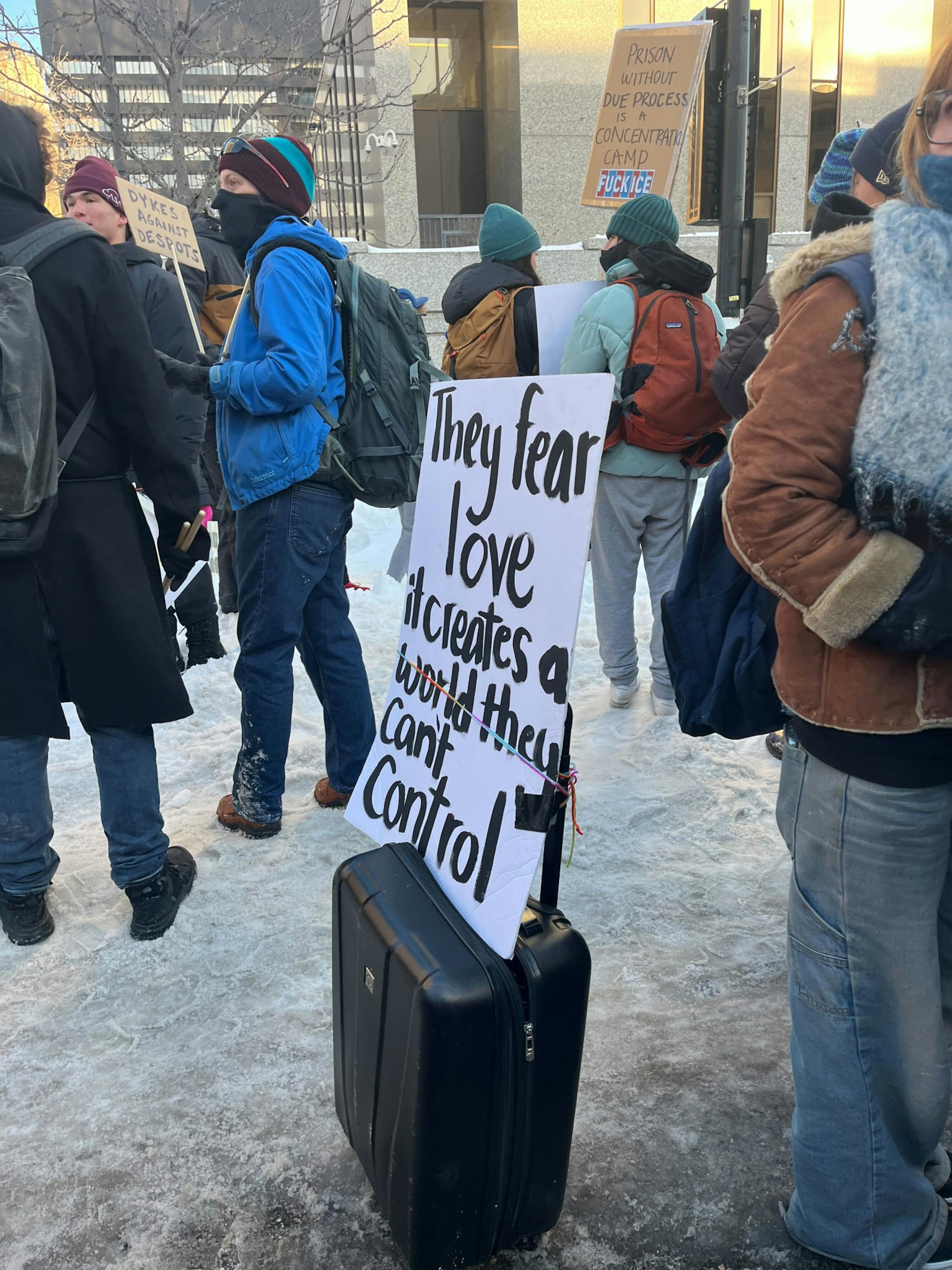
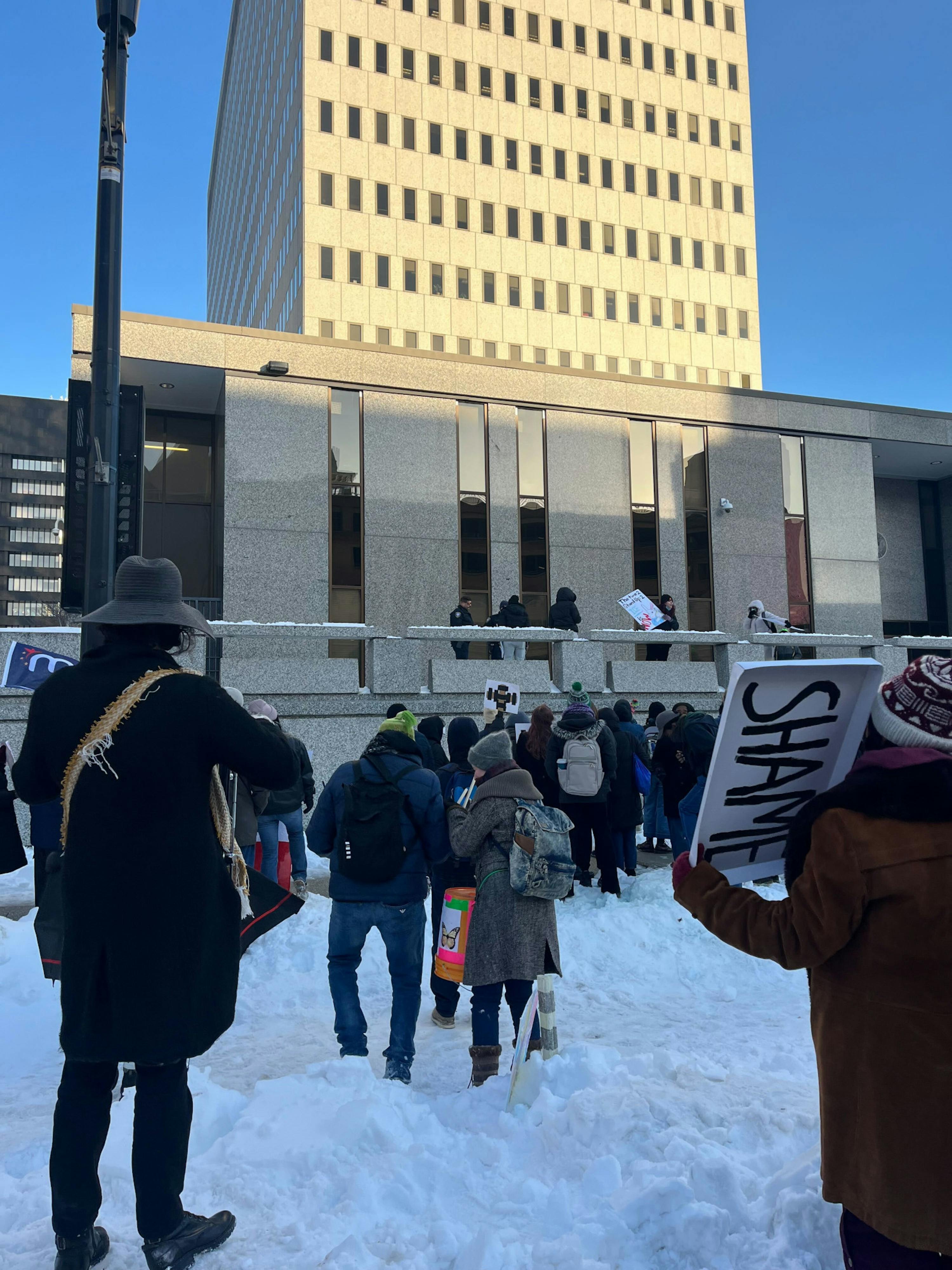
The Baltimore protest against ICE lasted for several hours, with participants marching in frigid weather. Outside the Baltimore ICE field office at 31 Hopkins Plaza, protesters were seen shouting at police officers various chants, such as “Quit your job!”
Aside from the deaths of Pretti and Good, other incidents involving alleged misconduct and excessive use of force have further intensified public scrutiny. For instance, on Jan. 20, ICE had detained a 5-year-old boy, Liam Ramos, on his way home from school in Minnesota. After transporting the boy and his father to a Texas detention center, uproar erupted across the United States, prompting condemnation from advocacy groups alongside elected officials.
On Monday, Feb. 2, Howard County Executive Calvin Ball announced that Howard County had revoked a building permit for a private detention facility that was proposed in Elkridge. According to authorities, this permit was intended for use by ICE. After the initial announcement of construction, emergency legislation was issued to ban permits for privately owned detention centers.
COURTESY OF HONORA MURATORI
Although county officials have listened to community concerns, the heightened visibility of ICE in the area has continued to affect residents’ sense of safety, particularly among students and immigrant communities.
For instance, sophomore Nutnicha Go described a heightened sense of fear and uncertainty felt by students and residents in an email to The News-Letter.
“I think that having ICE around campus or even around the city of Baltimore has just put everyone on edge, because we never know how they would act. People are scared to walk the streets safely, especially with their constant presence just known, and having people disappearing from the streets is just terrifying,” Go wrote.
Student organizations at Hopkins have also voiced opposition to ICE activity in Baltimore and expressed solidarity with immigrant communities. Some groups have released statements condemning federal immigration enforcement practices and urging both city and University leadership to take stronger action.
In an email to The News-Letter, the Johns Hopkins College Democrats reaffirmed their support for due process protections and criticized recent ICE raids as well as detention conditions in the city.
“In the wake of recent ICE raids and further threats to community safety, we at Johns Hopkins College Democrats are reaffirming our stance that all people deserve the right to due process under the law regardless of immigration status,” they wrote. “We wholly condemn the inhumane conditions experienced by those held in the George H. Fallon ICE detention facility and the increasing number of violent ICE raids in the city of Baltimore.”
Moreover, the group expressed support for state and local officials who have pushed back against expanded ICE activity and called on the University to take a more active role in protecting undocumented students.
“Our organization strongly supports Governor Wes Moore's resistance to cooperate with the federal administration's expansion of ICE and recent efforts made by Democratic lawmakers to enforce restrictions on ICE in Baltimore, such as the Maryland Senate’s initial approval of SB0001, which would prevent law enforcement from wearing facial coverings while on duty,” they wrote. “As students at Johns Hopkins, we urge University leadership to advocate for protections for undocumented individuals and provide safe reporting channels, accessible information on student rights, and further support to undocumented students on campus to preserve the safety of our community.”
The aforementioned SB0001 is entitled “Public Safety — Law Enforcement Officers — Prohibition on Face Coverings.” This bill aims to require the Maryland Police Training and Standards Commission to develop a model policy that prohibits the use of a face covering in the performance of duty. ICE agents have notoriously worn facial coverings during enforcement operations, a practice that has been criticized for reducing accountability and increasing fear.
COURTESY OF HONORA MURATORI
Hopkins students have echoed similar sentiments, emphasizing the personal and emotional toll of increased ICE activity on families and communities. In an email to The-News-Letter, sophomore Ember Gray shared her concerns about the impact of ICE’s presence on vulnerable communities and her own family.
“I think their presence is incredibly harmful to the community; they fearmonger and intimidate vulnerable parts of the community. They’re essentially bullies that have been given guns. It's had a big impact on my family,” Gray wrote. “My sister is visibly a person of color and is often mistaken for being Mexican. I’ve had a lot of concern for her safety, especially as their presence is becoming more and more violent and prevalent. I shouldn't have to worry about her being kidnapped or shot by wannabe cops.”
Further, Gray criticized ICE as an extension of federal policies that she believes undermine civil liberties and public safety.
“I think that ICE’s role is very much a progression of the administration’s aggressive divisiveness and hateful motivations, but that they go against not only the state’s law enforcement and current ideals, but the Constitution and the ideals which this country was founded on,” she wrote.
Gray’s concerns reflect broader criticism from students and advocacy groups who argue that ICE’s presence on or near college campuses creates fear among undocumented and international students. These concerns have prompted calls for clearer communication from the University and additional protections for affected members of the Hopkins community. In an email to The News-Letter, the University responded to student concerns and outlined its current stance on federal immigration enforcement.
“We understand and share the deep concern that members of our community have expressed regarding recent federal immigration actions and policies,” a spokesperson wrote. “As we have throughout the past year, the university is closely monitoring changes in U.S. immigration and border policies, and we are sharing updates with our international community through the Office of International Services.”
On Feb. 3, the Student Government Association proposed the SGA Resolution regarding ICE as a part of their nonlegislative business. In the resolution, SGA outlined its condemnation of recent immigrant enforcement actions, affirmed its commitment to due process and called on University leadership to reaffirm protections for undocumented and international students. In an email to The News-Letter, the SGA issued an official statement on their stance.
“Supporting the student experience in partnership with University Leadership is the SGA’s highest priority, and we will carry this forward through thoughtful and intentional engagement with students,” they wrote.
COURTESY OF HONORA MURATORI
Despite administrative statements, some students expressed that the University’s response to the presence of ICE did little to ease the fear felt across campus, particularly among international students. Several students have agreed that they were seeking clearer guidance and more concrete protections from the University’s administration.
An anonymous student going by the pseudonym Peter echoed similar fears in an interview with The News-Letter, describing his growing sense of anxiety amid the increased presence of immigration enforcement.
“I think [that] the increased presence of ICE in cities like Baltimore leads to a sort of fear within our international community of students here [...] I don’t know anyone personally who may have been personally affected by the presence of ICE, but just [the] idea that it could be you,” he said. “[I] have that fear that it could be me getting shot just because I’m sitting here protesting in response to the government attacking its own citizens.”
Moreover, Peter criticized what he described as a shift in ICE’s mission away from public safety and toward political enforcement.
“I think [that] within this current administration, ICE’s goal is to be more of a thug-like presence and to execute the political orders of the Commander in Chief rather than their initial intended purpose,” he said. “Now, instead, we’re just snatching people off the streets, and it’s like the KGB. So I think it differs in that way and that this is more of a political organization, whereas the local and state law enforcement officials are working really more within the letter of the law.”
For frequently asked questions on University immigration policy information, Hopkins affiliates can access the “Immigration Policy Information & Frequently Asked Questions” tab on the Office of International Services Website. Further, additional guidance on questions regarding public safety and the Johns Hopkins Police Department (JHPD) can be found on the “Guidance in Response to Questions about Federal Immigration Enforcement” section on the public safety website. Finally, shared updates regarding federal immigration actions are accessible under the “Recent Federal Immigration Actions” tab on the Office of International Services website.
Catherine Chan, Josh Eckstein, Honora Muratori and River Phan also contributed to the reporting of this article. The JHU College Republicans and Hopkins Justice Collective did not respond to requests for comment.