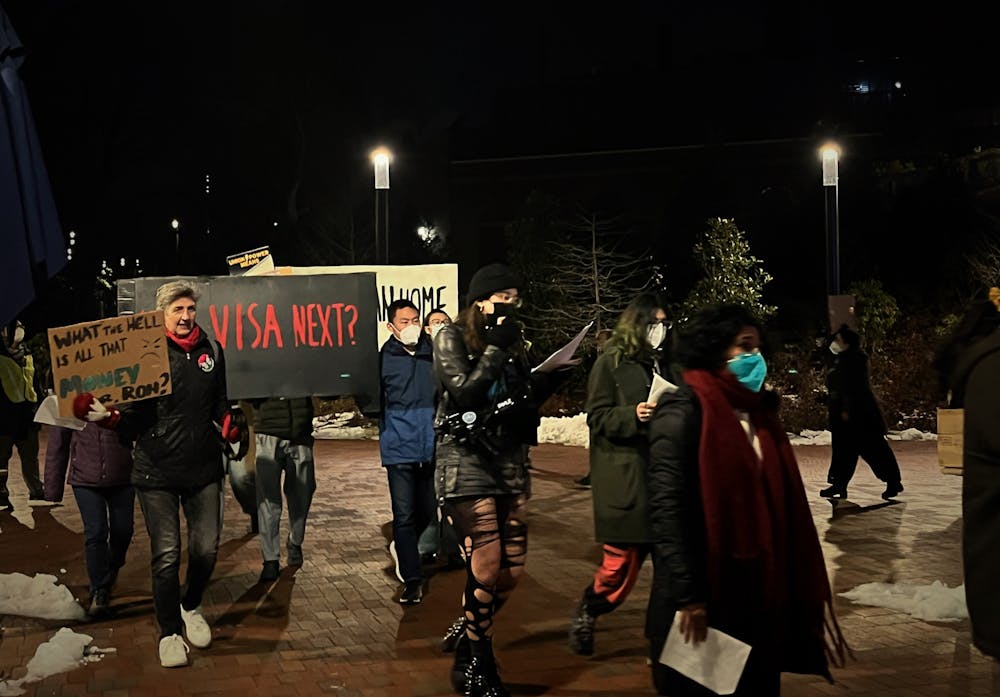
On Wednesday, Dec. 17, the Teachers and Researchers United (TRU-UE) union coordinated a noise demonstration at the Bloomberg Student Center to stand in solidarity and raise awareness for Ehsan Rajabi’s unprecedented circumstances.
Rajabi is a second-year Iranian graduate student in the Krieger School of Arts and Sciences in the Department of the History of Art studying Islamic art and architecture. In mid-August, upon Rajabi and his wife’s return to the United States from a visit to Rajabi’s brother in Toronto, the pair’s visas were canceled on site, leaving them stranded in Canada. Subsequent denials of visa reapplications followed President Trump’s travel ban, which prevented individuals from 39 countries, including Iranian nationals, like Rajabi, from entering the United States. In his open letter on his visa cancellation, Rajabi confirmed an exception to the rule in Section 4 of the June 4 Presidential Proclamations because the two were already in the United States before the proclamation was passed.
“My visa application was denied under the current travel ban, even though we should be exempt, as we were already in the United States with valid visas on the proclamation’s effective date,” Rajabi wrote.
According to Rajabi’s open letter, he had asked the University to facilitate connecting him to Maryland Senator Chris Van Hollen, to no avail. Pending his appeal, Rajabi also proposed a work-study exchange with the University of Toronto, to which the University stated it was unable to resume his salary while he was not in the United States.
“[The University] instructed me to contact the senator myself, offering to step in only if the issue remained unresolved after six months,” according to Rajabi’s open letter address.
Four months later, the pair remain in Canada awaiting a change in their status, contemplating returning to Iran. To offset the gravity of significant financial expenses, such as Rajabi’s inability to receive a salary, work in the United States or Canada without a valid visa and pay monthly rent for his and his wife’s Baltimore flat, Rajabi had sought assistance from the University’s Office of International Services, which declined to provide monetary support for legal representations. In an official statement, a representative stated that the University can not alter visa cancellations due to the dependency on federal policies.
Lauren Cook, a fourth-year Art History graduate student and TRU-UE affiliate, attended the demonstration and shared her frustration with the University’s inaction in an interview with The News-Letter.
“Ehsan is a colleague and friend of mine. What’s happened here has been a real travesty. I'm very disappointed in the University — especially after last spring, where it made such a strong commitment to help international workers,“ Cook stated.
In an interview with The News-Letter, retired French professor Claude Guillemard agreed with Cook, pushing the University to help Rajabi’s situation.
“[It is] not that Canada is a bad place to be stuck in. Absolutely not. But when the visas of my students — our students — got canceled, we all knew it was illegal, unjust and unacceptable… I expected my institution to fight, and I'm so horrified that they don't when they have the power to do so, when they have the money to do so,” said Guillemard.
In an interview with The News-Letter, sophomore Taiyo Tagami shared how, if thrown into a similar situation, he would feel devastated.
“If you're coming here to do research, have a job, and you have everything planned — especially as an international coming all the way to the US — that doesn't just mess with your life. [A visa cancellation] is going to ripple into your future; the stress, all the relations you need to maintain, all the opportunities you miss out on,” said Tagami.
According to TRU-UE’s written statement on Rajabi’s visa cancellation, the noise demonstration’s sole purpose was to raise awareness of Rajabi’s situation and call for the University to provide funding and legal representation for Rajabi’s legal proceedings.
Some students had expressed concerns over the noise disturbance during finals week. However, Cook shared that the demonstration was intentionally planned to take place during reading week.
“Even though a lot of us are studying for finals ourselves, in order for protests to be effective, they have to be disruptive, in a sense. And that's why we thought a noise demo during finals week would be an effective way to let Hopkins know that we haven't forgotten about Ehsan,” explained Cook.
Sophomore Darena Ho is among many students who do not feel negatively impacted by campus demonstrations.
“I don’t really see them that often — and honestly, they haven’t impacted my life. [When] I go to class and I see one, I just walk past; no one is harassing me or anything,” says Ho.
Guillemard approaches demonstrations like this one with a hint of optimism, regardless of any concrete outcome.
“I think [demonstrations are] a way to spread the word. If one more person today knows about [Ehsan’s] case and is a little less trusting towards Hopkins, I think it's good, because it's really about trust here. Hopkins does not protect its own students when it's not convenient. And it's good for people to know that. I have the personal justification for any good demonstration when it's, to me, on the right side of history. It's at least for the future generations. Because when they look back and wonder what Hopkins, the Hopkins community, did, well, they stood up,” said Guillemard.