“Mostly, we don’t want to harm each other,” Danusha Laméris avows in her short poem “Small Kindnesses.”
Coming across this line made me think of my time spent in observation. I have curated a list of my best takes on kind objects and occasions that are easily swept past in chasing the next glimmering goal.
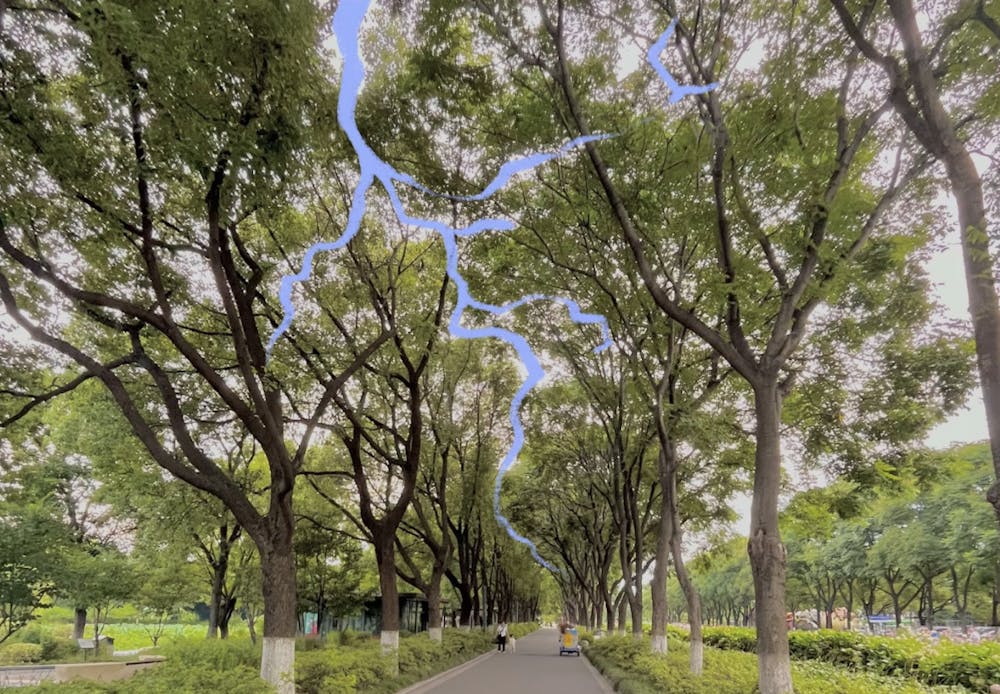
There is a natural phenomenon where trees in dense areas avoid clashing with each other by tending their canopies at a respectful distance so that each woodland resident may have a fair bid at sunlight. From a utilitarian perspective, it seems strange. Why would evolution select for a behavior where, instead of vying for a coveted resource, trees reach a hushed and mutual agreement of withdrawal? Crown shyness, or canopy disengagement, is abundantly observed in the vegetation that surrounds us. Tree branches arrange against the edge of a pristine azure sky in fractal-like shapes, resembling tiny, sprawling riverbeds.
And while trees cannot speak, or summon up their roots to participate in travel, they somehow have marvelous ways of protecting each other – in silence, and in secret. When one tree falls, pheromones are rapidly released across a shivering thicket to alert others, serving as a warning and call for help. Nearby trees extend their benevolent roots, intricate laceworks of fiber mingled with the gossamer mesh of mycorrhizae, to send aid to the fallen companion.
Take my minerals, nutrients, and all of this good earth along with it, they say. We are lucky to coexist, after all.
Apart from coniferous plants, I like granting ordinary objects expression even in their apparent stasis. Cotton socks hung up to dry on a laundry line yaw against the wind, reaching for their symmetrical halves at a palm’s distance. Star anise crushed into fine powder against the blunt edge of a camping knife blooms an oxidized red when acquainted with pan oil. The spent floss of velcro-strapped sketchers is laid to rest after many good years of holding ankle to sole. In the fire of summer, the tassels of my mother’s hair gather up the intense solar glare before exhaling back into a placid umber.
“Mostly, we don’t want to harm each other.”
A more recent addition to this ongoing directory of kind happenings, I’ve decided, is umbrella communication in the rain. When a downpour begins and I walk past others fleeing a storm, there is an instant where the metal axes of our umbrellas tilt in avoidance of canopy collision, flicking clear, marble droplets across the pavement. The wetness variably hits an eyelash, and as I blink, the world splinters into a foggy kaleidoscope. When it rains, I think so much about escape, about seeking warmth and dryness in the zip-up of my felt coat and trembling skin, away from harsh weather, a small puddle pooling around my feet. Even so, rain is a way of the sky giving back the water that evaporates out of breath, out of unfurling sapling leaves, rushing through creeks and reservoirs.
While I’ve made note of occurrences that touch me happily, I cannot omit the objects from my view that appear to have a pointed voice. Like, the anti-roosting spikes with their protruding spiny fingers on adorned door frames, or park benches segmented with too many armrests. We have found ways to circumscribe others, using such designs.
Consequently, it is always important to look, to peer around with wide eyes at objects and people alike, with the enormous sense that we are inhabitants of the same brush, often never coming into direct contact. But in our quiet neighbor-ness, there is so much capacity for reciprocal care.
Crystal Wang is a sophomore from Baltimore, Md., studying Molecular and Cellular Biology.