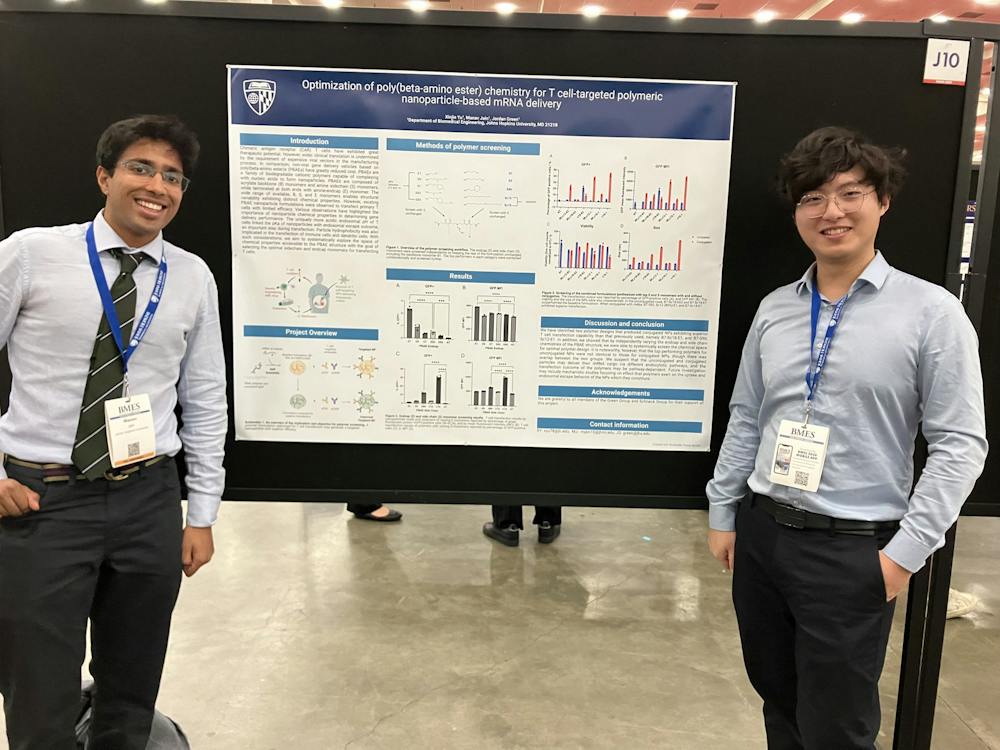
Manav Jain is a fourth-year PhD student in the Department of Biomedical Engineering who was one of five Biomedical Engineering graduate students to be named a Siebel Scholar. Advised by Jonathan Schneck and Jordan Green, his research focuses on developing biological materials that can be delivered into the body to treat diseases. Most notably, he has developed a specialized lipid nanoparticle that genetically engineers T cells to fight cancer and autoimmune diseases in vivo.
Jain’s curiosity and interest in scientific research started early. He credited his upbringing in a college town — an environment full of people who made careers as researchers and professors — as the root of his interest in the practice. For his undergraduate studies, Jain attended Georgia Tech, where he studied biomedical engineering and started conducting his own research developing T cell therapies.
“I reached out [to the lab] because I originally wanted to work on stem cell research. And then the person that I ended up working with was doing T cell therapy research, and they were specifically working on something called (CAR) T therapy… so I got really into immunology from working in that lab, even though that wasn't really something that I’d expected to do.”
During his time at Georgia Tech, Jain also interned at Amgen and Genentech, two major biotechnology companies. These experiences deepened his interest in the field and exposed him to the industry side of biomedical research. When Jain decided to apply to graduate school, he had plans to return to biotech after completing his degree. However, his experiences at Hopkins, especially in mentorship, have shifted his plans toward academia.
“Over the course of grad school, I realized that I really actually like mentoring undergrads… Some of the undergrads that I've worked with are some of the smartest people ever… Getting to see when undergrads go from being sheep to becoming fully grad-level thinkers is really cool to see... I liked the aspects involved with being in an academic setting… so I think I want to be a professor.”
Reflecting on his experience, Jain highlighted one of the most important skills that he learned early in his graduate studies: that of reading and synthesizing papers.
“The more you read, the faster it gets... I think the process of reading a bunch of papers, synthesizing all the information that you got and then drawing new findings… is really helpful… Writing a review paper in the second year of my PhD helped me to think broadly about certain thematic areas that I wanted to look at during my PhD.” Jain advised.
Incorporating these skills and learnings, Jain carries out research focused on developing mRNA lipid nanoparticles capable of entering the body and efficiently editing T cells to combat B cell-based diseases. In the past, T cells had been traditionally edited by drawing blood and editing the cells ex vivo. This approach faces challenges, including the steep monetary cost of the therapy and the fact that patients must have their immune systems depleted prior to reintroduction of the edited T cells. More recently, scientists have used viral vectors to deliver gene therapies to T cells. However, these viral vectors are limited to one dose per patient, and they have the possibility of inciting unwanted immune responses.
Therefore, Jain turned to mRNA lipid nanoparticles as a cost-effective, efficient and safe method for T cell editing. Specifically, antibodies that can be recognized by T cells are conjugated to the outer surface of the nanoparticle, which allows T cells to recognize and take up these particles. Once inside the cell, the lipid nanoparticle dissolves, releasing the mRNA encoding the CAR. Since mRNA is relatively unstable, the CAR is only expressed transiently. This transient expression serves as an advantage of the system, as Jain described.
“Let’s say you have cancer or an autoimmune disease... You want to kill off all the bad B cells and then eventually want the healthy B cells to come back. If you have a CAR T cell that expresses the CAR forever… that's a lot of B cell-killing cells inside your body, and that means your B cells will never come back.”
Additional advantages of Jain’s developed system are that the nanoparticle can be stored indefinitely at -80°C and can be administered in multiple doses. As a result of this research, Jain was named as a Siebel Scholar.
“Siebel Scholars recognizes the most talented students at the world’s leading graduate schools of business, computer science, bioengineering, and energy science,” the foundation’s website states. “Each year, more than 90 exceptional students are selected as Siebel Scholars based on academic excellence and leadership potential. Each receives a $35,000 award toward their final year of graduate studies.”
Jain described the application process for the award as being quite straightforward: a short biography, a CV and 1–2 letters of recommendation. Since the recognition is given in the final year of graduate study, the award serves less as a motivation for a student’s current graduate research, but more as a springboard for one’s future endeavors. As such, Jain considered possible future directions for his research.
“Now the question is: How much smarter can these particles get? Something that I'm really interested in… is the question of if we can create tools that can non-invasively detect certain diseases or cancers… and combine those diagnostics with mRNA nanoparticles. You could have a nanoprobe that would only react in a certain disease situation… conjugated to a nanoparticle [that] could release a therapy,” Jain concluded.