What’s in an artist? From what do they fashion their work? In their new retrospective exhibition on Finnish author and illustrator Tove Jansson (1914–2001), the Quentin Blake Center for Illustration sets out to answer these perennial questions by looking not only at the artist but the people who surrounded her.
The newly announced exhibit, titled “Tove Jansson and her Families,” will feature previously unseen drawings and is “the UK’s first ever exhibition to focus on Tove Jansson’s work as an illustrator,” and runs from Nov. 21, 2026, to May 9, 2027. Most famous for her work on the Moomins, hippopotamus-like creatures both endearing and blunt, Jansson illustrated extensively for numerous magazines and wrote novels such as The Summer Book and Fair Play outside her books for children. In the spirit of this retrospective exhibition, I too wanted to reflect on Jansson’s work in the quarter-century after her passing in 2001.
Jansson’s childhood
Tove Jansson was born to sculptor Viktor Jansson and graphic designer Signe Hammersten-Jansson in a Swedish-speaking minority within Helsinki, Finland. With a father whose sculptural work is still on display in her hometown, and a mother who “designed most of Finland’s postage stamps from 1929 until 1962,” Jansson was exposed to aesthetic, bohemian influences from an incredibly early age. The Quentin Blake Center’s exhibition will include some of Jansson’s earliest humorous magazines and booklets which she sold to her classmates starting from the age of seven.
Her tendency towards satire began early too. According to Jansson’s biographer Tuula Karjalainen, she was reprimanded at 12 years old “for drawing a caricature of her teacher on the class black-board.” At 16, Jansson went on to study art in Stockholm. While her parents’ artistic influences followed her her entire life, she was also exposed to a great drive towards Modernism in the art world of the Finnish 1930s.
The Moomins
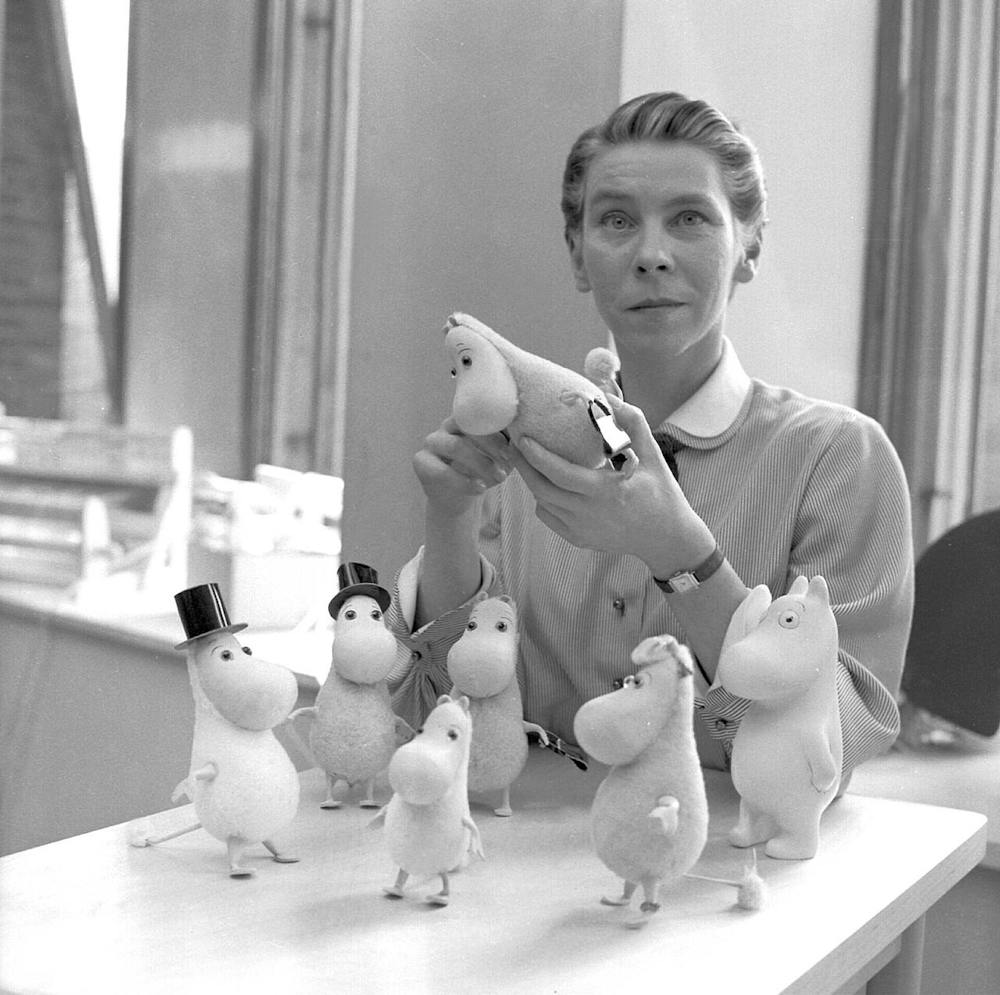
In addition to exhibiting her early satirical and comic works, the Quentin Blake Center’s exhibition features art depicting “the origins of the beloved Moomins.” The Moomins’ origins appeared in political cartoons which Jansson drew for Finnish anti-fascist left-wing magazine Garm during her teenage years. According to Kathryn Davis’ introduction to Jansson’s The Summer Book, an even earlier version appeared as an “insulting portrait of Immanuel Kant... on an outhouse wall after she lost a philosophical quarrel with one of her brothers.” Jansson would continue to illustrate for Garm until the end of its publication in 1953, contributing “around five hundred drawings... including every single cover from 1944 onwards.”
In her illustrations for Garm, a Moomin-like, long-snouted creature would accompany her signatures. They thus represented Jansson herself, but they would also appear in her more grim, private work to represent “ghostlike and scary creatures... released from the shadowy forces of the subconscious.” Yet during World War II, she began to reimagine the Moomins in a world of their own, and “through them she escaped” into the idyllic valley of her children’s stories.
But the Moomins were not characters typically featured in magically happy children's books. It was important for Jansson to include more strife and more reality, wishing not “to shut out the mystery, tenderness and cruelty that were a part of the child’s world.” She may have wanted to escape from the war, but she did not want to deceive herself, nor anyone else. Children, like the main character Moomin or the mischievous Little My, are clever and rambunctious. Indeed, the characters of Moominvalley “often [say] rude things and even [swear] at times.” They may not be role models, but they are funny and endearing.
Biographical Influences
Moreover, the Moomins and Jansson’s other work often reflected the people in her own life. Family is central to the Moomins in particular. The main family consisting of Moomin, also known as Moomintroll, Moominmama and Moominpapa took after Jansson’s own family. Jansson saw herself in the precocious Little My as well as in Moomin himself.
Moomin’s best friend, the gruff, always-traveling Snufkin, takes after Finnish left-wing intellectual Atos Wirtanen, whom Jansson was in love with and briefly engaged to. Leaving Moomin and Moominvalley every winter to travel south, Snufkin parallels Wirtanen’s absenteeism and need to be alone. Thus left behind, Moomin gave voice to his author’s love and love troubles:
“Moomintroll, who waited and yearned so terribly. Who sat there at home, waiting and admiring, and who said: Of course you should be free. It’s obvious that you need to go away. And I understand that you have to be alone sometimes.
And at the same time Moomintroll’s eyes were dark with disappointment and helpless longing.”
Jansson’s other works, such as The Summer Book and Fair Play, are equally influenced by her family and loved ones. The Summer Book, written one year after the death of Jansson’s mother Signe Hammersten-Jansson, is immanent with quiet grief. The story, a series of vignettes, is set on an island on which a grandmother and her six-year-old granddaughter Sophia live after the death of the latter’s mother. They go about exploring the island, observing the animals, writing stories and talking to each other. The two discuss death with a funny casualness which only the very young and very old can manage. A daughter figuring out how to live without a mother, Jansson imbues The Summer Book with the striving working through of loss.
Similarly set on an island, Fair Play captures the serene love between two elderly women, the artist Jonna and the writer Mari. The story is inspired by Jansson’s own relationship to her life partner and lover Tuulikki Pietilä, one of Finland’s most influential graphic artists who taught at the Academy of Fine Arts, Helsinki. Like Jansson and Pietilä — who “spent every summer for nearly 30 years” on a “tiny barren island no bigger than a football pitch” — Jonna and Mari work on their crafts and their relationship with each other.
Work and Love
Tuula Karjalainen’s biography on Jansson is titled Tove Jansson: Work and Love, named after Jansson’s motto: Laborare et Amare. Through her career, Jansson shows that love and work are more than two separate practices to alternate between, but rather two things mutually influencing one another. Her work is full of the people whom she loved, and who loved her in return.
Published at a tumultuously political time, the Moomins drew criticism for “portraying an excessively bourgeois view of the family.” It’s true that Moominpapa, Moominmama, and Moomin live lives befitting traditional familial and gender roles. Yet their inclusion of and community with other characters, as well as Jansson’s own nontraditional life, points toward the flourishing of multiple families, families beyond the family, as circles around one, enriching one's own work and love.