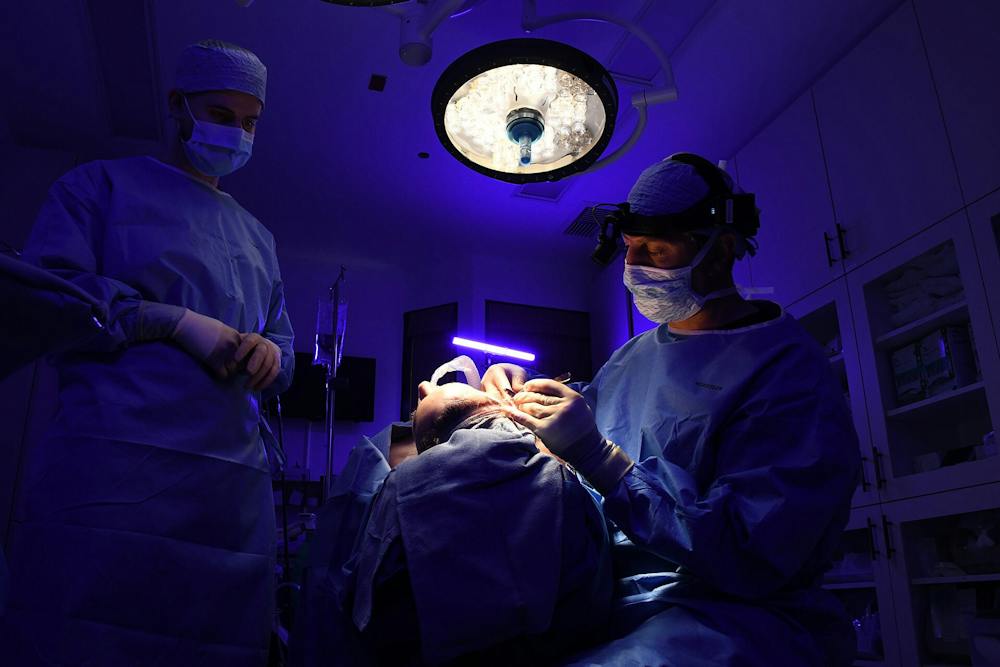
Dr. Amy Quan specializes in aesthetic plastic surgery and has earned her Master of Public Health at the School of Public Health and her medical degree from the School of Medicine. In a recent interview with The News-Letter, she discusses the science behind facial fat grafting, how the procedure differs from botox and traditional dermal fillers and the growing role of regenerative medicine in plastic surgery.
Unlike fillers, which use synthetic materials to restore facial fat volume, fat grafting relies on tissue harvested directly from the patient’s own body. The procedure typically involves removing fat from areas such as the lower abdomen and processing it before carefully injecting it into regions of the face that have lost volume due to aging or hormonal changes.
“By definition, a graft means there is no blood supply to the tissue ... I would harvest [fat] in a non-traumatic way [from a donor site] … and then I would reuse it in a way to volumize the face, where, through hormonal changes and aging, the patient has lost some volume,” Quan said.
Quan explained that one of the primary reasons why she incorporates fat grafting into her practice is the field’s shift toward more natural methods of facial rejuvenation. While botox and hyaluronic acid fillers remain an effective treatment option, fat grafting offers an alternative that uses the patient’s own tissue instead of manufactured materials.
“We have tried to shift into a more organic and natural way of harnessing the body’s natural stores to revolumize an area rather than using a man-made gel ... Once it’s incorporated, it becomes a part of you,” Quan states.
However, not every patient is an ideal candidate for facial fat grafting. Quan explained that successful grafts rely on both adequate donor fat and a healthy recipient site capable of supplying the transplanted tissue with nutrients. Patients who smoke or have conditions that impair circulation may experience lower graft survival rates.
This procedure also requires patience. Unlike fillers, which produce immediate results, fat grafts gradually establish a new blood supply over several months before their final outcome becomes apparent.
“If someone wants an immediate fix… they’re probably not a good candidate. But for someone who can have six months to a year to really work with me on the re-volumization, I think they’re a better candidate,” Quan continued.
Quan noted that fat grafting is commonly used to restore volume to the temples, cheeks and chin, which are areas where the deep fat pads naturally diminish with age. By replacing this underlying support, surgeons can restore and improve facial contours while still maintaining a natural appearance.
Since some of the transferred fat is expected to not survive, Quan must balance accounting for this expected loss with avoiding excessive augmentation.
“I expect about 50% of it to not take, but I wouldn’t want to do too much because that might look a little unnatural. Again, this is something you can add on to, but it will be very hard to subtract from,” Quan emphasizes.
Apart from affecting graft survival and appearance, careful placement is critical in reducing the potential complications of facial fat grafting. Quan explained that blood vessels and nerves travel through specific anatomical planes of the face, which surgeons must consider when determining where to inject the fat.
“Anytime you inject them in the face… the most important thing is, first of all, you want to make sure you know where the blood vessels are and where the nerves are, and you don't inject first of all directly into a blood vessel.”
If fat obstructs a blood vessel, the tissue supplied by that blood vessel can lose its blood supply. Quan explained that one of the most serious complications surgeons consider is the loss of vision, particularly when injecting around the eye.
“The thing we worry most about in facial fat grafting is loss of vision,” Quan said. “Some fat can escape into a blood vessel that leads to the ophthalmic artery, so we just have to be careful where we place the fat.”
Beyond restoring facial volume, Quan believes the future of fat grafting has an important role in regenerative medicine. She explained that harvested fat can be further processed into stem cell-rich preparations that may improve the appearance of very fine lines on the face, which is something that cannot be achieved by fillers.
“I think the field is moving towards more autologous tissue, more stem cells and more regenerative medicine over the past ten years ... not just to volumize, but also to rejuvenate,” Quan said.
As research into regenerative medicine continues to advance, Quan believes that plastic surgery will increasingly rely on the body’s own tissues to restore both appearance and function.
“To be able to use a little bit of that fat that we don't want and to put it in a place we do want, I think that's a very cool cycle of innovation and knowledge… and that's kind of the quintessential tenet of our field.”