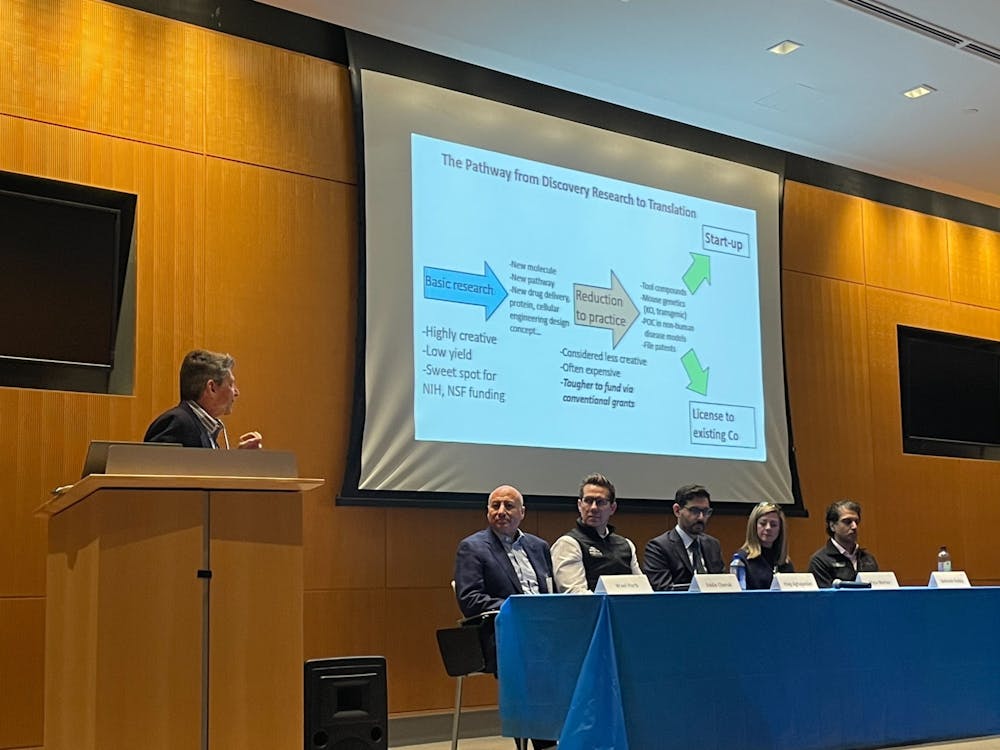
How does research become reality? How do findings in the lab reach the clinic? On Wednesday, March 11, at the Johns Hopkins Translational Immunoengineering (TIE) Symposium, various experts shared their insights on these questions during an enlightening panel discussion.
In a world driven by science and technology, research continually redefines how people live. Practically every human will turn to medicine for relief in times of illness. And in these fields, few names are as recognizable as Johns Hopkins University. Within the research “garden” in the University, investigators pour their efforts into growing and harvesting “fruit” — perhaps a new molecule, pathway, protein, therapeutic or medical device. Yet, the greatest challenge lies in ensuring that those fruits can be shared widely and enjoyed by many, a process that depends on successful translation and commercialization.
The process of translating research discoveries into practical and accessible solutions presents numerous obstacles — such as in securing ample funding, scaling from lab to mass-production, navigating conflicts of interest, maximizing sustainability and upholding ethical standards. The discussion largely centered around the idea of a “reduction to practice.” Namely, a discovery must be extensively validated and optimized in real-world models — animals, prototypes or early clinical studies — to develop a reliable product. Indeed, translating discoveries often requires moving beyond the academic lab into the private sector, involving start-ups or licensing of findings to existing companies.
Although basic research endeavors are often viewed as more creative and receive more NIH or NSF funding, the “reduction to practice” stage is often seen as less creative and more expensive, making it tougher to fund via conventional grants. Locally, examples of funding sources for translational ventures include the Maryland innovation initiative, Johns Hopkins Technology Ventures and Blackbird Laboratories. Additionally, the PAVA Center for Entrepreneurship serves as the University’s main source of early-stage startup funding. Such programs aim to provide mentorship, legal and logistical support and access to investors, helping promising research set out on the path to translation.
Eddie Cherok, chief business officer at Blackbird Labs, a Baltimore-based startup incubator, oversees the organization’s investment ventures. When considering what makes an idea investable, Cherok highlighted that the target population remains the first priority. How could it address the currently-unmet needs of end users, such as patients? A recurring theme throughout the discussion, in fact, was this patient-first mindset. What matters is how the idea will reach patients and help them in new, substantial ways. To that end, it is imperative to work closely with clinicians in order to truly understand and address the relevant issues and concerns. Additionally, researchers must consider how their idea compares to previous technologies or approaches and how it will fit into current practices. Rather than focusing solely on discovery, researchers must think ahead to how their work will be used in practice while considering feasibility, scalability and competition.
One noteworthy story shared during the discussion is that of Haig Aghajanian, an Assistant Professor of Medicine at the University of Pennsylvania, who furthered his translational pursuits by officially founding the company Capstan Therapeutics in November 2021. Making such a substantial transition from academia to industry is unconventional but not entirely unheard of. As Aghajanian explained, he did not originally plan to walk this path. Rather, it came as the logical next step for him, driven by a desire to bring innovative technologies to patients. Aghajanian specifically focused on developing in vivo CAR T-cell therapies to treat cancers and autoimmune diseases. These therapies involve genetically programming a patient’s own T-cells to recognize and attack disease, offering a highly-targeted and potentially transformative approach to cancer treatments. In Aghajanian’s words, the ultimate realization was clear: advancing his ideas to the clinic required going to the private sector. Yet, at times, his vision became clouded by adversity.
Not only did the shift come with a steep learning curve, as academia and industry operate under fundamentally different expectations and cultures, the COVID-19 pandemic disrupted his lab and research trajectory. Aghajanian described how the closing of his lab and difficulty in re-establishing his academic career constituted a difficult time in his life. In spite of such difficulties, however, he kept pushing and looking for opportunities, dedicating himself to the development of Capstan and embracing the role of a “reluctant entrepreneur” to continue his passion for translation. Aghajanian noted that the company’s success largely stemmed from its academic culture, in which innovative ideas were constantly generated and openly shared through publication, contrasting with the self-interest often prioritized in industry.
The potential of Capstan’s CAR T-cell therapy has been recognized — so much so that the biopharmaceutical company AbbVie paid a record-breaking $2.1 billion to acquire it in June 2025. Now that Capstan has been acquired, Aghajanian finds himself at another crossroads in his career. Yet, his overarching goal remains the same. Whether in academia, industry or a new venture, Aghajanian expressed a continued interest in bringing novel technologies to the clinic, suggesting that his journey in translation is far from over.
So, how does research become reality? As the discussion and Aghajanian’s journey made clear, there is hardly a single answer or a single path. Translation is a complex, iterative process defined by the collaboration of many hands and minds, the persistence to get back up again and again and the courage to step beyond traditional boundaries. And what better place to strive for these ideals than at Hopkins? In the end, discoveries only matter if they reach the people who need them. Sustained efforts are needed to push discoveries out of the lab and into the world, where they can truly make a difference.