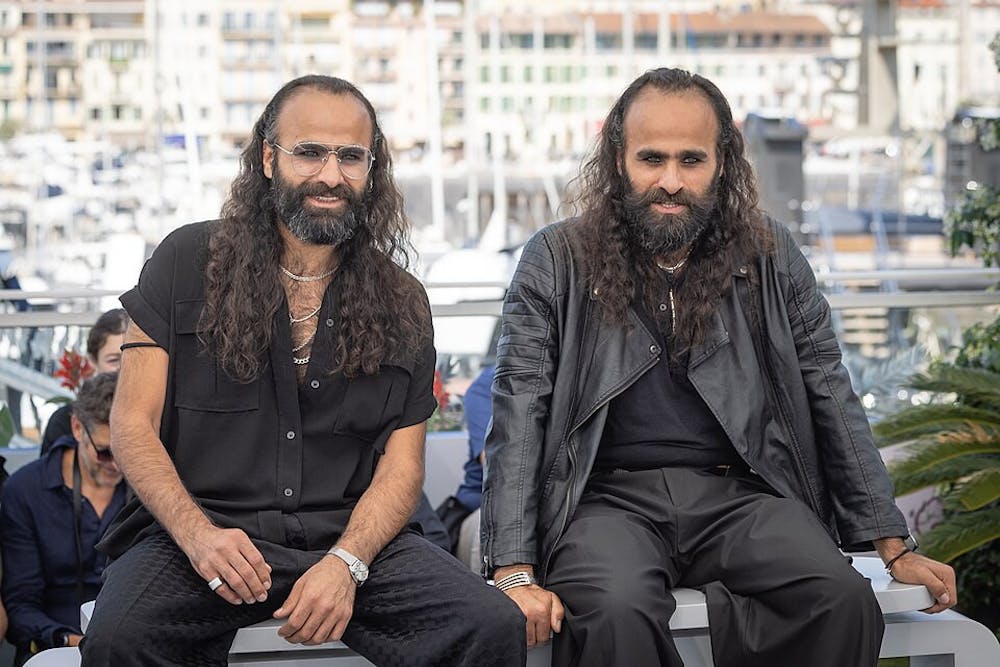
The Nasser brothers’ feature film Gaza mon amour, in its manageable one-and-a-half hour runtime, lumps subtle commentary on contemporary life in Gaza in the same package as well-timed satirical humor that has many viewers laughing out loud. The film made $58,090 in the international box office and served as Palestine’s representative for Best International Feature Film at the Oscars in 2022.
While named quite similarly to Alain Resnais’ 1959 romantic drama Hiroshima mon amour, a hallmark of the French New Wave, Gaza mon amour paves its own path entirely, with an entirely different focus and outlook on its subject. Resnais follows a whirlwind love affair that takes place in Hiroshima between a French actress with a history of trauma and a Japanese architect, while focusing on commentary about war, the cruelties of the hydrogen bomb and the incredible pain and fear that comes with forgetting. Rather than an explicit war commentary told through the lens of a romantic relationship, Gaza mon amour uses the dreary nature of its setting and its characters as a backdrop for a heartwarming story about the possibility of love, of finding both love itself and the courage to pursue it in unlikely places and at any stage of life.
The film follows Issa (Salim Daw), a 60-year-old fisherman who begins to fall for the widowed seamstress Siham (Hiam Abbass) when he sees her daily at the market while bringing his catch to sell. The monotony and unsatisfactory nature of everyday life is lamented throughout the movie by the various characters’ money troubles, the vocal complaints of Issa’s friend Samir (George Iskandar) and Siham’s lackadaisical divorcée daughter, Leila (Maisa Abd Elhadi). Throughout the film, Issa’s well-meaning but overbearing sister Manal (Manal Awad) attempts to introduce him to women he could marry since she disapproves of his chosen bride.
Just as the viewer begins to settle into what seems a humorous but likely predictable film, Issa pulls something unexpected up in his net: an ancient bronze statue of Apollo that Issa later accidentally severs when trying to hide the statue in his closet. This portion of the story is full of comedy and feels absurd, but it is based on a real story of a fisherman finding an ancient statue which was then confiscated by Hamas in an attempt to sell it to a museum or another nation.
This all sets the stage for the tone and plot of the rest of the film. Comedic scenes — Issa admitting his wet dream to a government official, an attempt to sell the statue’s detached phallus at a pawn shop, dancing to Spanish love songs while cooking fish, over-shortened pants — are strewn throughout events that could otherwise feel devastating, heartbreaking or pitiable. These include moments of conflict between Issa and Manal or Siham and Leila, Issa’s arrest, the explosion of an Israeli bomb, or constant electricity cutoffs leading Siham to roll bread in the dark. Such a juxtaposition adds layers to the tone of the entire movie since undercurrents of sadness flow beneath scenes that are primarily farcical and even the most joyous moments have a tinge of creeping bleak reality seeping through.
The bleakness of the film’s setting is further established by Christophe Graillot’s cinematography. The underdeveloped urban landscape is washed out, filled with grays, blues and khaki tones. One need only glance at the shot of Issa holding his umbrella over Siham, perhaps the film’s most iconic scene, to see this in full effect. This develops the dichotomy that makes the film so powerful — that of satire and solemnity — on a scale within the sphere of power in film that literature does not have: its visual language.
There are multiple instances of visual elements throughout the film that illuminate the characters’ personalities and histories. For example, encouraged by Manal on a visit to Issa, one of the women allows a larger opening of her burka to show more of her face (in contrast to the other women who wear hijabs or less concealing headscarves). However, she quickly readjusts it upon the arrival of men from the government. This small moment gives insight into the culture and gendered dynamics at play in the setting’s specific cultural scenarios.
Gaza mon amour leaves viewers a lot to grapple with after watching. As someone to whom the landscape of the movie is entirely foreign, but also someone who lives in a world inundated with news about Palestine, it certainly left me questioning some of my own preconceptions. I walked into the screening expecting to feel disturbed by bleak commentary on Zionism, Palestinian nationalism or war. But when I left, I felt entirely the opposite: I felt joyous and hopeful. I would smile recalling some of my favorite moments from the film, and this remains true even while writing this.
I was given the opportunity to see this film by the series on “Love and Family in Palestinian Cinema” hosted by the Global South Humanities Initiative in the University’s Alexander Grass Humanities Institute. This series gives Hopkins students and affiliates a wonderful opportunity to engage with Palestinian voices through film, with screenings every couple weeks throughout the 2026 spring semester. As I grapple, then, with my own inherent biases and a seeming expectation that all art from a war-stricken country must be centrally about war, I can only encourage everyone to take any opportunity you have to challenge your own biases in the same way.