Everyone who really knows me knows that I am ethically non-monogamous when it comes to careers. Even majors. At the end of all the one-night stands with strangers that I don’t have, I hear wedding bells and buy joint burial plots before the sun rises. The way that you imagine moving to a city after spending two days visiting, I flirt with the idea of dedicating my life to a career after one tenuously relevant experience. When I stitched closed the neck of a decapitated stuffed doll the other day, I imagined my name towing the credentials MD.
I’ve suffered this lifestyle for a long enough time now. In middle school, my career aptitude test came back with four “excellent” matches: OB/GYN, midwife, coroner and funeral director. (Crane operator ranked last.) I don’t know what I answered to inform those results; but somehow, like a reading from an off-base psychic, this made me trust it more.
My results were like scarlet letters. Few people demand more men to involve themselves in women’s health, or at least no one seemed thrilled at the thought of me in pink scrubs. On the other hand, adults were wary of encouraging a middle schooler to set his sights on dead bodies. Lively company is important.
Nowhere on my list do I remember seeing writer. Perhaps I didn’t earn it, or maybe the quiz makers didn’t want to encourage that behavior — like those signs in parks, “please don’t feed the geese.” Maybe the odd menagerie of OB/GYN, midwife, coroner and funeral director was as close as the test could come to saying writer. Or maybe I should apply myself to earning a useful degree with a return on investment as much as I do to practicing alchemy with these test results, creating my own conclusions from mismatched evidence pointing in different directions.
The thing is, as with writing, these careers are all about beginnings and endings. As an OB/GYN or midwife, you’re there for the beginning of life; as a coroner or funeral director, you’re there for the end. Cutting a newborn baby’s umbilical cord may not be the same as world-building or writing exposition, and embalming a corpse is surely different than tying together loose ends in a conclusion. However, the propensity to be present for these milestones granted to every life is shared between all of these careers, writers included.
I have a hatred for things that follow me, but then again, that isn’t completely true. I hate things that follow me that I already don’t like, or things that I’m lukewarm to at best. As a child, I remember feeling stressed when my grandma told me that the sun she sees at her house is the same one that follows me, but I was comforted when my aunt told me that everyone sees the same moon. I’m soft for dogs who follow me, but obsessed cats put me on edge.
The thing that’s been following me throughout this article is the same thing that follows me every time I write: the feeling that, no matter how hard you try, you’re always saying everything wrong. Have you seen the Reddit post about the immortal snail? That’s how I feel. A question that I’ve never been brave enough to add to the discussion: What if I have a crush on my snail?
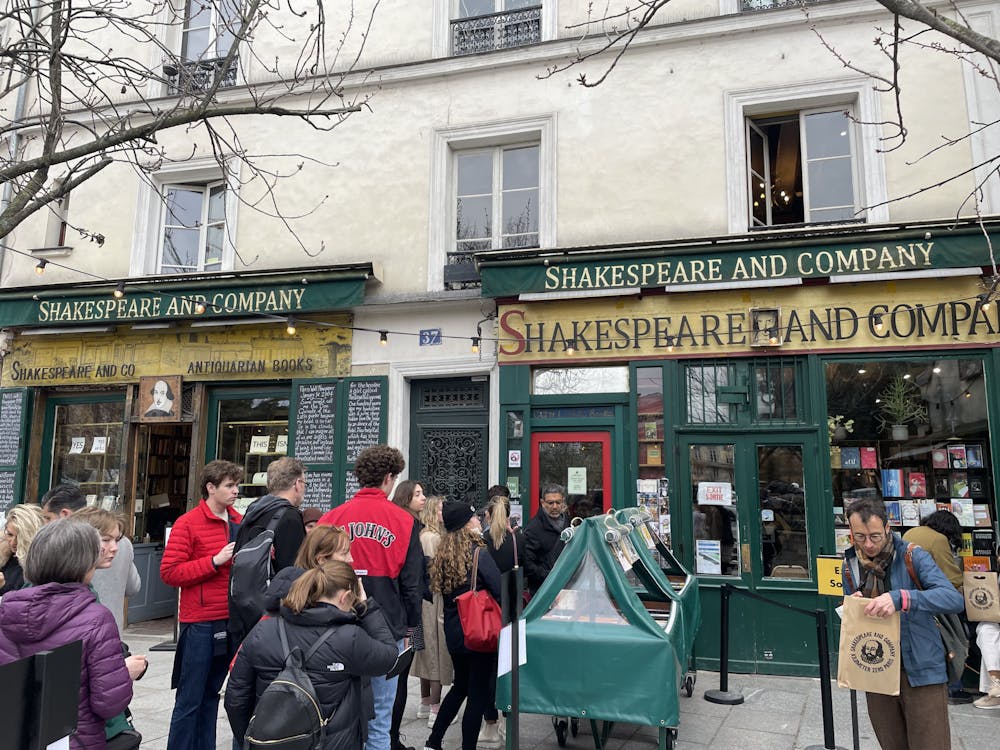
Of course, I’m not talking about the snail. Rather, I have a crush on the maybe malicious thing following me. Ever since I was a junior in high school and feeling pretentious returning from a school trip to Paris, reading Jacques Lacan’s psychoanalytic theories on the plane, I’ve resigned to the fact that language is a leaky ship trying to communicate our ideas to one another across violent oceans. Then again, that middle school test told me I could be bringing in almost $300,000 per year as an OB/GYN, and here I am majoring in creative writing. I must have a good reason, so why?
Because I like when things I like follow me, like the feeling like I’ll never be able to communicate myself through writing well. Isn’t that sentence proof enough — using the word “like” four times in two different meanings? Did my words even make sense in the end?
In a talk I gave to a first-year seminar on poetry the other day, I had to answer “Why poetry?” Honestly, for something I’m majoring in more or less, I had never given it serious thought. The thing I can’t escape — the fact that it’s impossible to communicate yourself with full accuracy through writing — showed itself to me once more as I thought through my answer. I believe that language inevitably creates some level of misunderstanding in every instance it’s employed, so why do we value language arts in equal measure as wordless arts, like painting or music? Wordless arts, by nature of avoiding language, avoid miscommunication. Why do I choose language arts above all else, even those wordless arts with which I’ve rendezvoused?
Consider if the tortoise never beat the hare. If the hare were still a feckless jackoff, and the tortoise still tried with all his might only to be beaten out by the hare centimeters before the finish line, would we suddenly prefer the hare in favor of the tortoise only because of the outcome? Just because the underdog only comes close to succeeding but ultimately fails doesn’t cause us to retire our loyalties. We root for the writers and poets not because they succeed in overcoming language’s fated misunderstanding, but because they come the closest to it and fail proudly, landing among the stars and closest to the moon compared to the wordless arts who enjoyed comfort on Earth. Yes, wordless arts work as tirelessly as language arts, but I believe the tools they use — colors, sounds, motions... — are closer to our prelingual understanding of the universe than the words that writers necessarily employ.
I may never be an OB/GYN or midwife or someone who knows about beginnings in speechless and unwritten irrefutable ways. I may never be a coroner or funeral director, who’s knowledgeable about the end like a bend in a familiar road.
Instead, I’m a writer who awkwardly attempts to communicate these themes and more like carrying buckets of restless water, and when I stumble and spill it all just before my destination, everyone laughs. No one blames me, and everyone is maybe a little bit happier because of it all, even if their lips are chapped and mouths dry.
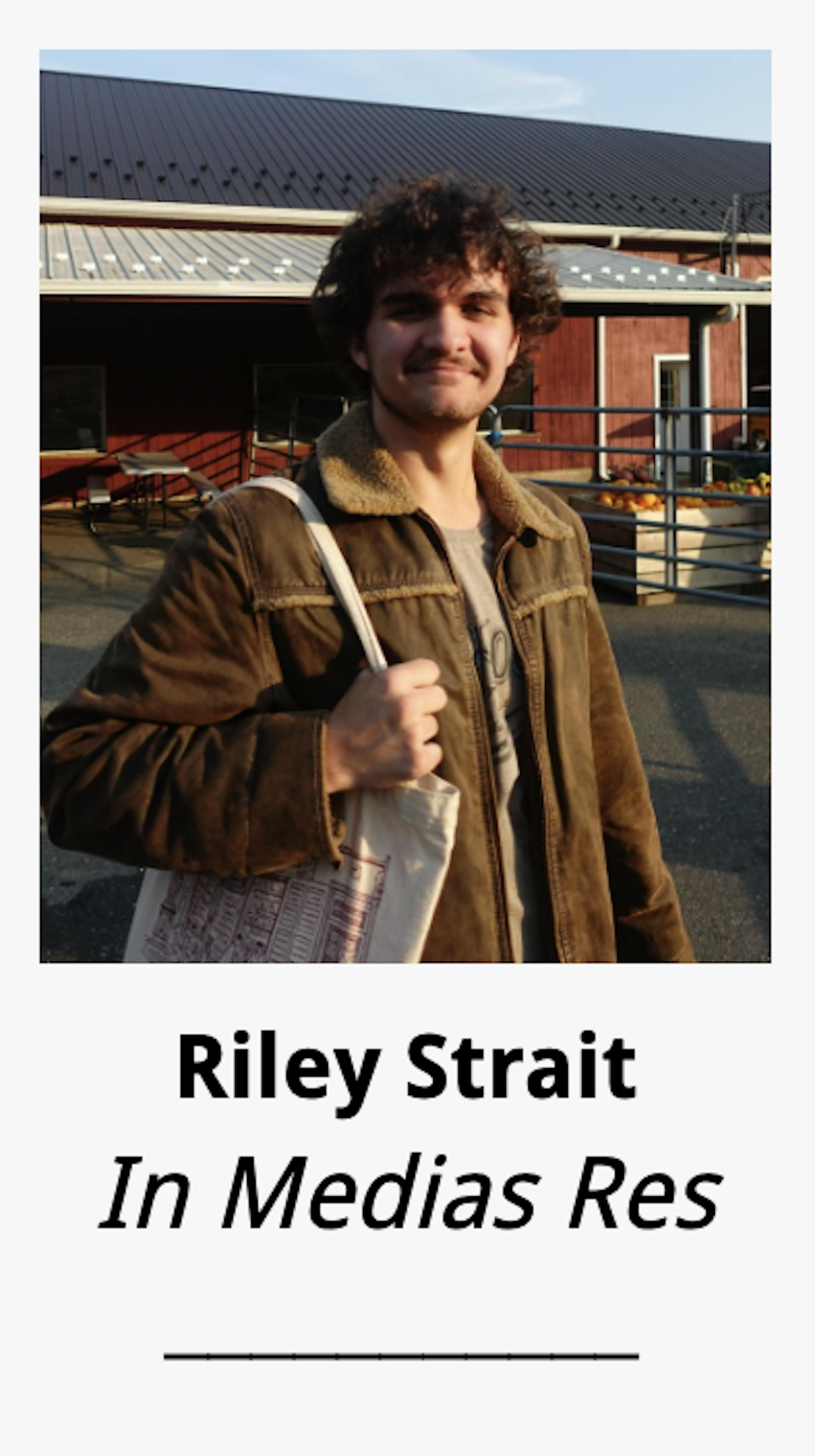
Riley Strait is a sophomore from Olathe, Kan. studying Writing Seminars and English. He is an Arts & Entertainment Editor for The News-Letter. His column, "In Medias Res," translates from Latin to "into the middle of things," shares narratives that bury occasional insights within fluff that often leave the reader wondering, "Did I ask?"