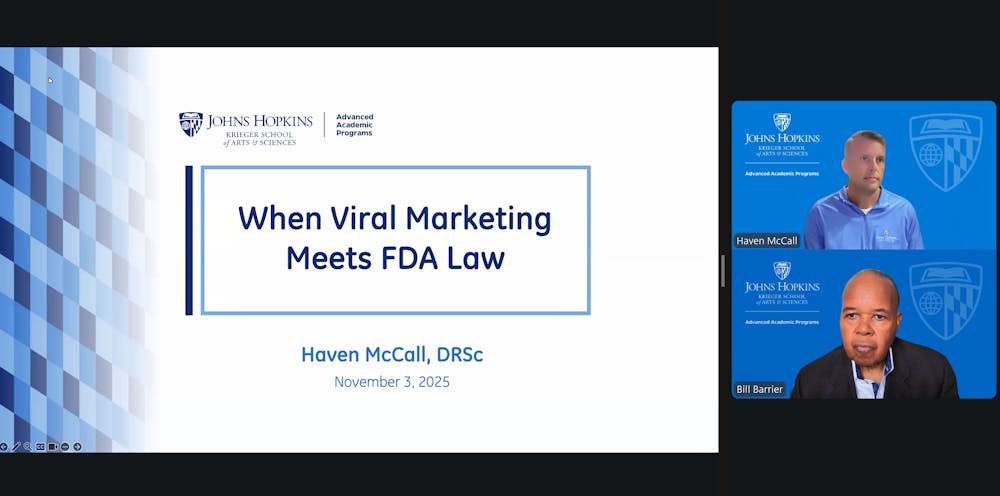
On Monday, Nov. 3, Haven McCall — a lecturer for the Master of Science (MS) Regulatory Science and MS in Biotechnology programs at Hopkins — gave a presentation on “When Viral Marketing Meets FDA Regulations.” This discussion is one of many that comprise the ongoing “Regulatory Matters” webinar series. McCall has been working in Food and Drug Administration (FDA)-regulated industries for a total of 25 years, with experience in areas including drugs, devices and biologics.
Throughout his presentation, McCall emphasized the importance of identifying and preventing viral marketing practices that are non-compliant with FDA guidelines. He did so by analyzing a series of case study examples that encompass a wide range of topics, from cosmetics to supplements.
The first case example McCall introduced was a promotional post the reality star Kim Kardashian made in 2015, which amassed around half a million likes within the span of only a few days. In the post, Kardashian gave a personal testimony of the product that included misleading claims and additional aspects that were not compliant with FDA regulations.
“The FDA issued a warning letter for the company, and it required not just the post to come down, but it [also] required Kim Kardashian to do a new post promoting the product within the lines of regulation,” McCall said. “This really began the FDA’s active surveillance on social media when companies, celebrities or individuals make claims about products.”
McCall acknowledged that it is the responsibility of companies to monitor their social media promotions, making sure their products are being advertised in the manner it was approved for under FDA guidelines. However, it is not only social media posts that are subject to FDA law.
“Any post anywhere that discusses a regulated product is considered a promotion by the FDA,” McCall said. “[This] means that a company is responsible for what they say, not just in their ads or interviews, but their comments. It also means that third parties are held within those regulations.”
One case study McCall covered that did not pertain to a social media post involved Jim Bakker, a televangelist. Bakker had made a false claim about his product, named "Silver Solution," stating it has the ability to kill COVID-19 viruses, despite there being no scientific or medical proof to support that claim. According to McCall, the product sales instantly rose as a result of his comment alone, and as a result, many consumers ended up ingesting dangerous amounts of it and suffered various side effects such as turning blue.
Furthermore, McCall delved into skincare- and beauty-related case studies involving popular brands.
“Supergoop! has a product they launched with the claim of an SPF of 50. It was a sunscreen product,” McCall said. “When they made this claim, they did so without following the regulations. They did not get approval or clearance from the FDA, and they did not follow the monograph requirements to do this.”
Similar to other cases discussed, the FDA issued a warning letter and released a public consumer report regarding the number of severe sunburns and skin reactions resulting from the false claims surrounding the product. However, he highlighted that the presence of viral marketing differentiates this case from other such cases, such as the aforementioned Bakker’s “Silver Solution.” Although it was certainly creative and trendy, he reiterated that these factors cannot replace compliance.
“Viral marketing and FDA law can coexist,” McCall said. “Again, creativity and compliance: they don’t have to be enemies. The key is integrity. The key is creating content that excites people but doesn’t endanger them. And when we pair innovation with compliance, we protect patients and preserve trust and ensure that good companies stay out of bad headlines.”