University considers closing department
Martine Rothblatt, a transgender activist, the founder of Sirius Satellite Radio and CEO and founder of United Therapeutics, spoke in Shriver Hall on Wednesday as part of the Milton S. Eisenhower Symposium (MSE).
DeRay Mckesson, an activist and Baltimore public schools administrator known for his leadership within the Black Lives Matter (BLM) movement, offered suggestions for furthering the movement at the Milton S. Eisenhower (MSE) Symposium on Oct. 20.
Kathryn J. Edin, a Bloomberg Distinguished Professor of sociology and public health, held a keynote presentation in the Shriver Hall this Tuesday that centered around her book $2.00 a Day: Living on Almost Nothing in America.
The Hopkins chapter of the Alexander Hamilton Society hosted a debate on Russian influence and foreign policy in the Middle East on Wednesday, Oct. 26 in Charles Commons. The debate featured Robert Freedman, a political science professor and Michael Singh, a national security expert from the Washington Institute for Near East Policy. Steven David, a professor of political science, moderated the discussion.
Executive Director of the Commission for Historical and Architectural Preservation, Eric Holcomb, spoke about urban planning and the development of Baltimore suburbia on Monday, Oct. 24 at Gilman Hall.
Having first endorsed the Trump-Pence campaign via their Facebook page on Sept. 26, the JHU College Republicans issued a follow-up statement last week to justify their initial endorsement.
LGBTQ Life at JHU and Johns Hopkins Organización Latina Estudiantil (OLÉ) hosted a discussion on the intersection of immigration and queer identity.
The Humanities Center hosted a lecture by Samuel Moyn, the Jeremiah Smith, Jr. professor of law and history at Harvard University, on Oct. 20 in Gilman Hall. In his lecture, entitled “The Doctor’s Plot: the Origins of the Basic Philosophy of Human Rights,” Moyn argued that Henry Shue, a moral philosopher writing in the 1980s, was the first person to articulate a philosophical defense of global human rights.
Baltimore native Kevin Shird discussed his recent book, Uprising in the City: Made in America at Red Emma’s Bookstore Coffeehouse on Saturday. The book explores the peaceful and violent protests in Baltimore over the death of Freddie Gray, one week after his April 2015 arrest.
The Humanities Center (HC) was founded in 1966 under the guidance of Milton S. Eisenhower, then president of the University. Eisenhower’s goal was to promote the study of the humanities at Hopkins, which had been undermined by a significant shift in the University’s academic focus toward the study of the sciences.
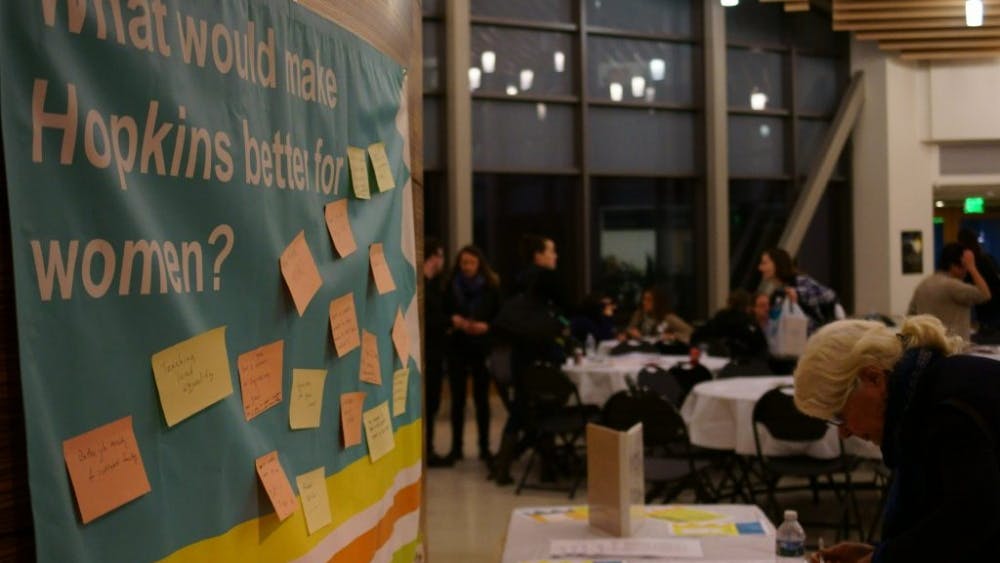
In celebration of some of its most accomplished female affiliates, the University held a ribbon cutting ceremony for the new Women of Hopkins installation at the Mattin Center courtyard on Tuesday afternoon.
Kyriakos Mitsotakis, leader of the political opposition in Greece, spoke on Friday about the country’s years-long debt crisis. Mitsotakis is the current president of the center-right New Democracy party, the second largest in parliament.
Baltimore State’s Attorney Marilyn Mosby spoke about her fight for criminal justice reform and the future of activism in the city at the Interfaith Center on Thursday, Oct. 13. She specifically called upon the Hopkins community to bolster its efforts in advocating social change in Baltimore.
In an exclusive interview with The News-Letter, His Excellency Tiéna Coulibaly, the Malian ambassador to the U.S., discussed the changing political landscape in his country and the importance of his diplomatic role in Mali’s economic development.
The Masculinity Project hosted a discussion titled The Psychology of Masculinity and Sexuality on Monday, Oct. 18. The project, which was piloted this semester, is a collaboration between the Gender Equity Office and LGBTQ Life and aims to host events throughout the year, including film screenings and student-led discussions.
Alex Hirsch, assistant political science professor at the University of Alaska, Fairbanks, presented his paper, “Hope against Hope: Counter-actualization in William Apess’ Native American political thought” as part of the Fall 2016 Colloquium Series, sponsored by the Program in Racism, Immigration and Citizenship (RIC).
J Street U, a self-described “pro-Israel, pro-Palestine, pro-peace” organization, hosted “Stop the Demolition of Susya,” an expression of solidarity with the Palestinian village of Susya, that explored the greater context of the Israel-Palestine conflict.
Professor Michael Dorf, the Robert S. Stevens Professor of Law at the Cornell University Law School gave a lecture titled “Does the Dead Constitution Have a Future?: Reflections on the Legacy of Justice Antonin Scalia” on Tuesday at 8 pm in Hodson Hall in an event hosted by The Academy at Johns Hopkins.