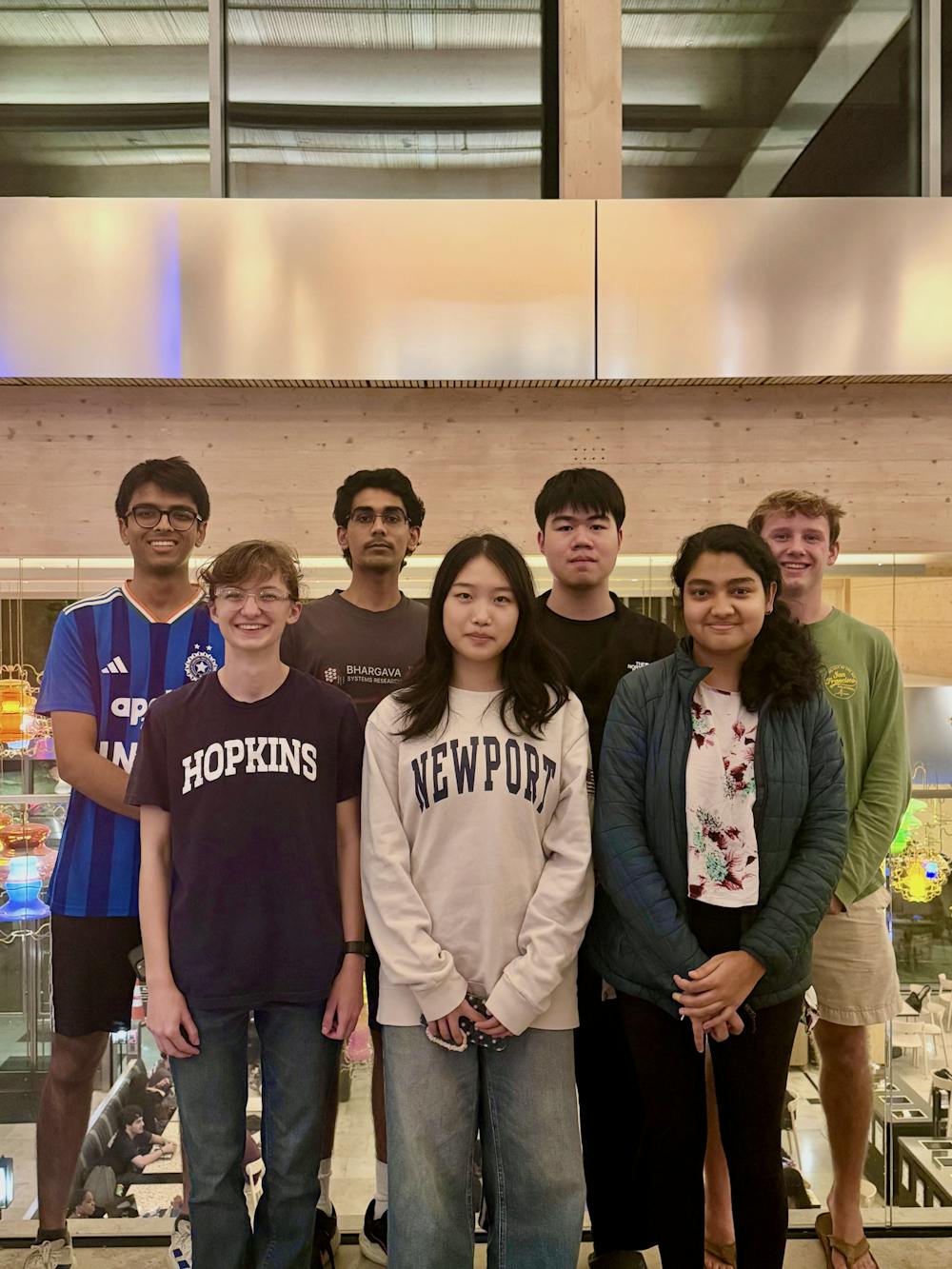
As complicated as it may sound, protein engineering can seem like a field reserved for professionals with years of specialized training. One undergraduate team at Hopkins, however, is challenging that assumption.
UPET, a student-led protein engineering group at Hopkins, has been selected as one of 30 teams worldwide for the top track of an international protein design competition supported by Anthropic and Adaptyv Bio. The so-called “Track 1” is meant “for labs and companies with significant protein design expertise and experts in at least one competition problem area.” As a result, UPET received $50,000 in Claude credits, $10,000 in GPU computing resources from Modal and guaranteed experimental testing for dozens of its protein designs.
The group is mentored by Jeffrey Gray, a professor of Chemical and Biomolecular Engineering at the Whiting School of Engineering and principal investigator of the Gray Lab, which researches computational and structural prediction and design involving glycans, membrane proteins and protein crystals.
The protein engineering UPET works on spans a wide range of complex problems. At its most basic level, however, protein engineering involves designing or modifying proteins to perform a desired function.
This could mean altering an existing enzyme so it breaks down materials — such as plastic — more efficiently, developing a protein drug that binds to a viral target or creating an entirely new protein with properties that have not previously existed in nature. In the Anthropic competition, UPET is tasked with designing, among others, intelligent therapeutics for next-generation medicine, including a pH-sensing tumor-specific EGFR binder for the first week.
In an interview with The News-Letter, Jonathan Ouyang, founder and president of UPET, explained the versality of protein engineering, both as a field that allows researchers to both modify existing proteins and design entirely new ones.
“You can either take existing proteins and adapt them, or, increasingly, you can generate proteins de novo, or from scratch,” Ouyang explained.
Ouyang had been drawn to protein engineering even before coming to Hopkins because of its potential to improve human health and quality of life.
“When I was going to college, I just wanted to do protein engineering,” Ouyang said.
That drive eventually became UPET: a space for undergraduates to simply do protein engineering.UPET is unique in its structure. It differs from a traditional research lab in one important way: students do not need years of prior experience before they can begin contributing.
The structure also creates a fast-paced learning environment that differs from traditional academic work.
Yash Bhargava, UPET’s simulation expert, described the pace of the competition in an email interview with The News-Letter.
“One thing I enjoy about UPET is how fast-paced it is. Right now, we’re participating in a competition where a new challenge is released every week, requiring a very different approach from traditional academic work. We’re pushed to understand a new biological problem, come up with design approaches, test different methods and iterate almost immediately,“ Bhargava said.
More than half of the organization’s members have no previous background in protein design and come from a variety of disciplines, ranging from Cognitive Science to Biophysics. Rather than treating that as a barrier, UPET has made education one of its central priorities.
With an emphasis on democratizing access to protein engineering, Ouyang believes the field is far more accessible than many students assume.
“These are things that are much more accessible than the average person thinks they are,” Ouyang said.
Ouyang compared scientific research with activities such as writing or playing music. Students often feel comfortable practicing those activities without asking for permission, he explained, while research can feel as though it requires passing through several institutional gates first.
“You can do real, good work,” Ouyang said, “and you don’t have to be screened by a lab or be mentored for years.”
But Ouyang’s ambitions for UPET extend beyond making protein engineering more accessible. He also sees AI fundamentally changing what undergraduate researchers can design.
With support from Anthropic, Ouyang hopes to expand the role of AI in protein design beyond prediction models and models trained on raw data. He envisions using agentic AI systems to oversee multiple aspects of the design process, including reasoning over biological data, interpreting experimental results and proposing how a molecule should be changed next.
Traditionally, scientists examine a structure and decide whether to alter a charged region, introduce a new interaction or mutate particular amino acids. AI systems may increasingly be able to participate in that reasoning process, making protein engineering more efficient.
For Ouyang, the competition is only the beginning. He envisions UPET growing into a hub for original research, patented protein designs and collaborations with Hopkins laboratories to design proteins, and, eventually, into a group capable of hosting a protein design competition of its own.