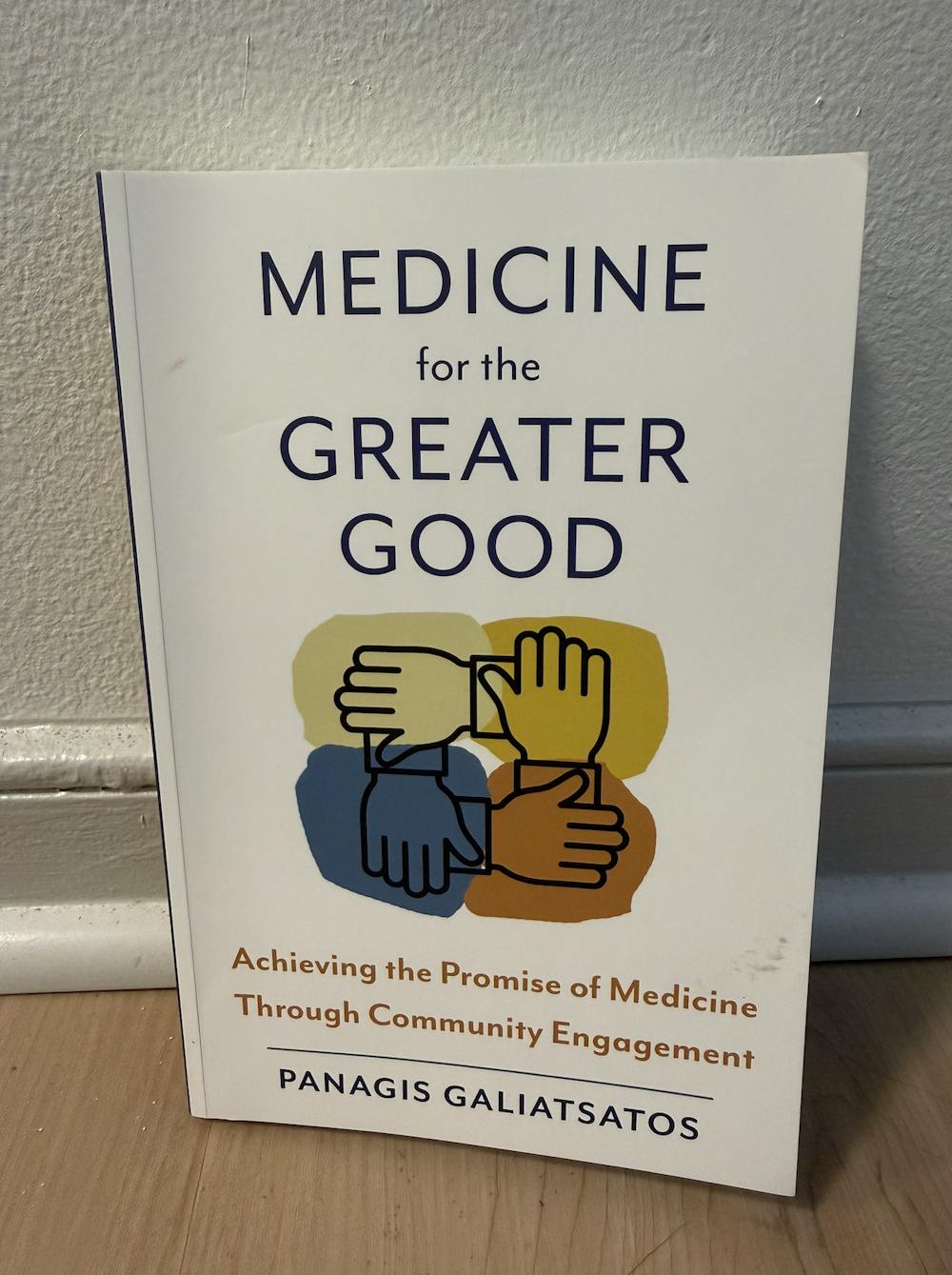
In a talk introducing his new book, Medicine for the Greater Good: Achieving the Promise of Medicine Through Community Engagement, at the local coffee shop Bird in Hand, Assistant Professor at the Johns Hopkins School of Medicine Panagis Galiatsatos reflected on Baltimore and the importance of community trust when it comes to doctors providing care to patients beyond the clinic.
In Galiatsatos' eyes, medicine does not begin when a patient enters a hospital. It begins at the patients’ schools, homes, neighborhoods and churches. Giving care and personalizing it starts at the places where people live long before they become patients.
Drawing from years of community work throughout Baltimore as well as his Baltimorean upbringing, he reflected on his experiences with community that pushed him to reconsider the traditional boundaries of a physician’s role.
The idea for this book, he explained, came about years earlier when he was still completing his medical training. After hearing Galiatsatos describe his approach to community engagement, one of his mentors told him: “You should write a book.”
At the time, Galiatsatos said, writing one seemed unrealistic while he was still trying to finish his medical training. Years later, however, the suggestion stayed with him as his work increasingly brought him outside the hospital and into Baltimore communities.
Eventually, the questions he received from others changed as well. People no longer only wanted to know what he was doing; they wanted to understand how they could do it themselves.
“What is your approach? How do you begin to do this?” Galiatsatos recalled people asking.
The resulting book is partly an answer to those questions. But Galiatsatos emphasized that he did not want it to function simply as an instruction manual. Instead, he described it as an “ode to Baltimore,” with stories of community members who shaped his understanding of medicine and challenged assumptions he carried with him as a physician.
One story Galiatsatos shared involved his early work with Armistead Gardens, an East Baltimore community. It’s considered an urban island, creating practical barriers to health care such as transportation, and the students in this community were frequently missing school because of asthma.
His first instinct was a medical one. Baltimore had pediatric pulmonologists, major hospitals and extensive healthcare resources. If asthma was keeping children home from school, he initially wondered why those resources were not solving the problem.
But going into the community changed the question.
A prescription could treat asthma, but it could not guarantee that a parent working long hours could reach a pharmacy. A specialist could recommend care, but that recommendation meant little if transportation made accessing it difficult. Health outcomes, he realized, were being shaped by factors that could not be understood from an exam room alone.
Those experiences forced Galiatsatos to confront the assumptions physicians can make when they encounter a patient's illness without encountering the conditions surrounding it.
The lesson became central to his broader argument: physicians cannot address health disparities exclusively through better treatment after someone becomes sick. They must also understand the social circumstances that repeatedly bring patients back into the healthcare system.
For Galiatsatos, that requires presence.
“Half the job that we’ll do is just showing up, listening to them, standing in it and trying to find resources,” Galiatsatos said.
Throughout the talk, Galiatsatos returned repeatedly to the idea of “showing up.” Community engagement, in his telling, is not a one-time screening or outreach event. Physicians must spend enough time in communities to understand their priorities rather than arriving with predetermined solutions.
That distinction becomes especially important amid declining public trust in medicine.
Galiatsatos argued that healthcare institutions have traditionally expected patients to come to them. Hospitals and clinics remain essential, but they represent only one part of people’s lives. Schools, churches, neighborhood organizations and other community spaces may hold relationships that stretch back years.
If medicine wants to regain trust, he argued, it must become present within the places people already trust.
Understanding these conditions, though, does not make medicine less scientific, Galiatsatos emphasized. It makes physicians better equipped to understand the circumstances in which disease develops.
Galiatsatos acknowledged that physicians cannot individually solve every social problem affecting their patients. But he rejected the idea that this limitation should keep them confined within hospital walls. Sometimes, he suggested, the first meaningful intervention is simpler: entering a community, listening to what people say they need and remaining present long enough to earn their trust.
Medicine for the Greater Good ultimately presents that philosophy not as an addition to medicine, but as part of medicine itself. Treating disease may begin with understanding the body. Caring for a person, however, requires understanding everything around it.