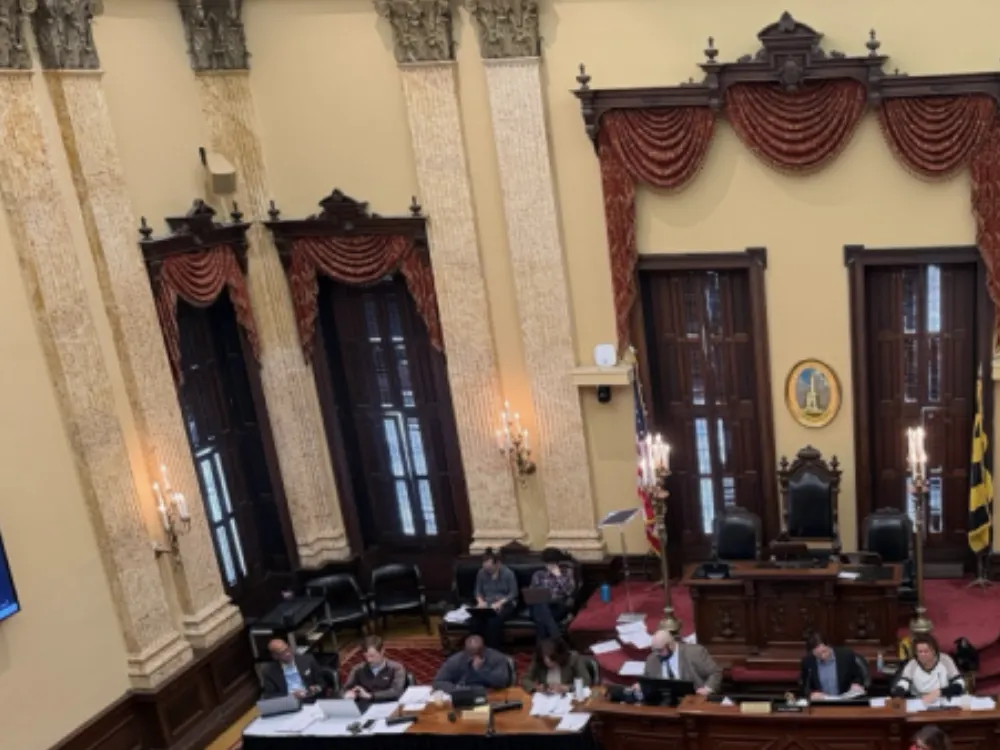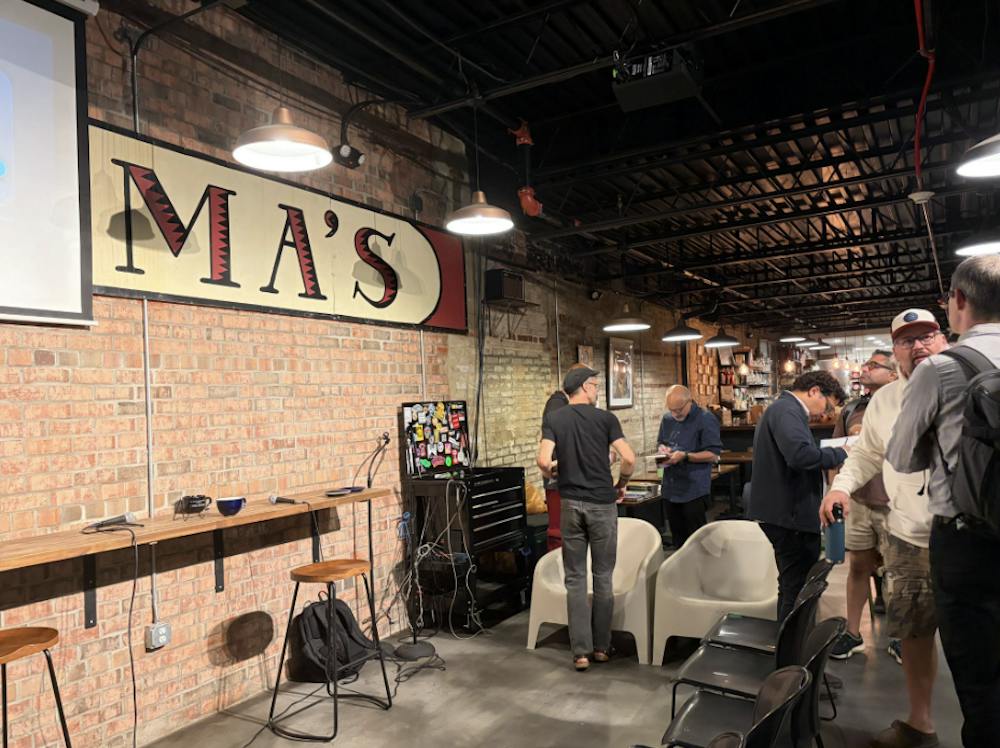
On Thursday, Oct. 1, Cornell Assistant Professor of History Tejasvi Nagaraja presented his new book at Red Emma’s in a conversation with Hopkins Associate Professor of History and Director of the Chloe Center Stuart Schrader.
The event featured Nagaraja’s Troop Movements: Labor, Race, and Global Freedom Struggles in America’s World War II. The book adopts a bottom-up, multi-scalar approach, examining how World War II mobilization brought workers into overlapping struggles over labor, race, citizenship and broader political and societal change during and after the war.
Schrader opened the conversation by emphasizing the book’s attention to ordinary people’s ability to shape political change.
“World War II is thought of as a moment of political consensus, but when you look beneath the surface, there was a lot of contestation and conflict, [...] and a lot of that conflict was powered by workers who were trying to build more equal and racially integrated workplaces,” Schrader commented.
Nagaraja teaches at Cornell’s School of Industrial and Labor Relations. He began his presentation with photographs of actors and activists Ossie Davis and Ruby Dee. By drawing connections between their wartime experiences and their later activism, Nagaraja argued that World War II should not be understood solely as a period of national unity against Nazi Germany and Imperial Japan. Instead, Nagaraja centered defence workers and military personnel who participated in strikes, civil-rights campaigns and protests over working conditions and racial discrimination while contributing to the war effort.
“World War II is not just this nice prologue of unity.” Nagaraja said, “Actually, the conflicts that happened in the early 1940s tell us a lot about the conflicts that would shape the 60s and the 2020s.”
Schrader then asked why Nagaraja places defense-industry workers and soldiers within the same framework.
“The lines were blurred between the foreign and the domestic in this particular war,” said Nagaraja, “tens of millions were serving in the armed forces and the defense industries in what I call a composite workforce, and that created blurred experiences and the possibilities for linked coalitions too.”
Nagaraja also connected wartime racial politics to policing. He recounted the 1942 killing of Black servicemember Thomas Broadus by a Baltimore police officer while Broadus was on leave. The case became a rallying point for local civil-rights activists, labor organizers and students, who organized around demands such as police reform, housing rights and desegregation.
The conversation later widened beyond Baltimore to the immediate aftermath of the war. Nagaraja described 1945 and 1946 as an uncertain period between World War II and the emerging Cold War, when workers and service members across different countries organized strikes and protests while anti-colonial movements challenged European empires.
He pointed to American service members and merchant mariners who questioned support for European efforts to restore colonial control in places such as Vietnam and Indonesia.
“They actually made people-to-people connections in that moment,” Nagaraja said, “and they envisioned another world.”
Returning to the civil rights movement, Schrader asked how the organizing of the 1940s connected to the activism of the 1960s. Nagaraja pointed to wartime migration and military service as opportunities for Black workers to build coalitions across regions and national borders.
“And so that civil rights movement was a labor movement, and that civil rights movement was in tension with policing and incarceration, and that civil rights movement was a global struggle,” Nagaraja said.
Eva Klaus, a student at the University of Maryland, Baltimore County, recalled how the event offered an opportunity to explore activism and meet people with shared interests in an interview with The News-Letter.
“This is one of the events that I liked the most.” Klaus continued, “I actually read part of his book while he was doing the talk, and while of course it's difficult to both absorb the information that I read and listen to his talk, I really liked the amount of depth he went into with his not only his book but his actual talks.”
Baltimore resident Ryan Hardey, who works on global trade policy, said his interest came from the relationship between war and social movements in an interview with The News-Letter.
“Being present in a longer conversation with somebody, especially like Tej, who's such an expert,” Hardey stated. “It just makes us smarter people.”