On Friday, Sept. 25, Hopkins Common Question series hosted Baltimore novelist Kate Reed Petty for “wRiTinG pROmPTs,” a collaborative, time-and place-based writing workshop. This event was the second of 14 events this year surrounding the Common Question: What is art?
Nate Brown, senior lecturer in the University Writing Program and administrator of the Common Question, introduced the event by emphasizing the value of gathering in person to create something that could not simply be reproduced online.
“In the age of Zoom learning and remote working and AI, it’s particularly cool to get together and get to do something sort of analog,” Brown said. “Something that we necessarily can’t replicate again.”
Petty’s writing series grew out of her own questions about storytelling in the age of AI. She said she believes deeply in storytelling as “a very human core art form” and wanted to explore what happens when people write together rather than treating writing as an entirely solitary activity.
“If everybody can write and everybody wants to write, what does that feel like to write together?” Petty asked.
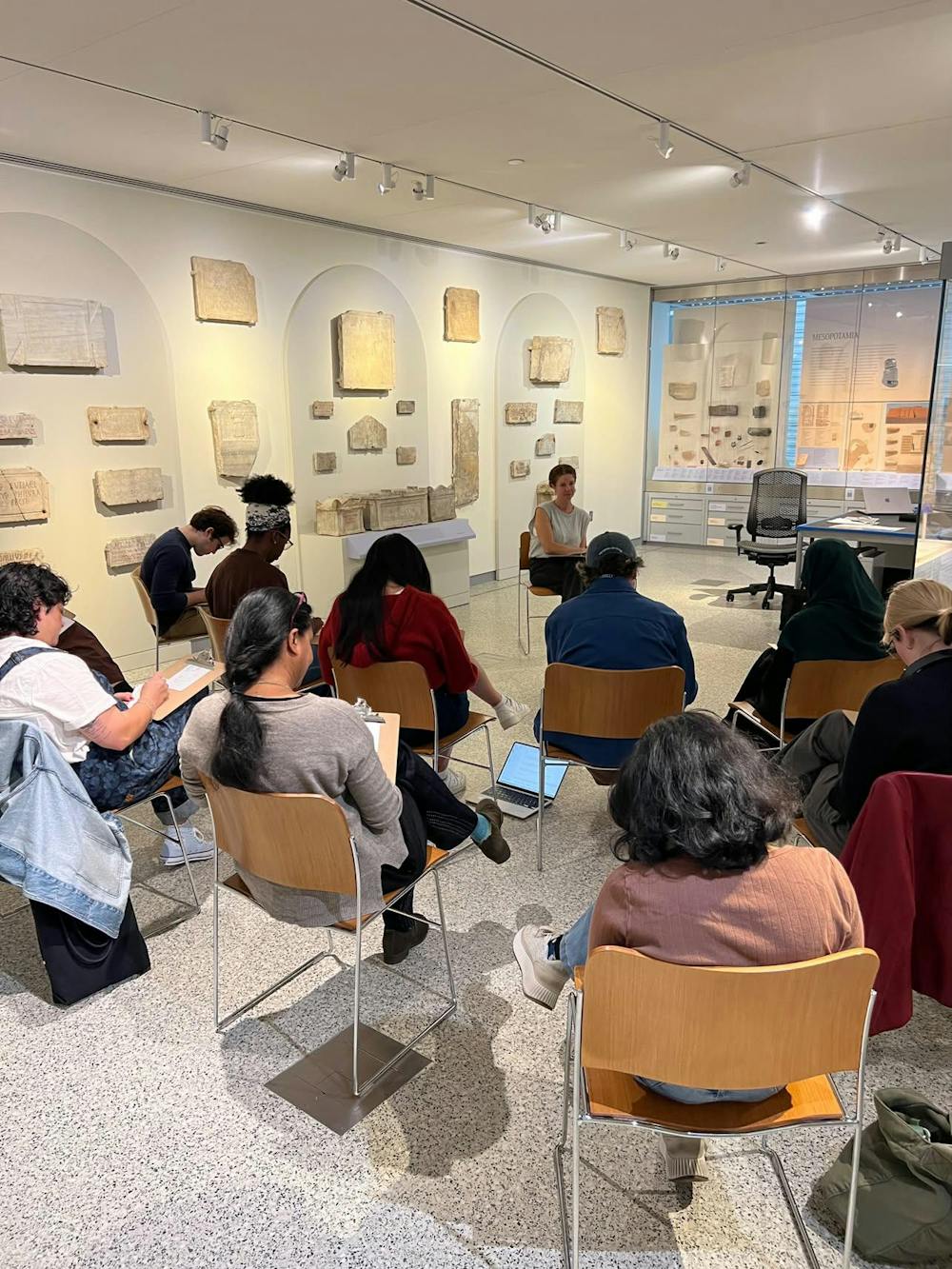
The workshop, which took place in the Archaeological Museum, began with participants sitting on chairs in the middle of the room. They were given a letter and drew a corresponding object — for example, a cupcake for “C”, or a bathtub for “B.” Then, they were brought to a fictional world. Petty narrated a fairy tale about scholars visiting the cabinet of a wealthy “cajillionaire,” where they encounter an octopus trapped inside an aquarium. The octopus, once a sea witch, has spent years trying to escape and ultimately discovers that the scholars may be able to help her through the power of storytelling.
Participants were gradually incorporated into the story, writing on their note cards about their families, their own experiences with stealing, and creating fairy tales involving their assigned objects. The prompts moved from personal reflection to imaginative storytelling, asking participants to invent characters, desires, monsters and enchanted objects.
The unusual, private format was designed to make writing feel less intimidating.
“I just want to reassure you that there’s no way that you can do this wrong,” Petty said. “Whatever you write down is going to be great, and you will not have to share what you write.”
For some participants, the personal prompts helped make the creative writing process easier. Alex Herz, who also graduated in the spring, had done some writing on his own and decided to come to the event on a whim.
“Why not come to this?” Herz said.
Herz thought the event reminded him of “being on field trips to museums when [he] was a kid.”
Petty said that encouraging people to write without the pressure of producing something polished is one of the goals of the series. She has led similar events at readings and other venues, experimenting with different formats, objects and spaces.
“Often people think that they shouldn’t write or they can’t write,” Petty said. “It’s really fun to see people be like, ‘Oh, I can just do this.’”
By the end of the workshop, participants returned their objects to their original owners and shared aloud the stories they had created with the owner. They then wrote a final version of their stories, deciding whether to preserve or change the meaning they had developed.
For Petty, the event was also an experiment. The Hopkins workshop was the first time she had presented this particular version of the story, meaning the participants were the first audience to experience it.
Ultimately, Petty said, she hopes participants leave with a simple feeling.
“I hope that people are just like, ‘Oh, that was fun,’” Petty said. “Like just to have a little bit of play in your day is so valuable.”