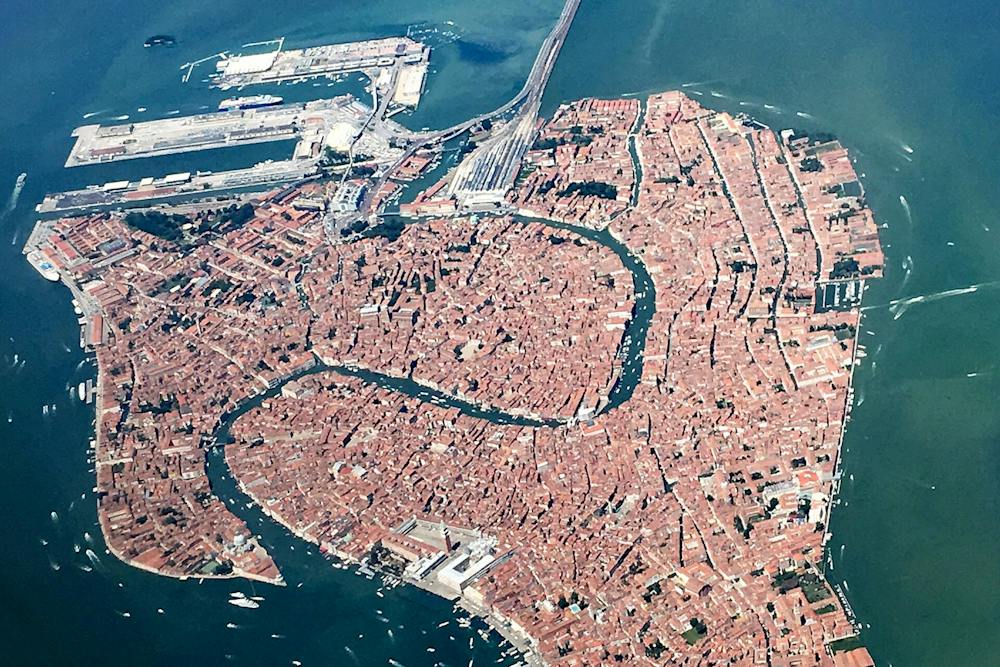
The city of Venice consists of various islands sitting in what is deemed as the Venetian Lagoon. Between these 130 islands lie small bridges that connect the floating areas together as one city. The lagoon consists of inlets connecting the Adriatic Sea to three main openings: Lido, Malamocco and Chioggia. To keep the city of Venice atop the surrounding water, an engineering marvel had to be constructed. On Thursday, Sept. 10, Georgia Institute of Technology (Georgia Tech) School of Civil and Environmental Engineering and School of Earth and Atmospheric Sciences professor Rafael L. Bras expanded upon his role as a supervisor during the construction of the Venice Gates, including a discussion of its execution and why this solution was chosen.
Bras started by providing a brief recount of Venice’s history and how its geographical structure came to existence.
“Venice has a history of 1000 years… It became Venice when people from the north of the [Venetian] lagoon moved away from attacks of northern tribes, and in essence settled in these islands… Then [the city] was [a] maritime power and controlled commerce for a long time, all along the Mediterranean.”
The Venetian Lagoon is amorphous, with many different entrances into the lagoon itself. Bras also highlighted various lines on a map of Venice from the 16th century. The Venetians diverted the rivers because they were a market power. After comparing this map to one from the present day, the diversions remain. Ultimately, these led to entrances, or inlets, into the lagoon. Had the Venetians not acted upon the environment, present day Venice would appear as a vast marshland.
“Then the other thing you notice of this lagoon is that it's an engineered environment. Nature does not make straight lines… They diverted the rivers so that sediment would not accumulate. They wanted to throw away the sediment out to the ocean because they didn't want to be invaded by land. They were [a] maritime power. They did not have armies. They had naval power, so they wanted to keep a lagoon to protect them, like a big mold for them in many ways.”
This allows for a shallow lagoon, in which depths vary from 10 to 17 meters. However, on Nov. 4, 1966, intense flooding from the Arno River swept into Florence; a similar event occurred in Venice. The tide reached extreme heights, going over the seawall and over the barrier islands, even breaching some of them. This was a high tide of 0.5 to 0.6 meters over the period of the event. With the combined effect of another meteorological surge, it created a record flood level of approximately two meters. Bras then explained the concepts that are generally attributed to furthering the issue.
“There are two elements that [have] created the problem. One is sea level rising… and one is subsidence; the whole lagoon environment sinks.”
According to Bras, the rate of sinking has accelerated historically especially due to reconstruction of the World Wars, where water was pumped for use by industrial regions. The lagoon has been subsiding at a rate of 0.4 millimeters per year. The rate of sea level increase has accelerated to around 2.7 millimeters per year, almost six times larger than the subsidence. In addition, the number of meteorological events that cause flooding have increased.
To solve these issues, an international contest was held for engineers and architects to come up with solutions.
“The solution, the best way to solve the problem, is to create a series of barriers that will close off the lagoon from the sea [when you predict a storm surge]. You predict the tide, you close the inlet, keep the ocean out, keep the lagoon down. Ocean can go up. Everything [is] good when everything is over. You open the barriers, and that's it.”
Bras outlined how this is not a new solution. In Rotterdam, Netherlands, there are also floodgates that when a flood is predicted, they cut off the canal and create a temporary dam. However, this type of gate was not acceptable for the Venetians. They are sizable and too obvious. Venetians wanted something that was able to conserve land, not alter the cross section of the inlet, and be invisible.
What Venice decided on were flaps. These large, “invisible” flaps sit under water in a crater, usually full of water. When a meteorological event is predicted, water is pumped out and the flaps float up and rotate around a hinge to create a barrier. Each flap is independent of one another, with a gap of about 15 centimeters between. The gates can open within 20 minutes, compared to Rotterdam’s six hours.
“This is the way it would operate. It's sitting on its cradle. You pump air out. They come out. They settle in. The sea goes up to wherever it goes. Creates a dam. Goes down the sea. When everything is level, you put water in, air in, and settle [back down] again.”
There are four sets of gates: Lido North, Lido South, Malamocco and Chioggia. The largest in weight are in Malamocco, which is the industrial hub of the area; the smallest is Lido North. The building of these structures required immense effort. Generally, the gates run from one end of the inlet to the other, closing off access to the land it encloses. In addition, refuge harbors were built for ships that may be stuck outside the barrier in case of a meteorological event. Essentially, the gates were floated to their location, sunk, and then joined.
“When the gates operate… the idea is that you make a prediction of the tidal flooding, and you predict that the tide is going to go above some level. The trigger in the operating rules of this is that you trigger a closure when you predict 110 centimeters.”
Bras then transitioned to another history lesson of the gates, dating back to 1984, when the concept was introduced. At this time, a special law was also made where a consortium named the Consorio Venezia Nuova gained power to protect Venice and the lagoon. Construction started in 2003 and was set to be completed in 2012. However, also at this time, corruption was rampant, including bribing and illegal financing. In addition to the economic crisis of 2008, funding to complete the project was low. The Italian government also fired individuals involved with the project, which left no experts to carry out the rest of construction. In 2020, the government decided to resume construction and eventually the gates were operational by 2021. Bras emphasized that although they were operational, there still was a change in how these gates were functioning.
“The big difference is that this is being operated manually because the automatic controls were all gone.”
Bras finished his lecture providing some images of a flooded Venice. He used these photos to illustrate that with the gates now in successful operation, the future of Venice is dry.