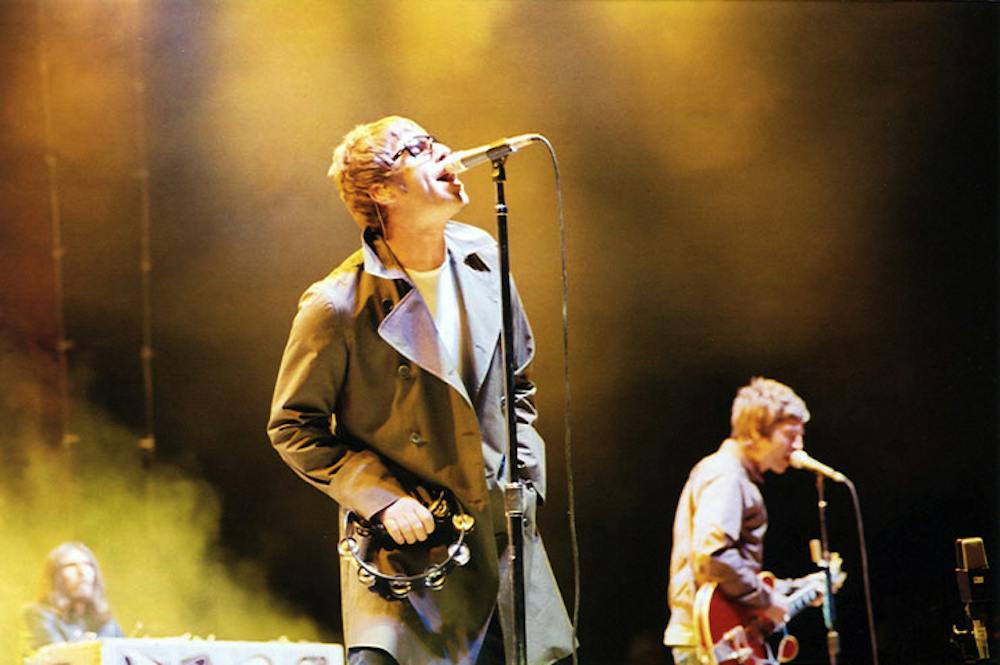
One year after the conclusion of their reunion world tour, and with 2027 tour dates already released, Oasis have come to the big screen with their documentary Don’t Look Back in Anger. Directed by Will Lovelace (Shut Up and Play the Hits) and Dylan Southern (The Thing with Feathers), it captures the length of their hit 2025 world tour with behind-the-scenes footage of the band, interviews with the brothers and testimonials by the fans who made it all possible.
Hello, it’s good to be back
Utilizing the iconic Oasis branding for headings, their tumultuous and meteoric rise through the ‘90s is captured with old clips that include concerts, television interviews and home videos. It’s a fast montage that builds up the tension until the infamous Paris 2009 show — where an announcer revealed to the waiting concert crowd that the brothers had fought backstage, resulting in the end of Oasis. The brothers did not speak again for 15 years.
From there, we fast forward to 2025, when six weeks of band rehearsals begin. Noel arrives first at the nondescript location. One of the first things he admits in his testimonial is that he never forgives people. Then, some time into the rehearsals, his brother Liam arrives. He says little, getting straight into the music and leaving right after. It’s a departure from his usual in-your-face behavior that surprises his brother, but he claims to respect it. This awkward, standoffish atmosphere mixes with the band’s hard work ethic to prepare for their first concert in Cardiff, U.K.
As we see the brothers wait behind the curtain to go on, Noel says in the voiceover that Liam wasn’t at rehearsal the day before. In an interview with The Guardian, the directors shared that there was “a palpable tension,” and that how the show would go was unknown not only to them but the brothers themselves. Then, as they walked on stage, Liam grabbed his brother's hand and lifted it in the air — a moment Noel says was not planned, but that they repeated at every one of the 41 shows on the tour that followed.
At the end of the day, there were no weepy or dramatic apologies. Instead, over the course of the tour, there was the steady crumbling of walls both in the public onstage and in the private moments. Noel remarks that he forgot how funny his brother was, and how they message and spend time together outside of shows when they didn’t before. It was a reconciliation that perhaps strengthened their bond more than ever before.
Return of the rock ‘n roll stars
Lovelace and Southern excel at capturing the raw, charged energy of an Oasis concert. A sea of hands and waves of bouncing fans screaming the lyrics of decades-old songs as if they were brand new. Unlike some music documentaries, there are long, uninterrupted clips of songs played almost through their entirety. For those who may have missed out on the tour, it’s a close second to the real thing. At one point, the Poznan dance is introduced and Liam’s playful antics (roughly paraphrased to “I don’t ask you to put your hands in the air like you just don’t care like the others, but I’m asking you to do this. Turn around, give a little cuddle to the guy next to you and jump”) bring a new layer of fun to the show.
All emotions are on display without inhibition. Notably, at the end of the Cardiff show, the movie audience becomes privy to those moments of reverence after a high-powered concert. Not just tears, but moments of laughter, embraces and even lying on the floor in equal parts exhaustion and wonder. To the sincere surprise of both brothers, the truths of their music still ring true today.
You’re my wonderwall
As much as this film serves to celebrate the success and incredible music by the band, it also serves to thank the fans who have remained loyal in the face of all the doubt from the press and themselves. They’ve passed down their music to their kids, creating a new generation of fans who can connect with their messages of community, being yourself, trying your best and never giving up.
In the documentary, we see examples of the connections fans have with the band: A Welsh mother and her nonverbal son bond over a love for the song “Talk Tonight,” a Korean free diver overcomes her depression through their music and young English woman who survived the Manchester Arena bombing with “survivor's guilt” finds a way forward with “Don’t Look Back in Anger.” It is these stories that highlight what makes these songs so powerful, even all these years later.
Midway through the tour, the brothers learn that Gary “Mani” Mounfield, their close friend and member of the groups Primal Scream and The Stone Roses, has passed away at the age of 63. It is a moment that shakes them both, and during the night’s show they dedicate their song “Live Forever” to him. In the voiceover, Liam says that after he watched The Stone Roses from the bar one night, he was inspired to start Oasis.
Some might say
However, given the title of the film and history surrounding the band, it was surprising that little information was given on the coming back together of the band after all this time. It’s a quick transition from the break up to the reunion. Although there is clearly tension, more time could have been used to discuss why the band decided to come back together at all. Both have had careers after the band’s breakup (Noel Gallagher’s High Flying Birds and Beady Eye, featuring Liam Gallagher and Oasis rhythm guitarist Bonehead) that enjoyed moderate success. So, why now? What was the ultimate catalyst? Perhaps we will never know.
Looking back
At the end of the documentary, it is revealed that the voiceover narration that runs throughout the film from Noel and Liam came from an interview they gave right next to each other the whole time. It’s a humorous reveal given the sometimes heartwarming and sometimes blunt comments each has said about the other. Still, it is that chaotic brotherly love that makes Oasis what it is, and ultimately, what makes this rockumentary so heartwarming. As Noel described, they were rewriting the story of the band. It is now one of forgiveness and redemption.