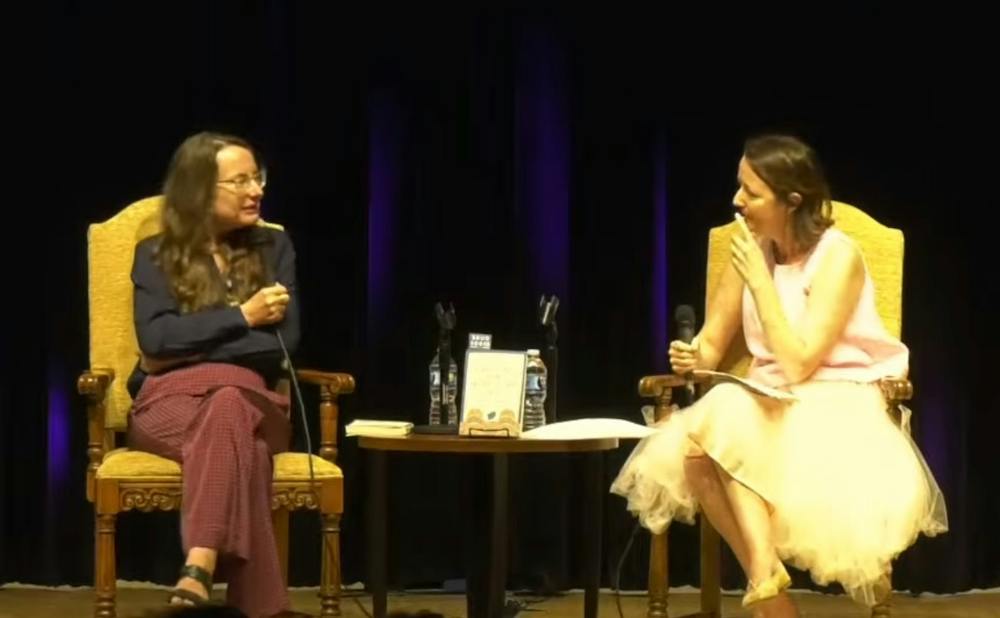
On Sept. 10, 2026 the Enoch Pratt Central Library hosted Emily Wilson in conversation with Classics Department Chair Karen ní Mheallaigh. Wilson, a Classics professor at the University of Pennsylvania, is best known for her translations of Homer’s timeless epics, The Odyssey and The Iliad, in 2017 and 2023, respectively. The event, titled “Crossing the Wine-Dark Sea,” promoted Wilson’s new book of the same name, which reflects on her journey translating classic works of antiquity.
After an introduction by library staff, Wilson read an excerpt from Crossing the Wine-Dark Sea:
“In an era of so many dizzying transformations, it is more valuable than ever to remember that the world has not always been as it is now,” Wilson began. “Turning back to antiquity can help us to imagine the unimaginable worlds of the past and also to reimagine our own rapidly changing society… We need to pay ever closer attention to language and consider the power of words to persuade, instruct and entertain.”
Wilson and Mhealllaigh then discussed the essence of translation. Instead of treating the process as a direct, one-to-one retelling of the words on the page, Wilson invited listeners to see translation as a performance and an experience. By translating with these factors in mind, one can bring new life to the work in another language and another time. This also suggests that not only are the absolute meanings of words important, but that the sonic qualities and rhythms of translated works are valuable as well.
Since The Odyssey was traditionally passed down through oral retellings for centuries, Wilson wanted her English translation to carry the same feeling it did in the original Greek, evoking similarities to the performance of an epic poem. This led her to adopt the iambic pentameter characteristic of English drama.
Furthermore, Wilson and Mhealllaigh explored the many metaphors of translation, including dressing up a text in new clothes, pouring the text like wine into a new vessel, dancing across a tightrope as one tries to balance the many truths of the text or working as a necromancer to revive the essence of an original.
One of the most famous Homeric epithets is that of “the wine-dark sea.” Historians have debated for centuries about its origin and meaning, since “wine-dark” is not immediately intuitive compared to modern descriptions of the ocean as “blue.” Wilson provided her own analysis of the phrase.
“Oînos is wine, and óps is a face or an eye. So more literally… it’s a wine-faced sea or wine-eyed sea,” Wilson described. “I love the idea… that the wine or the sea is looking back to us… almost like a goddess… because that verbal detail of óps also comes in these epithets for Hera (cow-eyed or ox-eyed) and Athena (bright-eyed or owl-eyed). So the sea is part of that list of divine or semi-divine figures whose gaze is scary and weird.”
Besides commentaries on The Odyssey, Wilson’s new book also contains essays analyzing classical Greek and Roman comedy and its relation to modern comedy.
“I wanted to intertwine a discussion of the often very, very artful and intricate lyrics of hip-hop into discussions of both Athenian and Roman comedy to showcase we actually do have poetic genres which use rhyme, and rhythm, and performativity, and multiple different metaphors, and linguistic cleverness and outdoing your rival comic poet, which of course is a theme of ancient comedy,” Wilson said. “We may think of comedy in too narrow a way if we think only of the sitcom… So part of the theme of the book also is that there are gaps and there are connections between modernity and antiquity, and they're not necessarily where you expect them to be.”
When asked about her choice to translate a particular work, Wilson replied that she would read pre-existing translations and consider if her own perspectives, experiences and knowledge would warrant a new translation of the work before starting a project.
The two panelists moved on to discuss Wilson’s “rules for the translator” in Crossing the Wine-Dark Sea.
“If the original makes you laugh, cry, feel excited, get goosebumps, feel puzzled, get bored, be charmed, etc., then the translation should try to create those effects on its readers. If the original has moral or ideological tensions or complexities, those should be legible in the translation. All great works of literature have such complexities. Translate the ambiguities,” Wilson stated.
Closing her talk, Wilson acknowledged that the limits of translating language will prevent every ambiguity or complexity from being fully conveyed.
“There's no such thing as a translation that uses none of the original words and yet is identical. That doesn't exist. It's not a thing. So starting from the position of impossibility, I think, helps one understand both how much chutzpah it takes to do it, and also how much humility you've got to have. We are doing something impossible, and we're doing it anyway.”
The discussion was followed by an open question-and-answer session and subsequent book signing. Wilson is currently working on a new translation of The Odyssey.