The Arts & Entertainment section presents our picks of art released during the summer. We hope you check them out!
Estelle Chen: Sophie Calle's The Sleepers installation at the Museum of Modern Art
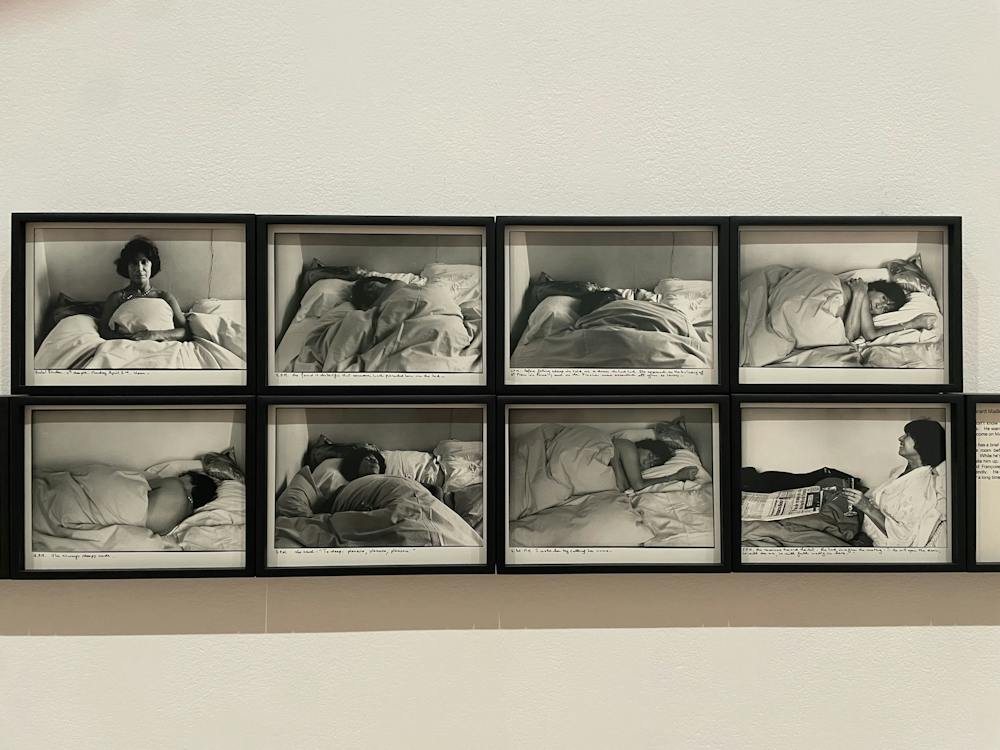
Many artists are inspired by dreams. Sophie Calle’s The Sleepers is inspired by sleep. The state of sleep is precisely that thing most vulnerable and unaware, which is exactly what prompted French conceptual artist Sophie Calle to invite 27 people into her bed over the course of eight days in 1979. She documented their bed habits; she fed them, questioned them and photographed them while they were sleeping.
This amalgamation of art, social experiment and semi-breach of privacy is an ongoing installation which opened last spring at the Museum of Modern Art. The Sleepers occupies the walls of an entire exhibition room. The people in her bed include strangers, friends and Calle’s own mother. During each one’s 8-hour shift, she takes a photo every hour. She notes what they wear to bed and how they arrange the sheets. No detail is too minute.
Traversing the installation this summer, I felt that I was both trespassing into something intensely private and witnessing the results of an ordered scientific procedure. Both feelings speak of a special care — Calle didn’t consider herself an artist at the time, but rather someone with a peculiar interest, attentively making public some of our most private experiences.
Yet Calle kept her distance from the sleepers, with “an attraction, not to know somebody’s life, but to know details.” The result is a strange beauty. The photos capture the comfort of rest through the frankness of strangers, at once intimate and the alien.
Saffron Hallett: the Musical Bodies exhibit at The Metropolitan Museum of Art:
Available from June 7 to Sept. 27, this exhibit covers the complex connections between music and the human form through a unique display of instruments, art and interactive experiences. Upon entering, the viewer sees anthropomorphic instruments from early civilizations, highlighting the use of instruments and music to capture age-old customs and their place as historical artifacts. Looped videos of dance and singing performances depict the function of the body as the first musical instrument and its many modes of expression. A display of instruments, like a 360-degree keyboard and a theremin, are accompanied with headphones to listen to performances and directly experience the sounds. For even greater immersivity, visitors can choose to use the giant floor keyboard similar to that used in the movie Big. The following section introduces pieces that reflect personal identities — like Prince’s Symbol Guitar — and cultural practices, such as the vast array of European pochettes (thin, portable fiddles used by dance masters who served aristocracy).
The final exhibits focus on the role of music in two important factors of life: love and death. From a painted harpsichord to porcelain figurines, these pieces exemplify Darwin’s own ideas on music in sexual selection such as bird song. Meanwhile, the juxtaposition with death in the accompanying room further stresses the presence of music throughout and beyond life. The most eye-catching piece in this room is the full Día de los Muertos drum kit of Alex González of Mexican band Maná — with all its skulls and vibrant turquoise color scheme. This free exhibit raises the bar in musical representation in museums by unveiling the rich tapestry between facets of human life and this magical art form, utilizing 130 pieces spanning 4,000 years of history in ways that immerse visitors of all ages.
Finnigan Keane: We Burned So Bright by TJ Klune
While the cover of the book is beautiful, it wasn’t what caught my attention. I had read TJ Klune in the past, reading both books in the Cerulean Chronicles series — House in the Cerulean Sea and Somewhere Beyond the Sea — and I thoroughly enjoyed both books. But, one thing to know about TJ Klune is his books are usually over 400 pages long! So, when I saw that his newest release We Burned So Bright, was merely 176 pages long, I was incredibly surprised. Although the length of the book has been a subject of much controversy and debate on the Internet, I think it makes the book all the more powerful. I won’t spoil the book, as I think it is an incredible book that everyone should read it. But, I will attach a snippet of the summary from the back of the book, as Klune words it more beautifully than I ever could:
“Husbands Don and Rodney have lived a good long life. Together they’ve experienced the highest highs of love and family, and lows so low that they felt like the end of the world. Now, the world is ending for real. A wandering black hole is coming for Earth and in a month everything and everyone they’ve ever known will be gone. Suddenly, after 40 years together, Don and Rodney are out of time. They’re in a race against the clock to make it from Maine to Washington State to take care of some unfinished business before it’s all over.”
As one can see, the incredibly short length of the book makes sense, making it feel like both the characters and the author himself are running out of time. Despite it appearing as such a sad book (and trust me, it is), there are a lot of beautiful, bizarre and absurd moments that get slapped in there. From impromptu weddings to the small, intimate moments Don and Rodney have, We Burned So Bright shows that not every moment before the end has to be depressing.
River Phan: Rose of Nevada directed by Mark Jenkin
In Rose of Nevada, two fishermen crew a mysterious boat and find themselves transported back 30 years ago as the now-deceased men who previously manned the vessel. Nick (George McKay) longs to return to his family once he realizes they've been displaced in time. Meanwhile, Liam (Callum Turner) enjoys his new role; back in their reality, he’s a wayward worker with no ties to anyone or anything, but in the ‘90s, he’s a father like present-day Nick.
While Nick tries to sail the boat back to his time, Liam settles into the town and his new life. Their personal motives complicate the two fishermen’s values and sense of duty as it becomes clear the small port town depends on them for economic survival. Nick, now constantly plagued by nightmares and visions of the original crew, confronts Liam about their disturbing situation as he descends deeper into despair while Liam solidly upholds his new identity. Their confrontation turns physical; the two men seem to be at irreconcilable odds.
Shot entirely in 16mm, Rose of Nevada fills the screen with an overwhelming sense of smothering, textured nostalgia: a ghost story haunted by an abandoned past revived against the wishes of its new inhabitants. As a sad, slow picture, Rose of Nevada methodically conveys the means necessary to letting go as the only choice before memory inevitably flees.
Selven Ren: The Odyssey directed Christopher Nolan
A story nearly three millennia old. An Oscar-winning filmmaker. And, for the first, time, a feature shot entirely with IMAX film cameras.
Christopher Nolan’s The Odyssey (2026) turns Homer’s ancient Greek epic into a massive 172-minute adventure. The film follows Odysseus (Matt Damon) as he struggles home to Ithaca after the Trojan War. Across the sea, his wife Penelope (Anne Hathaway) is surrounded by suitors competing for her hand and his throne. Meanwhile, their son Telemachus (Tom Holland) sets out in search of his father who never returned. With angry gods, terrifying monsters, brutal wars and a perilous journey at its core, Homer’s story already has everything a fantasy fan could ask for.
But, Nolan’s ambition goes far beyond simply bringing a well-known ancient hero to the big screen. The film offers a unique, Nolan-esque take on Odysseus, shedding light on the darker side of the heroism that has defined The Odyssey for thousands of years. Nolan’s Odysseus is less a legend than a survivor — a man driven by instincts, cunning and everything he has suffered along the way.
And then, there is the music. Reuniting with Nolan after Tenet and Oppenheimer, renowned composer Ludwig Göransson delivers one of the film’s most striking creative strengths. He blends music with his unique sound design to create a distinctive sonic landscape that gives us a vivid sense of the character’s inner world.
Whether you’re a Nolan fan, a mythology buff or simply looking for a place to spend a few hours, The Odyssey gives you plenty of reasons to make the trip to IMAX.
Steve Wang: Lost Weekend by Phoebe Bridgers
In the six years since her last solo album, Phoebe Bridgers’ career seems to have taken an impossibly sharp turn toward the mainstream: she was touring the world after Punisher took off, and then again with her supergroup boygenius after the release of The Record, and then again opening for Taylor Swift… all while processing the passing of her father in early 2023.
It is not surprising then that her new album, Lost Weekend, is one of movement and experimentation for Bridgers. She does not simply settle with the ambient, droning indie-folk that made her popular, instead opting to incorporate new influences all the way from bluegrass to indietronica.
The album opens with Bridgers at her father’s funeral “crying in a suit and tie” while she explores her relationship with dissociation in front of an appropriately sparse, piano-led instrumental. After nearly a minute of outro, the album’s lead single "Lost Boys" opens to a more uptempo tone and horn lines from Bright Eyes’ Nate Walcott reminiscent of “Kyoto.”
As the album continues to unfurl, we see some of Bridgers’ signature deathly potent one-liners on “The Governor’s Waltz” with “you’re next to me / I’m next to nothing” and “being myself wasn't easy / do it for me” standing out, a surprisingly joyous love song to Bo Burnham in “Bobby” and a massively epic buildup at the end of “I Can’t Wait.”
In all, Bridgers manages to come back from her hiatus with a beautifully intimate album that is both wonderfully celebratory yet haunted with grief and sorrow.