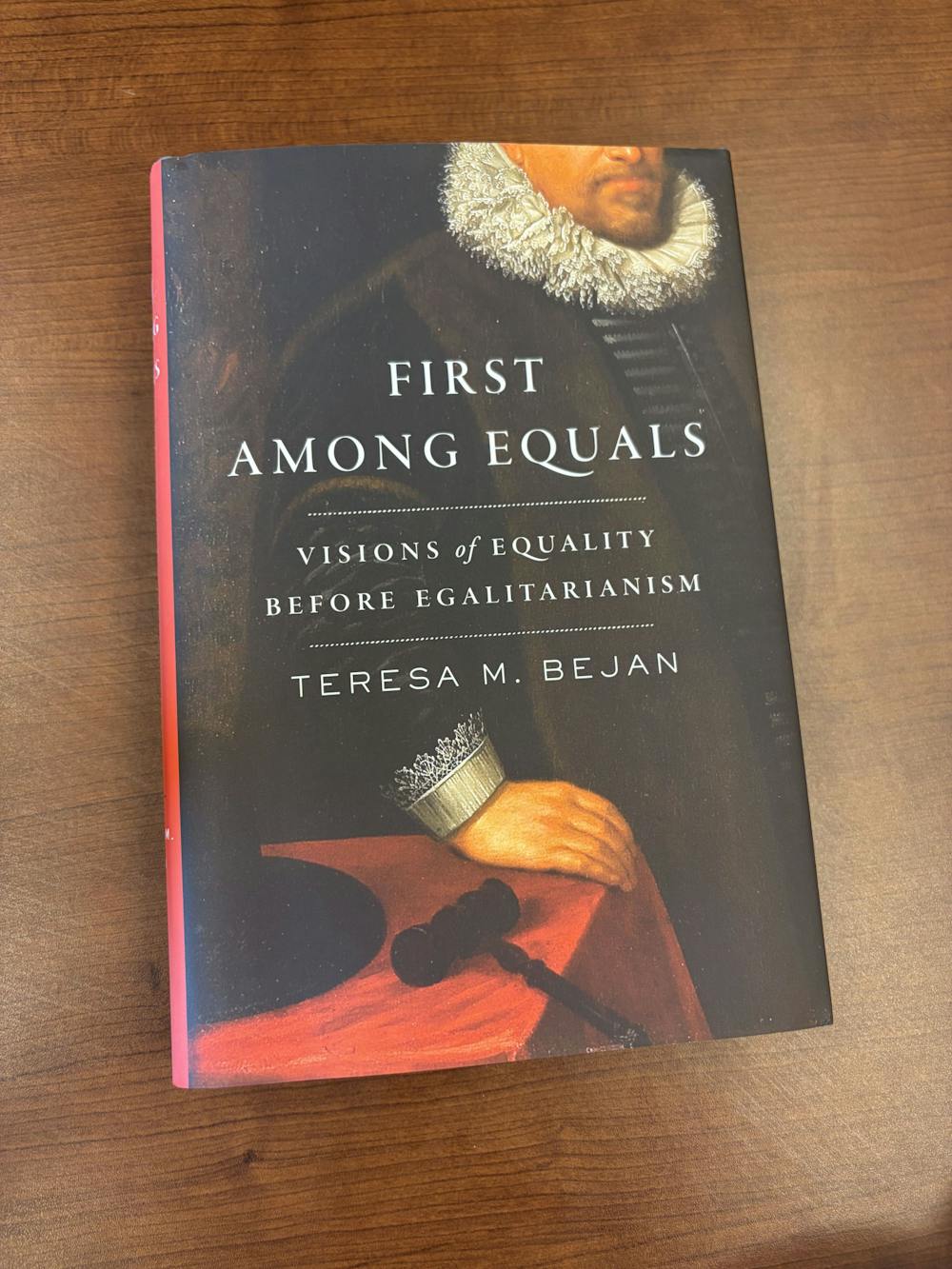
On Sept. 23, 2026, the Alexander Grass Humanities Institute hosted Teresa Bejan for a book lunch centered around her newest release: First Among Equals: Visions of Equality Before Egalitarianism. Bejan, a Professor of Political Theory and a fellow of Oriel College at the University of Oxford, has been working on the novel for the last decade. The book lunch was one feature in a series of events hosted by AGHI focused on conversing with interdisciplinary authors in a non-formal environment.
When asked about the greater purpose of these lunches, professor Jeanne Marie Jackson described, in an email to The News-Letter, how they create an informal space for scholars to engage with authors.
“New Book Lunches give humanists at Hopkins the chance to engage with authors outside the usual ‘talk, followed by question-and-answer’ format,” Jackson wrote. “It's a small, intimate group of colleagues brought together for real conversation, across the bounds of disciplines and Departments.”
These lunches are hosted once a semester and spotlight a recent interdisciplinary humanities book, encouraging difficult conversations around it outside of the bounds of a formal discussion. This year’s through line between their talks is “Tradition/Continuity/Conservation.” According to Jackson, Bejan’s First Among Equals connects back to this theme, especially at a time where central ideals like egalitarianism are mostly taken for granted in today’s democracy.
Bejan began the event by discussing the catalyst for the book’s inception: her struggle with landing in a hierarchical educational landscape. She described the culture shock in moving to Oxford, somewhere where academic titles and hierarchical norms were seen far differently to her experiences in the United States and Canada.
“One thing I really struggled with was just the differences in academic culture from… the U.S. and Canada, and then landing in a place which, on the one hand, was more hierarchical and exclusionary than any other university I’d ever been in,” Bejan said.
Bejan had been introducing herself to students with her academic title, but in Oxford’s new landscape, this “title-first” structure was seen as gauche. This brought up the central question in her mind: Is the demand for women to be acknowledged by title an egalitarian demand or a hierarchical one? For Bejan, the answer was simple.
“It’s a hierarchical demand. I want to be recognized as your superior in this context,” Bejan said.
As for her colleagues, this question was more confusing. Bejan was discussing egalitarianism, a political doctrine that forms the basis for political equality in citizens as their universal equality. She believes that this ideal is largely taken for granted, and in that sense, her question was seen as nonsense by those colleagues.
“This book is my response to try to show them that they were the people who were peddling nonsense, and I was doing proper scholarship, but hopefully in an engaged and entertaining way,” Bejan said.
Bejan’s book, which will be released to the public in late October, reflects on the ideal of egalitarianism in both the general context and the educational one. She hopes to offer tools for other philosophers and theorists to rethink their internal concepts of egalitarianism, instead of deliberately offering her own vision.
“I came into this project and realized that the… egalitarian biases in political philosophy had no way to talk about hierarchies as anything other than aberrant, or anything other than potentially dominating,” Bejan says. “It just seemed to me that that’s so obviously out of touch with what we’re doing everyday in an educational context.”
Ruth Braunstein, a professor of Sociology at the SNF Agora Institute, noted the significance of First Among Equals in regards to her own experience working with contemporary American politics.
“Thinking through like the actual texture of the hierarchical and acknowledging relationships people want, I think is actually a really helpful way forward,” Braunstein said.
Jackson agreed with this sentiment in an email to The News-Letter discussing the impact of Bejan’s book in today’s world.
“Bejan’s work on the prehistory of ideals that are now mostly taken for granted — in this case, egalitarianism — speaks across political theory, history, and philosophy to address core concerns about what it means to live in a democracy, now,” Jackson wrote.
AGHI hosts events throughout the semester, whether book lunches like Bejan’s or associate lectures and seminars. Look to the Alexander Grass Humanities Institute events calendar for more information regarding future planned features.