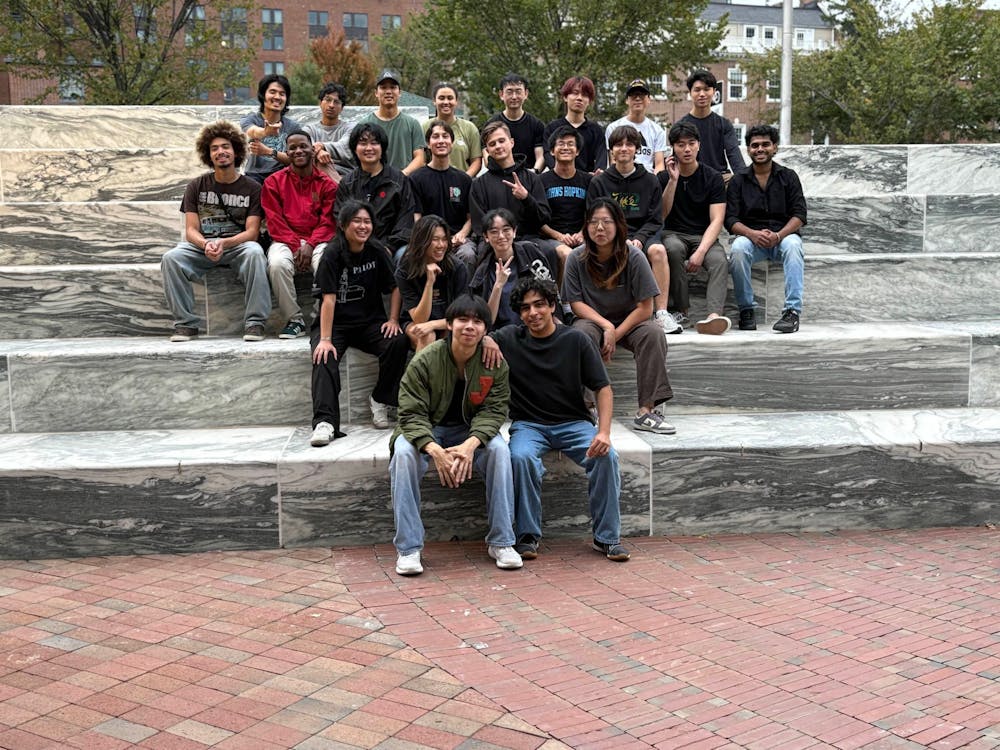
On a Thursday night in the back practice rooms of the Bloomberg Student Center, the Hopkins Breakers were practicing past bedtime. As other students prepared to finish up studying for the night or began to tuck in for a Celsius-fueled all-nighter, I caught the Hopkins Breakers just starting a night of dancing, and I noted down their reflections on the past year, their breakdancing journey and their upcoming performance at the 2026 Culture Show.
Breakdancing was fashioned by New York’s African American and Latino populations in the ‘60s and ‘70s and has recently seen a global rise in popularity thanks to its inclusion in the 2024 Olympic Games. Tied to its roots as a form of street-dancing, breakdancing at Hopkins has always been a point of connection between students and the broader Baltimore community. Outside breaker Jon Jon, a local Baltimore resident who started practicing with the team in 2017, recalled the beginnings of the Hopkins Breakers in an interview with The News-Letter.
“As far as I understand, it was a bunch of students who kind of broke off from the other dance clubs,” he said. “This was in an era of breaking where Baltimore was pretty big. There were a lot of big names in the breaking scene in the area: DJ Fleg, Lions of Zion's crew... and, as far as I understand, local Baltimore breakers have been coming since near its inception.”
Through the Hopkins Breakers, students connect with these Baltimore locals, and the club often functions as the first step in their breaking journey. Luca Fang, a sophomore Neuroscience major who serves as the co-president of the Hopkins Breakers alongside Jessy Cao, recalled not having any prior dance experience before joining in an interview with The News-Letter.
“I was like, I'll go check it out,” he said. “I remember because I learned to freeze and I was like, ‘Wait, that's fire, so I have to do that more.’”
Freezing, a move where the breaker holds an unusual position in a theater-esque tableau, is one move in an expansive, difficult repertoire that breakers hope to master. Just as a painter has their techniques and a ballet dancer has their positions, breakers have their foundational movements. These movements are often intensely physically demanding and require a lot of core strength. Fang, who is working on his windmill, pointed out how the airflare relies on the same arm and core muscles as the gymnastics event on the pommel horse.
For Jon Jon, these movements are “the vocabulary that they use to express themselves in their freestyle.” Breakers use these building blocks to assemble a longer connected routine. Although the breakers plan out their music and some of their ensemble choreography, they leave a lot of time in their performances for cyphers, where one or two members improvise movements while the group surrounds them and cheers them on.
Club member Waldo Alvarez, a senior majoring in Molecular and Cellular Biology and minoring in Film and Media Studies, is currently working on his freestyle, reinventing it, approaching it from new angles and hoping to find a kind of fluidity and groove. A freshman member, Hari Prasad, described the unique approach of breakdancing as “a combination of musicality and physical performance.” At the moment, they are also working on using these movements in a smooth sequence of self expression — learning their body, its limits, its abilities and how the physical and the artistic drive manifest together.
The Hopkins Breakers are already practicing for their next performance at the Culture Show on April 23. In their creative process, the Breakers often try to choreograph and pick music thematically relevant to the event. When they performed at the Chinese Student Association’s Lunar New Year Banquet, they chose relevant fusion music at the intersection of hip-hop and C-pop. The goal, as Jon Jon put it, is always to find “something relatable to the audience as well as relatable to the dancers.”
But with shows like the Culture Show, where the theme is more general, the breakers have more freedom to pick music that more closely expresses what they’re personally interested in dancing to. Alvarez recalls his first time choreographing: He had personally gotten into Brazilian funk and incorporated his interest into their performance. Fang, who is choreographing for the Culture Show, is choosing a song with a beat that particularly resonates with him.
The practice of expressing individuality and bringing one' s own background into their dance forms a fundamental core to the art form.
“Breaking itself comes from minority immigrant culture,” said Jon Jon. “There are elements of breaking all over the world, from all different cultures — martial arts, gymnastics, others dance styles like ballet, popping, or even ballroom dance styles — and people bring that with them when they enter breaking. And that kind of helps form what everybody's distinctive style becomes.”
The club is a site of connection through the breakers’ various kinds of unfettered self-expression, but the connection continues outside of the dancing itself. Jon Jon, who has practiced with the club for nearly a decade, reflected on the family atmosphere in his interview.
“It's like a family that grows up and has little freshman babies, and then [...] those freshman babies grow up and they start teaching, and that’s really the essence of breaking,” he said.
For him, the generations cycle through these processes of growth and mastery.
Current senior Leon Ye, an English major who has been with the breakers since his freshman fall, describes his favorite aspect of the breakers as the socials they host. It’s precisely these socials, their monthly get-togethers, that foster the connections across generations.
“I feel like when I was a freshman, that was how I got to know the older members,” he said. “And I feel like that's how I got to know the younger members now. So, I mean, they just bring us all closer. It's a fun time. We just choose to do whatever, you know, as a friend group.”
If you, dear reader, might be interested in joining, rejoice in knowing that there are no auditions.
“It's not that hard,” Fang reassured. “You can do it. You should try it. You'll be okay. It's really fun — don’t be intimidated. It's definitely not easy, but, surprisingly, it's very attainable.”
It might be surprising how fast you can progress. Prasad discussed this in his interview with The News-Letter.
“For a lot of things, it's just about the mental block and the very specific type of flexibility required for that one move, so progressing that fast initially was really exhilarating... I'm really excited to keep drilling, keep getting better at these moves. Hopefully, [I’ll] bag a few power moves by the time I graduate. I really look forward to that.”
For the rest of us who might prefer to clap, cheer and watch in awe from the audience seats, we can look forward to what the Hopkins Breakers have in store for us at the Culture Show on April 23.