While brainstorming for my first Voices article this semester, I found myself rereading the pieces I wrote when college was still new enough to feel like something from a movie. One line from the first article I ever wrote stopped me: “I entered college believing in my ability to create and reinvent myself.”
I remember clearly my breathless certainty in October that reinvention was both possible and required, as if the version of me who arrived on campus could be neatly folded away and shelved, replaced by someone more social, more punctual, more curious, more fun, more worthy of being a freshman at Hopkins. Just more. Months later, that confidence seems naive, not because I regret wanting to change but because I no longer believe that real life ever allows for that kind of clean break when starting over.
I cannot pinpoint the exact moment I came to this revelation, but I keep tracing it back to the first day of my Reintroduction to Writing course, “Revising ourselves, our texts, and our world,” when our professor handed us a journaling prompt that sounded deceptively simple: What would you write if you weren’t afraid? Set a timer for 10 minutes. We were told our journal would remain private and no one would read what we wrote, but that we would have to reflect on the experience aloud in the next class.
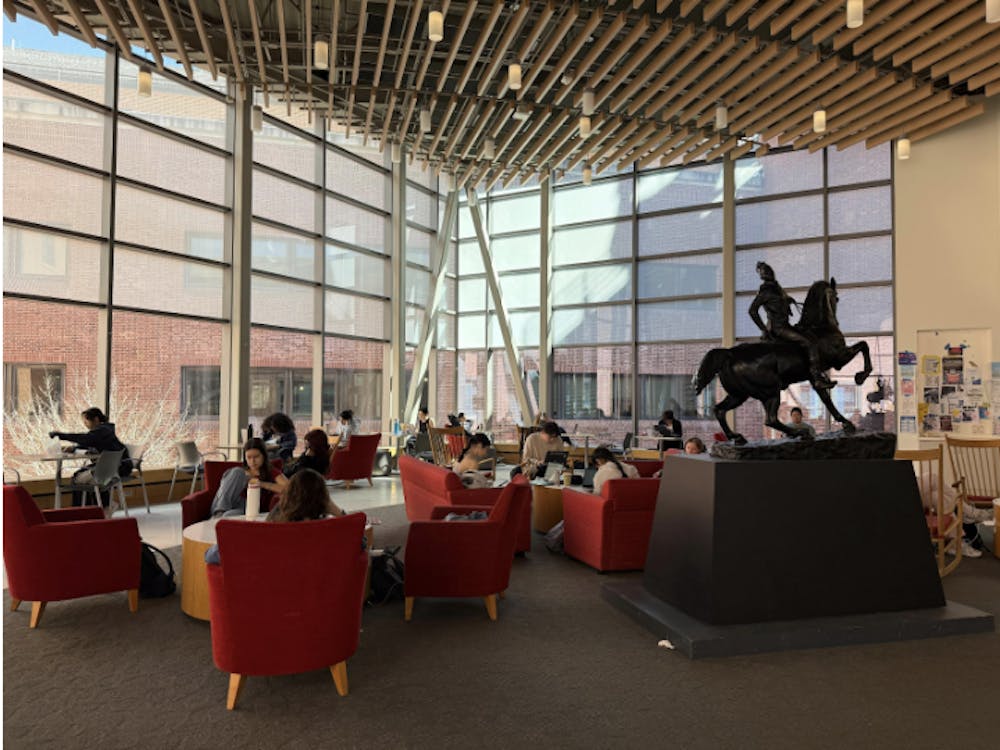
The absence of a grade meant the absence of any sense of urgency. Ever the procrastinator, in the last possible hour before my second Reintro class, I was settled on a couch in the crowded Mudd Atrium, staring at a blank Google Doc with my 10-minute timer having long run out. I kept waiting for a cinematic idea to surface, but I instead found myself skeptically thinking that being afraid of writing something was silly. Why would someone be afraid of writing? The prompt stayed untouched at the top of the page: simultaneously simple, impossible and nonsensical.
Turning to my perpetual panacea, I got up to buy coffee, hoping motion and caffeine would dislodge whatever was stuck. Somewhere between the line at the café and the walk back to my seat, I realized that it was not the absence of fear but my embarrassment holding me back. The prompt was asking not what we were afraid to just write, but what we avoided naming even in the privacy of our minds. As much as I hated to admit it, there was a lot.
What appeared on the page once I returned was not a single story but a list. What would I write about if I wasn’t afraid? Grief over a high school friendship I had once assumed would carry me into adulthood. Gratefulness for my parents that I regret never properly expressing. Resentment I prefer to disguise as indifference, anger with no clear destination, small betrayals that shouldn’t still bother me but do, old crushes, dreams I have let go of with time, dreams I’m still chasing… The list went on.
Sitting there in Mudd, I was startled by how easily experiences that once felt definitive had receded into the background of my life, replaced by assignments, meetings and the constant forward motion of the year. What I had believed to be fundamental and forever had become distant temporally, geographically and mentally, as if memory could be overwritten by busyness. The act of writing felt less like confession, and more like excavation as though I was brushing dust off objects I had buried with layers of new experiences. The list didn’t provide clarity or closure but restored weight to those memories, and when I finally stopped typing, I felt exposed in a way that had nothing to do with an audience and everything to do with the fact that to revise, rather than reinvent, yourself requires that you to reread what you have before you can decide what deserves to remain. When I confronted the version of myself who lived through those moments, I had to admit that she was not yet obsolete.
It was not something I was eager to relive, but what I had assumed would be a methodical class about thesis statements and the mechanics of outlining revealed itself as an extended exercise in self-interrogation, one that treated the phrase “revising ourselves” not as a clever titular pun but the actual curriculum. Over the following weeks, each class required us to read a section from The Book of Alchemy by Suleika Jaouad, a collection of reflections on everything from beginning to rebuilding, perception to embodiment. We then picked prompts from the section to respond to, as if we were borrowing strangers’ questions in order to discover our own.
When I began each journaling session, the first 15 minutes followed a consistent script, my pen circling the same safe surface thoughts — complaints about Orgo Lab, bucket-list items for an upcoming spring break trip to UPenn, conversations with my roommate inflated to fill the page. Then, without fail, my writing would shift from simply documenting the day to reorganizing the many stories running through my head. The delay seemed almost ritualistic, as if honesty required a waiting period before it would consent to appear, the way your eyes must adjust before you can see in the dark. While at first I dismissed the assignment as busywork, I gradually found myself anticipating my hour in Mudd with an iced coffee turning liquid beside my laptop, drawn by the unsettling possibility that I might discover something I had not planned to say.
Without any audience to impress or persuade, the words on the screen accumulated into a record of thought patterns I could finally examine from a distance. Writing became a way of externalizing the clutter in my mind, and once it was out, I realized how much space it had occupied, how repetitive some of its contents were, and how flimsy the logic looked when transcribed into sentences. I could see, with embarrassing clarity, the leaps in reasoning I made when I convinced myself a friend disliked me, the selective memory that supported my worst assumptions, the reflexive compassion I offered others alongside the austerity I reserved for myself.
The process did not only expose insecurities but also my small, stubborn preferences like my tendency to spend too long on birthday cards because I wanted every word to be intentional, my habit of taking long walks, my loyalty to shows my friends had already dismissed as irredeemable. Even traits that had complicated my past, like my instinct to assume the best in people or to be disarmingly transparent, began to look less like liabilities to be corrected and more like elements of a personality I was not obligated to edit away. The strengths I take pride in now were born from those early insecurities and experiences I was trying to forget and to revise myself meant tracing those qualities back to their origins rather than pretending they appeared fully formed.
In class, we kept returning to the question “What does it mean to revise yourself?” and I realized how destabilizing it is to attempt a process without any vision of the finished draft, to change without knowing whether the movement constitutes growth or merely motion. There is no rubric for personal revision, no exemplar paragraphs to emulate, no margin comments clarifying where the argument loses coherence, only a chorus of unsolicited feedback drawn from comparing our Instagram feeds to our friends’ and our LinkedIn profiles to upperclassmen.
I’ve realized “reinvention” carries the seductive clarity of a lightning strike, the fantasy that we can illuminate a completely new version of ourselves overnight, whereas revision resembles dragging your feet through mud, the progress slow enough to feel imaginary until you look back and notice how much the landscape has shifted. But as Jaouad wrote in one of her journals, “It is possible to alter the course of [your] becoming.” That’s even more true when you understand where you’ve already been.
Our earlier drafts are not embarrassing evidence of who we used to be but necessary context for who we are trying to become. So consider this an official correction to my article from October: I no longer want reinvention because there are too many parts worth keeping. What I want instead is revision — the chance to reread my life with more patience, to keep what is still honest, to cross out what no longer fits and to trust that I am a person in the process of becoming not more, but simply becoming.
Vidhi Bansal is a freshman from Upper Saddle River, N.J., studying Neuroscience. In “Meanwhile,” Bansal finds meaning in the unfinished and the unglamorous, showing how the in-betweens are often where life actually happens.