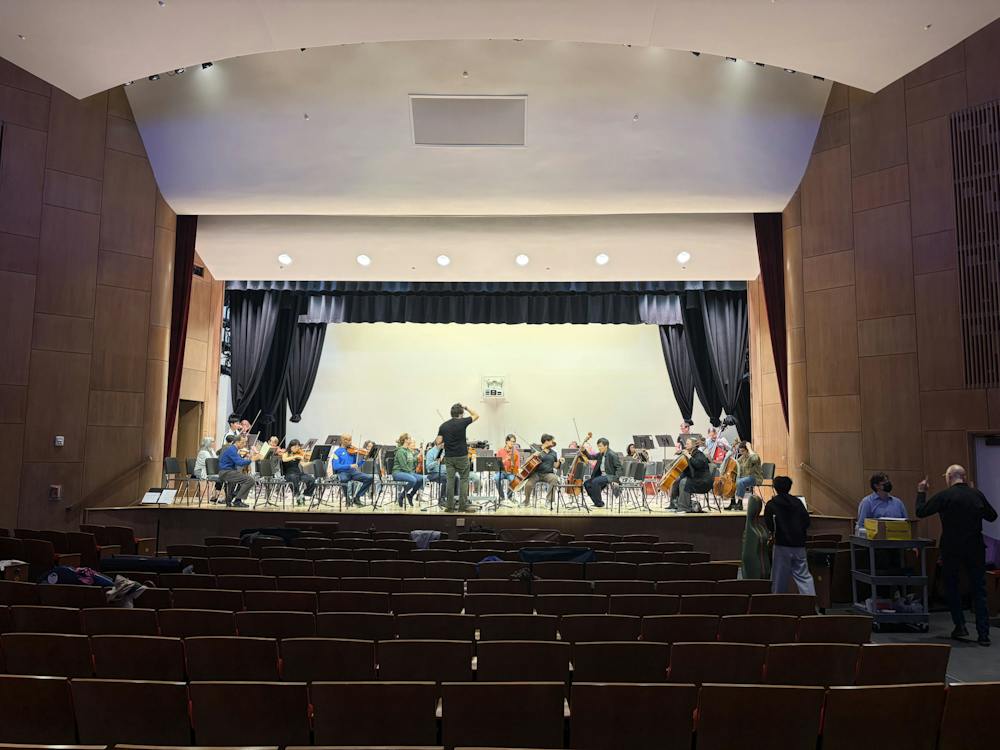
The Hopkins Symphony Orchestra (HSO) is a community orchestra made up of Hopkins students, faculty, alumni and staff, as well as Baltimorean community musicians. As Baltimore City’s only community orchestra, HSO serves as a way for local musicians to perform orchestral music at a high artistic level.
Hopkins Symphony Orchestra is composed of the Symphonic Orchestra, which is led by Music Director Jed Gaylin, and the Concert Orchestra, led by Blair Skinner. The Symphonic Orchestra is the organization’s big ensemble orchestra, with around 130 members. The Concert Orchestra, by contrast, is a string-only ensemble with only around 40 to 50 members.
In an interview with The News-Letter, HSO General Manager Marcie Kolacki explained that the Concert Orchestra allows musicians to develop their skills while still performing at a high level.
“Consider the concert orchestra… [it’s] not quite a training level ensemble, but… it’s a place [for musicians] to develop their skills,” Kolacki said. “That's a really good place to do it, especially for string players because this is really like one of the only places for string ensembles to happen on campus.”
HSO has been in operation since 1981, and some community members have been members since the very beginning. According to Jed Gaylin, who has served as the Music Director for HSO for the last 35 years, the combination of these more experienced community members with Hopkins students is very effective for HSO.
“The community members bring experience. The student musicians bring the zeal of playing this piece for the first time. They're up on their game, they've been practicing and winning competitions in high school,” Gaylin said. “The combination is really very… generative. I mean, it sort of keeps that engine just perking along.”
Over the last 35 years in his role, Gaylin has noticed a distinct shift in the makeup of the orchestra. When it was first founded, HSO was more geared towards the community aspect, with far more of the members being Baltimore City residents.
However, today, a higher portion of HSO is made up of Hopkins students.
“We have a real mix of experience, different levels, like a lot of different backgrounds, and it's just a really cool way to bring everyone together,” Kolacki said. “It's a great community. I just feel like I was very embraced right from the beginning, and we have a lot of members that have been here since the orchestra was founded in 1981.”
Regardless of their position in HSO, involvement with the organization has been cited as very rewarding and beneficial experience for participants. Even those not playing an instrument in HSO are able to benefit from what HSO brings, such as sophomore Cleo Wang, a stage manager with HSO since January. Wang and other stage managers are involved in ensuring that rehearsals and performance operate without error. They set up, take down the stage and deal with any unplanned problems.
“Just being able to be here for the concert and… make sure everything's…. running smoothly, it's super fun and… really rewarding,” Wang said.
For others, HSO and playing music offers a release from the stresses of everyday life. First-year graduate student and HSO cellist Micheal Chung, a student in the University’s CBID program in biomedical engineering, highlighted how music has become his escape from the stressors of his graduate program.
“It’s very intense. So music is kind of my break from that,” Chung said.
For student musicians, HSO also provides an opportunity to build connections and friendships with other musicians outside of their academic work.
Allison Lee, a sophomore violinist in HSO, agrees that HSO has helped decrease her stress.
“I get to de-stress and it's a fun way to connect with other people and to socialize through having a common goal, which is making good music,” Lee said.
Chung also noted the importance of music as a universal connector.
“I feel like music's kind of a universal language,” he said. “We all came here to play great music, and I think just having all the different instrument sounds, everyone kind of working together to make something…. really beautiful that's meant to be shared. There's just something about it that I really enjoy.”
Every year, auditions for HSO are held in the fall. Candidates are expected to come prepared with two contrasting performance-ready pieces, and they are given ten minutes to present their pieces. Kolacki emphasized the importance of making this process as low-stakes as possible.
“It's really, really scary to walk into a room and play your instrument for strangers. One of the really scary things about being a classical musician is auditioning,” she said. “We try to keep it as friendly of an environment as possible and make people feel welcome.”
Kolacki also noted that HSO aims to keep the organization as open as possible. With HSO being a community orchestra, she believes it should accept as many people as possible taking capacity into consideration. The fact that HSO is split into two different ensembles makes this goal easier to implement. Additionally, once someone is accepted into HSO, they will not have to re-audition in future years.
HSO is having their first performance on Saturday, Oct. 10 at 7:30 PM in Shriver Hall. The performance, which is titled Northern Pastorals, centers around themes of change and adapting to a new environment. As with all HSO events, the performance will be free to all Hopkins students.