I’m good at coming off crazy. It comes natural to me, and even when I don’t necessarily subscribe to the brand of crazy I’m selling, sometimes it still slips out, like saying your old age the day after your birthday. Just recently, someone described to me being a project starter but lacking follow-through, and I asked if they were an Aries. (I do not believe in astrology, really.) That isn’t my only offense, and usually, the energy of the conversation drops by 10 degrees as if a ghost passed by. Another way I’ve been my own worst brand ambassador: talking about ghosts, which I also have a neither-here-nor-there attitude on but which I won’t give up in conversation.
Crazy, when applied to me, is not a coded word. Or, if it is code, then it only translates to something innocuous, like “a lot to deal with too early in the morning.” There are people we pass everyday, however, who are stamped as “crazy” in a way that feels wrong to write without quotes around it. I met a lot last summer, and as I just sat down to write something — I had no plan going in — they spoke to me like the chorus in an ancient Greek drama. Right there is another one of those statements the like of which has killed conversations for me before, but within it is a collision of the two worlds I’ve discussed so far: the “crazy” speaking to the crazy.
Methods of modern transportation make me sad to think about when it comes to how they affect socialization. In fact, more than a broken record, I’m a car spinning out when it comes to this topic, seeing how I’ve written twice about trains, “crazy” people and feeling anti-social. I’m coming back for thirds — but this time, have no fear, because now it’s all about buses.
Before I even cite the evidence I unintentionally gathered this past summer — which, by the way, is that not the most beautiful kind of evidence? the unintentionally gathered? — I want to acknowledge something: Of course, I know this topic is a tenuous (im)balance between humanity and safety. We have constructed a society where one person’s prioritization of their own safety necessarily lessens the humanity of another being. I am not claiming anyone should feel guilty for keeping themself safe, nor am I arguing that they should stop; instead, I am trying to not normalize, as I think is happening, the dehumanization of someone else simply because we are conditioned (sometimes rightfully) to believe they are “dangerous,” which we euphemistically call “crazy,” the kind with quotes and obviously comes from other social determinants.
How would you like me to stop pontificating and bring in the stories, the raw material, which I’ve been pussyfooting around?
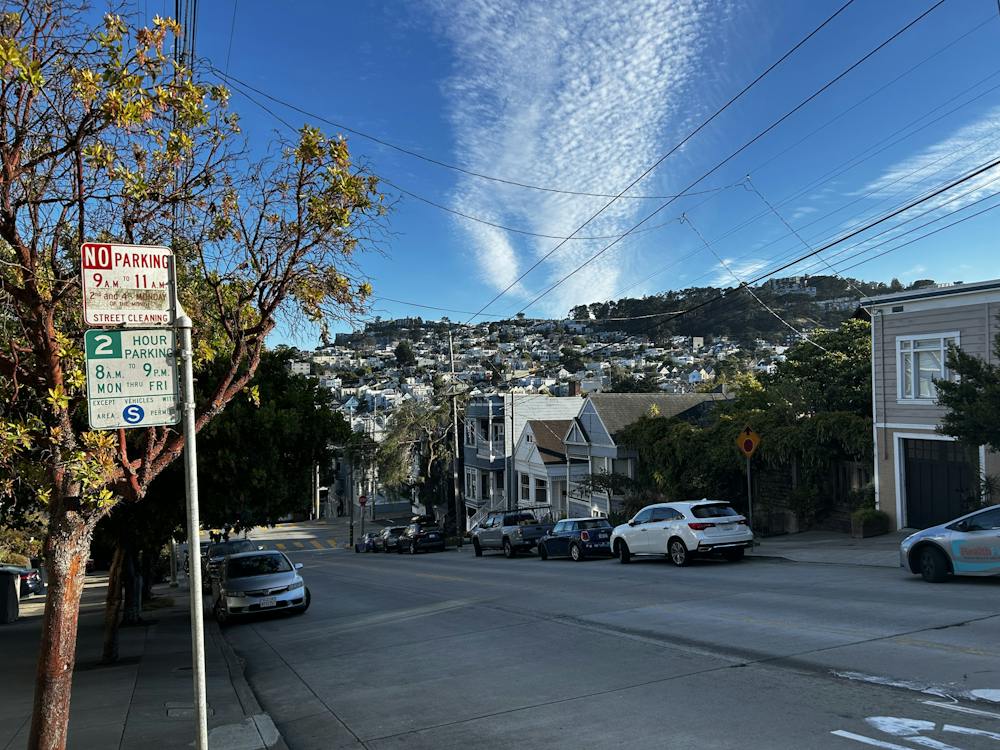
With some friends from my internship in San Francisco this summer, I was returning home on a public bus. We were talking in our closed circle when a man not much older than us began laughing at some of the quips we made, then added a few of his own. This summer forced me to realize more than I had before the conditions that have emboldened me to be friendlier to strangers in circumstances when no one else is: Not only am I, yes, a large-framed white man, but I’m from the Midwest, where conversation with strangers is as guaranteed when setting foot outside your house as seeing a pickup truck.
That is to say, I did not want the man to feel shut down by our group, so I politely responded. Sure, I can admit that the things he was saying were awkward, but there was insufficient reason to assign malice. It was tolerable for the remaining five minutes of our bus ride.
Just now, I was going to write a comparison to introduce an older man who briefly jumped into our conversation on that bus as well. Something cliché came to mind at first, “Like moths to a flame, passengers joined my friend group’s discussion,” but then I realized how even a statement so small and “harmless” as this only bolsters the habits I’m railing against. Why are my friends and I, young and educated and vivacious (if you’ll allow me to flatter myself), the thing burning bright and hot, and everyone besides us are low down on the casting sheet, the ugly, hated and dusty monsters of moths?
Once we disembarked, we all laughed. “Wasn’t that crazy?” However, in lightheartedness, I was asked why I in particular talked so much to the man, though by my standards I didn’t think I did anything unusual. Meanwhile, others traded their experience, stories and tactics in how they have trained themselves to disengage from strangers, no matter how friendly.
As a child, I once gave credence to every parent’s worst nightmare, and I wasn’t punished for it. As I walked home alone, a neighborhood man offered to drive me the rest of the way because it seemed as if it would rain. I said sure, and thankfully, nothing bad happened. Perhaps this, in part, either explains or exemplifies my pollyannish attitude toward strangers.
Another time last summer we took a sunset bus to Ocean Beach. There was a man whom everyone on the bus carved a vacancy around, despite no obvious reasons why. Or, I should say, no valid reasons why. Yes, he appeared like someone who you could guess people would avoid, but it was purely cosmetic: In his behavior, he displayed no serious threat to having someone beside him. So, following urinal etiquette, I left only a one-seat gap between the man and myself, while the next nearest person was across and five seats down from him.
He started talking to us, complimenting some of our styles, saying he looked like us when he was younger, when he would go to the movies with his wife, whom he misses since she passed. In my mind, I started feeling indignant on this man’s behalf that everyone would treat him so inhumanely from appearances alone. He was becoming gradually more energized from having people to talk to, and he began telling a long-winded and meandering joke, which I followed keenly even as he was marring the telling with his excitement, causing everyone else to adopt faces of visible concern.
The gist was this: There’s a dead body with a cork in its rectum, and when you remove it, the anus begins to emit a sound. In the man’s retelling, this sound was a sort of jazz scatting, which he put his everything into, erupting into a scat and flailing his body in a way that caused others on the bus to begin staring. The punchline came when a medical examiner is invited from far away and late at night to witness the oddity, to which he responds, “I didn’t come all this way to hear some dumb ass sing!”
A joke like this pushed the man irrevocably into the territory of “crazy.” Everyone, it seemed, immediately treated him like a criminal because of how the joke was so unheard-of to any of us, and it involved a dead body and also a bizarre scatting. However, after the fact, I discovered that this joke is actually well recorded, even if the man’s jazz and punchline seem to be undocumented permutations.
I’ve made a good case for this man so far. But in the end, shortly before we were about to step off the bus in perfect terms, he said something off-color and bigoted in a way that caused us to stop talking with him, proving everyone else “right” who didn’t engage from the beginning.
But were they really right, and were we wrong? Is there a way to tell by looking at someone, by making surface-level observations, that they are destined to pose a threat to your safety in some way — and how certain do you have to be to act on this?
We live in a society where daily we walk by and ignore people in obvious need of help. We pacify ourselves and square this behavior that we’re ashamed of by claiming that it’s for our safety, and sometimes it is, but I believe we all know that, really, most of the time the people we ignore are victims of circumstance themselves who cannot, nor do they want to, turn us into victims of something else. I know “most” is a weighty claim, but I would invite you to consider: If one feels the majority are indeed threats to safety, how can one be certain they aren’t ignoring the rest to such an extent that they cannot even call them to memory once they pass by?
We do not want to believe the things that have happened to others less fortunate could happen to us or any ordinary person. We pretend that the daily war they have been drafted into was instead a “tragedy” that they practiced, auditioned, rehearsed for and perform for us to scrutinize, leaving us feeling better about ourselves after.
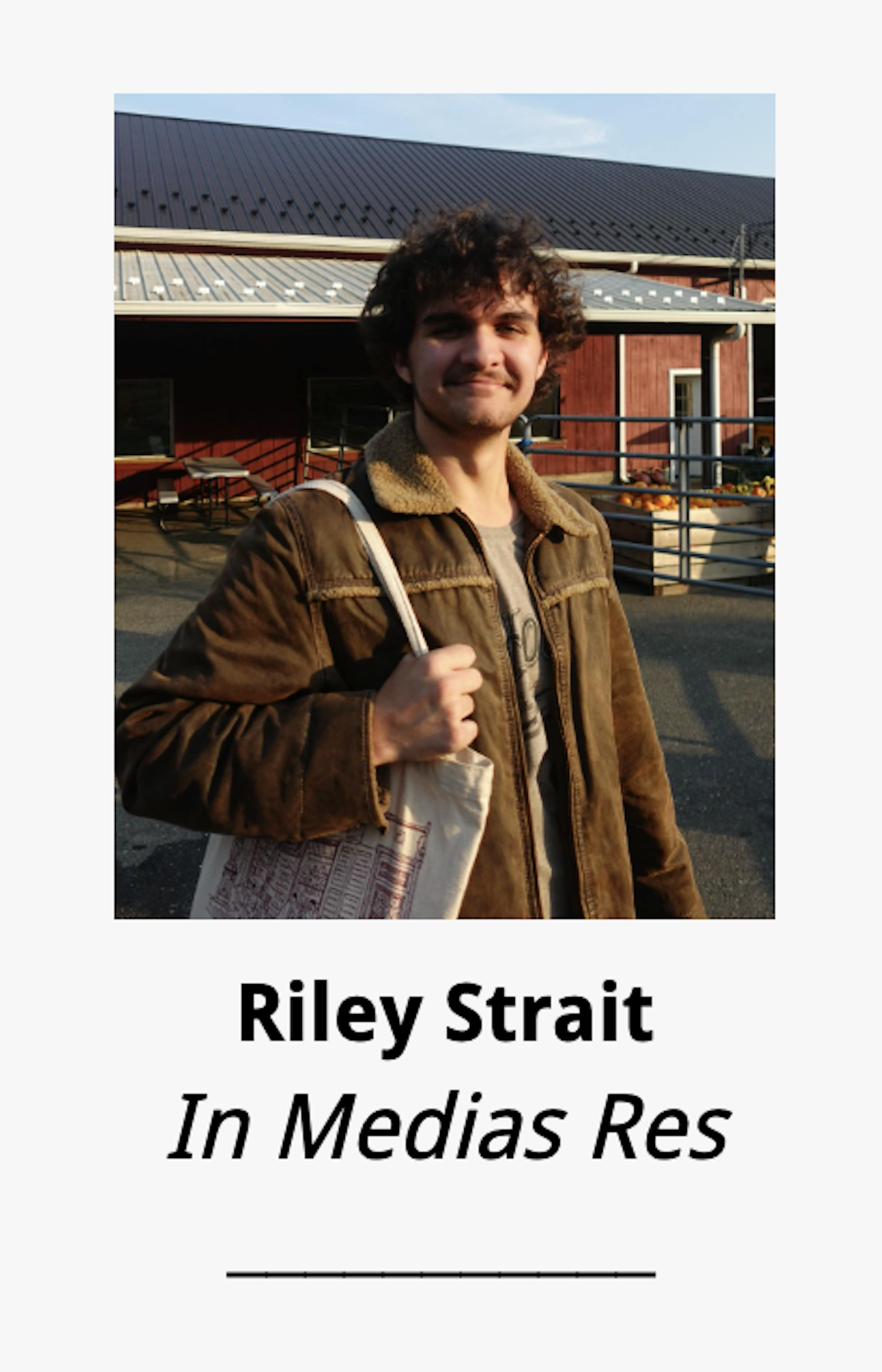
Riley Strait is a junior from Olathe, Kan. studying Writing Seminars, English and Anthropology. He is Voices Editor for The News-Letter. His column, "In Medias Res," translates from Latin to "into the middle of things," shares narratives that bury occasional insights within fluff that often leave the reader wondering, "Did I ask?"